
Laboratory Medicine ›› 2026, Vol. 41 ›› Issue (7): 643-649.DOI: 10.3969/j.issn.1673-8640.2026.07.005
Previous Articles Next Articles
GAO Yuting1, HOU Ze2, ZHANG Yuxin3, WANG Mengwei3, LIAN Entao4, WANG Xinyi2, YE Yingnan2, JIA Kegang2( )
)
Received:2025-09-17
Revised:2026-02-10
Online:2026-07-30
Published:2026-07-23
CLC Number:
GAO Yuting, HOU Ze, ZHANG Yuxin, WANG Mengwei, LIAN Entao, WANG Xinyi, YE Yingnan, JIA Kegang. Prognostic value of the ratio of neutrophil-to-high-density lipoprotein cholesterol ratio in patients with heart failure with reduced ejection fraction[J]. Laboratory Medicine, 2026, 41(7): 643-649.
Add to citation manager EndNote|Ris|BibTeX
URL: https://www.shjyyx.com/EN/10.3969/j.issn.1673-8640.2026.07.005
| 组别 | 例数 | 年龄/岁 | 性别 | BMI/(kg·m-2) | 收缩压/kPa | 舒张压/kPa | 高血压/[例(%)] | |
|---|---|---|---|---|---|---|---|---|
| 男/[例(%)] | 女/[例(%)] | |||||||
| 无MACE组 | 167 | 67(56,73) | 123(73.65) | 44(26.35) | 25.59(22.40,28.08) | 17.29(14.76,19.15) | 10.64(9.31,12.10) | 87(52.10) |
| MACE组 | 117 | 67(59,75) | 82(70.09) | 35(29.91) | 24.49(21.71,28.09) | 16.09(14.76,18.89) | 10.64(70,11.97) | 65(55.56) |
| 统计值 | -0.808 | 0.436 | 0.714 | 1.177 | 0.022 | 0.331 | ||
| P值 | 0.419 | 0.509 | 0.476 | 0.239 | 0.983 | 0.565 | ||
| 组别 | 糖尿病/[例(%)] | NYHA Ⅲ~Ⅳ级/[例(%)] | LVEF/% | LVEDD/mm | LAEDD/mm | RVEDD/mm | ||
| 无MACE组 | 39(23.35) | 128(76.65) | 31(27,36) | 62(57,69) | 45(42,49) | 34(30,38) | ||
| MACE组 | 39(33.33) | 106(90.60) | 29(25,35) | 63(57,70) | 48(44,52) | 35(32,41) | ||
| 统计值 | 3.440 | 9.232 | 2.873 | -0.277 | -3.704 | -2.506 | ||
| P值 | 0.064 | 0.002 | 0.004 | 0.780 | <0.001 | 0.012 | ||
| 组别 | RAEDD/mm | WBC计数/(×109L-1) | AST/(U·L-1) | Alb/(g·L-1) | TB/(μmol·L-1) | |||
| 无MACE组 | 37(33,42) | 6.60(5.30,8.40) | 22.00(16.75,31.25) | 41(37,43) | 14.70(10.20,20.80) | |||
| MACE组 | 40(35,46) | 7.20(6.20,8.80) | 27.00(18.50,36.50) | 38(35,42) | 18.20(11.20,26.40) | |||
| 统计值 | -2.910 | -2.450 | -2.778 | 3.306 | -2.333 | |||
| P值 | 0.004 | 0.014 | 0.005 | <0.001 | 0.020 | |||
| 组别 | Cr/(μmol·L-1) | UA/(μmol·L-1) | 尿素/(mmol·L-1) | eGFR/[mL·(min·1.73 m2)-1] | HDL-C/(mmol·L-1) | |||
| 无MACE组 | 78(65,95) | 428(353,527) | 7.40(5.70,9.00) | 84.90(68.55,112.44) | 1.04(0.87,1.19) | |||
| MACE组 | 87(71,108) | 485(372,619) | 8.90(6.60,12.60) | 72.98(54.09,99.59) | 0.87(0.73,1.04) | |||
| 统计值 | -2.471 | -2.692 | -3.873 | 2.288 | 5.390 | |||
| P值 | 0.014 | 0.007 | <0.001 | 0.022 | <0.001 | |||
| 组别 | LDL-C/(mmol·L-1) | HCR | LMR | BNP①/(pg·mL-1) | NHR | |||
| 无MACE组 | 2.39(1.97,3.03) | 0.35(0.05,1.15) | 3.84(2.67,5.60) | 740(382,1 646) | 4.21(3.07,5.85) | |||
| MACE组 | 2.18(1.72,2.71) | 0.10(0.04,0.22) | 3.19(2.25,4.18) | 1 930(1 100,3 340) | 5.76(4.33,7.69) | |||
| 统计值 | 2.750 | 1.462 | 3.316 | -6.583 | -5.329 | |||
| P值 | 0.006 | 0.146 | <0.001 | <0.001 | <0.001 | |||
| 组别 | 例数 | 年龄/岁 | 性别 | BMI/(kg·m-2) | 收缩压/kPa | 舒张压/kPa | 高血压/[例(%)] | |
|---|---|---|---|---|---|---|---|---|
| 男/[例(%)] | 女/[例(%)] | |||||||
| 无MACE组 | 167 | 67(56,73) | 123(73.65) | 44(26.35) | 25.59(22.40,28.08) | 17.29(14.76,19.15) | 10.64(9.31,12.10) | 87(52.10) |
| MACE组 | 117 | 67(59,75) | 82(70.09) | 35(29.91) | 24.49(21.71,28.09) | 16.09(14.76,18.89) | 10.64(70,11.97) | 65(55.56) |
| 统计值 | -0.808 | 0.436 | 0.714 | 1.177 | 0.022 | 0.331 | ||
| P值 | 0.419 | 0.509 | 0.476 | 0.239 | 0.983 | 0.565 | ||
| 组别 | 糖尿病/[例(%)] | NYHA Ⅲ~Ⅳ级/[例(%)] | LVEF/% | LVEDD/mm | LAEDD/mm | RVEDD/mm | ||
| 无MACE组 | 39(23.35) | 128(76.65) | 31(27,36) | 62(57,69) | 45(42,49) | 34(30,38) | ||
| MACE组 | 39(33.33) | 106(90.60) | 29(25,35) | 63(57,70) | 48(44,52) | 35(32,41) | ||
| 统计值 | 3.440 | 9.232 | 2.873 | -0.277 | -3.704 | -2.506 | ||
| P值 | 0.064 | 0.002 | 0.004 | 0.780 | <0.001 | 0.012 | ||
| 组别 | RAEDD/mm | WBC计数/(×109L-1) | AST/(U·L-1) | Alb/(g·L-1) | TB/(μmol·L-1) | |||
| 无MACE组 | 37(33,42) | 6.60(5.30,8.40) | 22.00(16.75,31.25) | 41(37,43) | 14.70(10.20,20.80) | |||
| MACE组 | 40(35,46) | 7.20(6.20,8.80) | 27.00(18.50,36.50) | 38(35,42) | 18.20(11.20,26.40) | |||
| 统计值 | -2.910 | -2.450 | -2.778 | 3.306 | -2.333 | |||
| P值 | 0.004 | 0.014 | 0.005 | <0.001 | 0.020 | |||
| 组别 | Cr/(μmol·L-1) | UA/(μmol·L-1) | 尿素/(mmol·L-1) | eGFR/[mL·(min·1.73 m2)-1] | HDL-C/(mmol·L-1) | |||
| 无MACE组 | 78(65,95) | 428(353,527) | 7.40(5.70,9.00) | 84.90(68.55,112.44) | 1.04(0.87,1.19) | |||
| MACE组 | 87(71,108) | 485(372,619) | 8.90(6.60,12.60) | 72.98(54.09,99.59) | 0.87(0.73,1.04) | |||
| 统计值 | -2.471 | -2.692 | -3.873 | 2.288 | 5.390 | |||
| P值 | 0.014 | 0.007 | <0.001 | 0.022 | <0.001 | |||
| 组别 | LDL-C/(mmol·L-1) | HCR | LMR | BNP①/(pg·mL-1) | NHR | |||
| 无MACE组 | 2.39(1.97,3.03) | 0.35(0.05,1.15) | 3.84(2.67,5.60) | 740(382,1 646) | 4.21(3.07,5.85) | |||
| MACE组 | 2.18(1.72,2.71) | 0.10(0.04,0.22) | 3.19(2.25,4.18) | 1 930(1 100,3 340) | 5.76(4.33,7.69) | |||
| 统计值 | 2.750 | 1.462 | 3.316 | -6.583 | -5.329 | |||
| P值 | 0.006 | 0.146 | <0.001 | <0.001 | <0.001 | |||
| 变量 | 单因素分析 | 多因素分析 | |||
|---|---|---|---|---|---|
| HR值(95%CI) | P值 | HR值(95%CI) | P值 | ||
| 年龄 | 1.005(0.991~1.019) | 0.470 | 0.997(0.981~1.014) | 0.766 | |
| 女性 | 1.160(0.781~1.723) | 0.464 | 1.029(0.646~1.640) | 0.903 | |
| BMI | 1.001(0.961~1.044) | 0.947 | |||
| LVEF | 0.963(0.938~0.989) | 0.006 | 0.978(0.946~1.010) | 0.178 | |
| LAEDD | 1.039(1.015~1.064) | 0.001 | 1.039(1.004~1.075) | 0.028 | |
| RVEDD | 1.037(1.006~1.069) | 0.018 | 0.975(0.924~1.028) | 0.346 | |
| RAEDD | 1.024(1.003~1.045) | 0.025 | 0.980(0.941~1.021) | 0.335 | |
| WBC计数 | 1.001(0.965~1.039) | 0.963 | |||
| AST | 1.002(1.000~1.003) | 0.022 | 1.000(0.998~1.002) | 0.688 | |
| TB | 1.017(1.003~1.030) | 0.016 | 0.998(0.980~1.017) | 0.863 | |
| Cr | 1.005(1.001~1.009) | 0.021 | 0.998(0.992~1.005) | 0.607 | |
| UA | 1.002(1.000~1.003) | 0.004 | 1.000(0.998~1.002) | 0.919 | |
| 尿素 | 1.019(1.001~1.037) | 0.035 | 1.000(0.968~1.033) | 0.998 | |
| eGFR | 0.999(0.994~1.003) | 0.525 | |||
| LDL-C | 0.730(0.583~0.914) | 0.006 | 0.739(0.549~0.994) | 0.046 | |
| LMR | 0.861(0.778~0.953) | 0.004 | 0.945(0.838~1.065) | 0.355 | |
| NHR | 1.081(1.043~1.120) | <0.001 | 1.068(1.018~1.121) | 0.008 | |
| BNP | 1.001(1.000~1.001) | <0.001 | 1.001(1.000~1.001) | <0.001 | |
| 变量 | 单因素分析 | 多因素分析 | |||
|---|---|---|---|---|---|
| HR值(95%CI) | P值 | HR值(95%CI) | P值 | ||
| 年龄 | 1.005(0.991~1.019) | 0.470 | 0.997(0.981~1.014) | 0.766 | |
| 女性 | 1.160(0.781~1.723) | 0.464 | 1.029(0.646~1.640) | 0.903 | |
| BMI | 1.001(0.961~1.044) | 0.947 | |||
| LVEF | 0.963(0.938~0.989) | 0.006 | 0.978(0.946~1.010) | 0.178 | |
| LAEDD | 1.039(1.015~1.064) | 0.001 | 1.039(1.004~1.075) | 0.028 | |
| RVEDD | 1.037(1.006~1.069) | 0.018 | 0.975(0.924~1.028) | 0.346 | |
| RAEDD | 1.024(1.003~1.045) | 0.025 | 0.980(0.941~1.021) | 0.335 | |
| WBC计数 | 1.001(0.965~1.039) | 0.963 | |||
| AST | 1.002(1.000~1.003) | 0.022 | 1.000(0.998~1.002) | 0.688 | |
| TB | 1.017(1.003~1.030) | 0.016 | 0.998(0.980~1.017) | 0.863 | |
| Cr | 1.005(1.001~1.009) | 0.021 | 0.998(0.992~1.005) | 0.607 | |
| UA | 1.002(1.000~1.003) | 0.004 | 1.000(0.998~1.002) | 0.919 | |
| 尿素 | 1.019(1.001~1.037) | 0.035 | 1.000(0.968~1.033) | 0.998 | |
| eGFR | 0.999(0.994~1.003) | 0.525 | |||
| LDL-C | 0.730(0.583~0.914) | 0.006 | 0.739(0.549~0.994) | 0.046 | |
| LMR | 0.861(0.778~0.953) | 0.004 | 0.945(0.838~1.065) | 0.355 | |
| NHR | 1.081(1.043~1.120) | <0.001 | 1.068(1.018~1.121) | 0.008 | |
| BNP | 1.001(1.000~1.001) | <0.001 | 1.001(1.000~1.001) | <0.001 | |
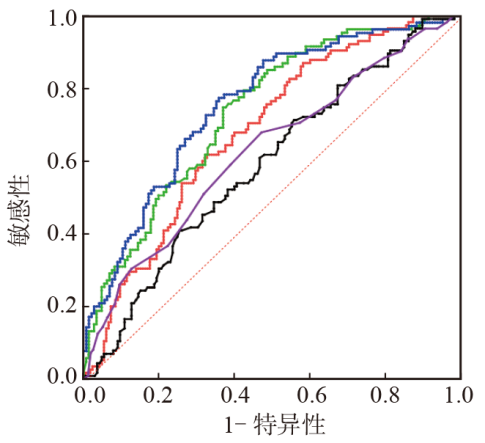
| 指标 | AUC(95%CI) | 最佳临界值 | 敏感性/% | 特异性/% | Youden指数 |
|---|---|---|---|---|---|
| NHR | 0.686 (0.604~0.768) | 5.075 | 62.4 | 67.1 | 0.295 |
| BNP | 0.741 (0.667~0.815) | 1 095 pg·mL-1 | 75.0 | 63.3 | 0.383 |
| LAEDD | 0.632(0.545~0.719) | 45.50 mm | 68.4 | 52.8 | 0.212 |
| LDL-C | 0.596(0.508~0.684) | 1.98 mm | 41.9 | 74.3 | 0.162 |
| NHR+BNP | 0.756 (0.683~0.829) | 0.338 | 78.0 | 64.0 | 0.417 |
| 指标 | AUC(95%CI) | 最佳临界值 | 敏感性/% | 特异性/% | Youden指数 |
|---|---|---|---|---|---|
| NHR | 0.686 (0.604~0.768) | 5.075 | 62.4 | 67.1 | 0.295 |
| BNP | 0.741 (0.667~0.815) | 1 095 pg·mL-1 | 75.0 | 63.3 | 0.383 |
| LAEDD | 0.632(0.545~0.719) | 45.50 mm | 68.4 | 52.8 | 0.212 |
| LDL-C | 0.596(0.508~0.684) | 1.98 mm | 41.9 | 74.3 | 0.162 |
| NHR+BNP | 0.756 (0.683~0.829) | 0.338 | 78.0 | 64.0 | 0.417 |
| [1] |
Rashid A M, Khan M S, Fudim M, et al. Management of heart failure with reduced ejection fraction[J]. Curr Probl Cardiol, 2023, 48(5):101596.
DOI URL |
| [2] |
Roger V L. Epidemiology of heart failure:a contemporary perspective[J]. Circ Res, 2021, 128(10):1421-1434.
DOI URL |
| [3] | Yancy C W, Jessup M, Bozkurt B, et al. 2017 ACC/AHA/HFSA focused update of the 2013 ACCF/AHA guideline for the management of heart failure:a report of the American College of Cardiology/American Heart Association task force on clinical practice guidelines and the Heart Failure Society of America[J]. Circulation,2017, 136(6):e137-e161. |
| [4] | 中华医学会心血管病学分会心力衰竭学组, 中国医师协会心力衰竭专业委员会, 中华心血管病杂志编辑委员会, 等. 中国心力衰竭诊断和治疗指南2018[J]. 中华心血管病杂志, 2018, 46(10):760-789. |
| [5] |
Simmonds S J, Cuijpers I, Heymans S, et al. Cellular and molecular differences between HFpEF and HFrEF:a step ahead in an improved pathological understanding[J]. Cells, 2020, 9(1):242.
DOI URL |
| [6] | 国家心血管病中心, 中国心血管健康与疾病报告编写组, 胡盛寿. 中国心血管健康与疾病报告2023概要[J]. 中国循环杂志, 2024, 39(7):625-660. |
| [7] |
Chiong M, Wang Z V, Pedrozo Z, et al. Cardiomyocyte death:mechanisms and translational implications[J]. Cell Death Dis, 2011, 2(12):e244.
DOI |
| [8] |
Ponikowski P, Voors A A, Anker S D, et al. 2016 ESC Guidelines for the diagnosis and treatment of acute and chronic heart failure:the task force for the diagnosis and treatment of acute and chronic heart failure of the European Society of Cardiology (ESC)developed with the special contribution of the Heart Failure Association (HFA) of the ESC[J]. Eur Heart J,2016, 37(27):2129-2200.
DOI URL |
| [9] |
Collier P, Watson C J, Voon V, et al. Can emerging biomarkers of myocardial remodelling identify asymptomatic hypertensive patients at risk for diastolic dysfunction and diastolic heart failure?[J]. Eur J Heart Fail, 2011, 13(10):1087-1095.
DOI PMID |
| [10] |
Abernethy A, Raza S, Sun J L, et al. Pro-inflammatory biomarkers in stable versus acutely decompensated heart failure with preserved ejection fraction[J]. J Am Heart Assoc, 2018, 7(8):e007385.
DOI URL |
| [11] |
Wang J. Neutrophils in tissue injury and repair[J]. Cell Tissue Res, 2018, 371(3):531-539.
DOI PMID |
| [12] | Yang L, Shi F, Cao F, et al. Neutrophils in tissue injury and repair:molecular mechanisms and therapeutic targets[J]. MedComm (2020),2025, 6(5):e70184. |
| [13] |
Ma Y. Role of Neutrophils in cardiac injury and repair following myocardial infarction[J]. Cells, 2021, 10(7):1676.
DOI URL |
| [14] |
Chiesa S T, Charakida M. High-density lipoprotein function and dysfunction in health and disease[J]. Cardiovasc Drugs Ther, 2019, 33(2):207-219.
DOI PMID |
| [15] | Das P, Ingole N. Lipoproteins and their effects on the cardiovascular system[J]. Cureus, 2023, 15(11):e48865. |
| [16] |
Huang J B, Chen Y S, Ji H Y, et al. Neutrophil to high-density lipoprotein ratio has a superior prognostic value in elderly patients with acute myocardial infarction:a comparison study[J]. Lipids Health Dis, 2020, 19(1):59.
DOI |
| [17] | Lamichhane P, AGRAWAL A, ABOUAINAIN Y, et al. Utility of neutrophil-to-high-density lipoprotein-cholesterol ratio in patients with coronary artery disease:a narrative review[J]. J Int Med Res, 2023, 51(4):3000605231166518. |
| [18] | Mcdonagh T A, Metra M, Adamo M, et al. 2021 ESC guidelines for the diagnosis and treatment of acute and chronic heart failure:developed by the task force for the diagnosis and treatment of acute and chronic heart failure of the European Society of Cardiology (ESC). With the special contribution of the Heart Failure Association (HFA) of the ESC[J]. Eur J Heart Fail,2022,24(1):4-131. |
| [19] | Pepine C J, Nichols W W. The pathophysiology of chronic ischemic heart disease[J]. Clin Cardiol, 2007, 30(2Suppl 1):I4-I9. |
| [20] |
Libby P. Inflammation in atherosclerosis[J]. Arterioscler Thromb Vasc Biol, 2012, 32(9):2045-2051.
DOI PMID |
| [21] |
Gordon D J, Probstfield J L, Garrison R J, et al. High-density lipoprotein cholesterol and cardiovascular disease. Four prospective American studies[J]. Circulation, 1989, 79(1):8-15.
DOI PMID |
| [22] |
Afari M E, Bhat T. Neutrophil to lymphocyte ratio (NLR) and cardiovascular diseases:an update[J]. Expert Rev Cardiovasc Ther, 2016, 14(5):573-577.
DOI URL |
| [23] |
Zhu F, Ji Y, Song J H, et al. Correlations between NLR,NHR,and clinicopathological characteristics,and prognosis of acute ischemic stroke[J]. Medicine (Baltimore), 2023, 102(24):e33957.
DOI URL |
| [24] |
Jiang M, Sun J, Zou H, et al. Prognostic role of neutrophil to high-density lipoprotein cholesterol ratio for all-cause and cardiovascular mortality in the general population[J]. Front Cardiovasc Med, 2022, 9:807339.
DOI URL |
| [25] |
Kou T, Luo H, Yin L. Relationship between neutrophils to HDL-C ratio and severity of coronary stenosis[J]. BMC Cardiovasc Disord, 2021, 21(1):127.
DOI |
| [26] |
Chen Y, Jiang D, Tao H, et al. Neutrophils to high-density lipoprotein cholesterol ratio as a new prognostic marker in patients with ST-segment elevation myocardial infarction undergoing primary percutaneous coronary intervention:a retrospective study[J]. BMC Cardiovasc Disord, 2022, 22(1):434.
DOI |
| [27] |
Manoochehri H, Gheitasi R, Pourjafar M, et al. Investigating the relationship between the severity of coronary artery disease and inflammatory factors of MHR,PHR,NHR,and IL-25[J]. Med J Islam Repub Iran, 2021, 35:85.
DOI PMID |
| [28] | Başyiğit F, Çöteli C. Relationship between the neutrophil to HDL-C ratio and anatomical significance of coronary artery stenosis in patients with documented myocardial ischemia[J]. Eur Rev Med Pharmacol Sci, 2022, 26(9):3179-3184. |
| [29] |
Ozgeyik M, Ozgeyik M O. Long-term prognosis after treatment of total occluded coronary artery is well predicted by neutrophil to high-density lipoprotein ratio:a comparison study[J]. Kardiologiia, 2021, 61(7):60-67.
DOI PMID |
| [1] | ZOU Zhenyang, YU Jinshu, HE Rendong, XIE Ning, GUO Bin. Roles of GDF-15,NT-proBNP and NLR in diagnosis,severity assessment and prognosis evaluation of chronic heart failure [J]. Laboratory Medicine, 2025, 40(10): 946-953. |
| [2] | LUO Lili, LIU Xiaohui, HAO Jianjun, WANG Lili, LUO Jiao, CHEN Qimei. Efficiency of serum homocysteine,BNP and fibrinogen for deep venous thrombosis of lower extremity after cesarean section [J]. Laboratory Medicine, 2024, 39(3): 277-281. |
| [3] | ZHANG Xin, MA Lijuan. Role of cardiac markers in children [J]. Laboratory Medicine, 2023, 38(6): 505-509. |
| [4] | YIN Ya, PAN Yuan, ZHOU Hongwei, SHEN Wei. Application progress of BNP and NT-proBNP in neonates [J]. Laboratory Medicine, 2023, 38(6): 518-523. |
| [5] | LI Li, SUN Haiyan, LI Yuanrui, DOU Min, TANG Wen, JIANG Limin, SHEN Lisong. Changes and clinical roles of perioperative NT-proBNP and PCT in children with congenital heart disease [J]. Laboratory Medicine, 2023, 38(6): 524-531. |
| [6] | LIU Yanan, XIA Min, HU Shaohua, ZHENG Yue, ZHANG Hong. Roles of lymphocyte subsets,inflammatory factors and NT-proBNP in diagnosis of Kawasaki disease [J]. Laboratory Medicine, 2023, 38(6): 532-537. |
| [7] | ZHENG Zhiyou, LI Xingzhao, XIE Yage. Changes and clinical significance of HbA1c,NT-proBNP,Hcy,SOD and TC levels in patients with diabetes cardiomyopathy [J]. Laboratory Medicine, 2023, 38(3): 282-286. |
| [8] | ZHU Chuanxin, ZHOU Yuping, HE Yan, ZHOU Qin. Diagnostic role of NLR,CRP,PCT,DD and NT-proBNP in severe corona virus disease 2019 [J]. Laboratory Medicine, 2021, 36(2): 190-193. |
| [9] | CHEN Bin, LU Weiwei, XU Zhongyu. Roles of serum NT-proBNP,CRP and MMP-9 in children with Kawasaki disease [J]. Laboratory Medicine, 2020, 35(3): 243-246. |
| [10] | ZHENG Wei, HAO Aijun, ZHU Guoyong, ZHANG Yinhui, WANG Dongyun, PANg Jie. Clinical roles of SAA,CRP,LYMPH#,NT-proBNP and DD in COVID-19 [J]. Laboratory Medicine, 2020, 35(12): 1238-1242. |
| [11] | YANG Yan, ZHANG Fujun, SHEN Songkun, WANG Houzhao. NT-proBNP,cTnI,Hcy,DD and hs-CRP for the diagnosis of coronary heart disease by ROC curves [J]. Laboratory Medicine, 2018, 33(1): 15-19. |
| [12] | JI Weixing, ZHOU Xinghui, WANG Xinhua, JIN Huiying, ZHENG Yao, CHEN Xiao. Relationship between plasma PCT level and cardiac function in AECOPD patients with heart failure [J]. Laboratory Medicine, 2016, 31(10): 874-877. |
| [13] | XIAO Chunhai, LIANG Shuang, LIU Jingfan, LI Feifei, ZHU Qinghua, QU Peipei, DONG Zhiwu. Evaluation of BNP quantification by single-epitope sandwich combined with cyclic enhanced immunofluorescent assay [J]. Laboratory Medicine, 2015, 30(5): 495-499. |
| [14] | WU Shuzhi,DENG Sheng,QIN Weiguo,CHEN Jian,YI Bin.. The clinical significance on the combined determination of NT-proBNP, H-FABP and cTnI in elder patients with severe heart failure [J]. , 2014, 29(4): 312-318. |
| [15] | MO Huifang, WU Jiong, SONG Binbin, ZHANG Chunyan, WANG Beili, LIU Xiaowen, GUO Wei, PAN Baishen.. The role of NT-proBNP in high-risk cardiovascular patients for long-term prognosis [J]. , 2014, 29(10): 1013-1018. |
| Viewed | ||||||
|
Full text |
|
|||||
|
Abstract |
|
|||||
