检验医学 ›› 2026, Vol. 41 ›› Issue (9): 913-918.DOI: 10.3969/j.issn.1673-8640.2026.09.015

• 论著 • 上一篇    下一篇

2020—2024年上海市三级公立医院临床检验质量指标情况分析

杨雪, 王青(), 蒋玲丽, 周靖, 胡晓波   

  1. 上海市临床检验中心, 上海 200126
  • 收稿日期:2025-07-06 修回日期:2026-03-24 出版日期:2026-09-30 发布日期:2026-09-29
  • 通讯作者: 王 青,E-mail:wangqing@sccl.org.cn。
  • 作者简介:杨 雪,女,1986年生,硕士,副主任技师,主要从事临床实验室质量管理工作。
  • 基金资助:
    上海市临床检验中心学科人才青年项目(2024RCJH-03)

Analysis of clinical laboratory quality indicators for Shanghai's tertiary public hospitals from 2020 to 2024

YANG Xue, WANG Qing(), JIANG Lingli, ZHOU Jing, HU Xiaobo   

  1. Shanghai Center for Clinical Laboratory, Shanghai 200126, China
  • Received:2025-07-06 Revised:2026-03-24 Online:2026-09-30 Published:2026-09-29

摘要:

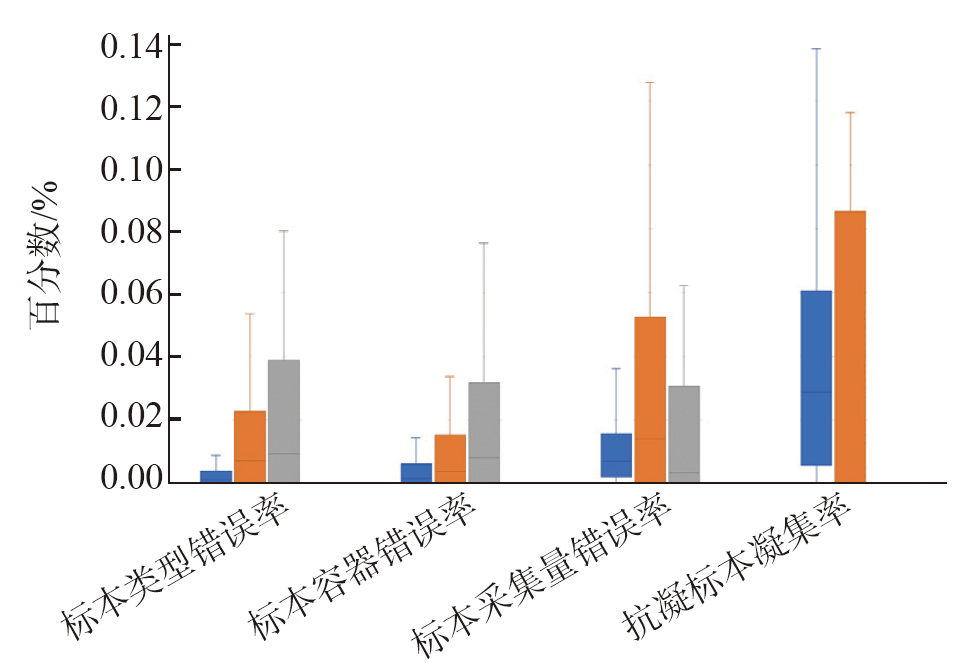
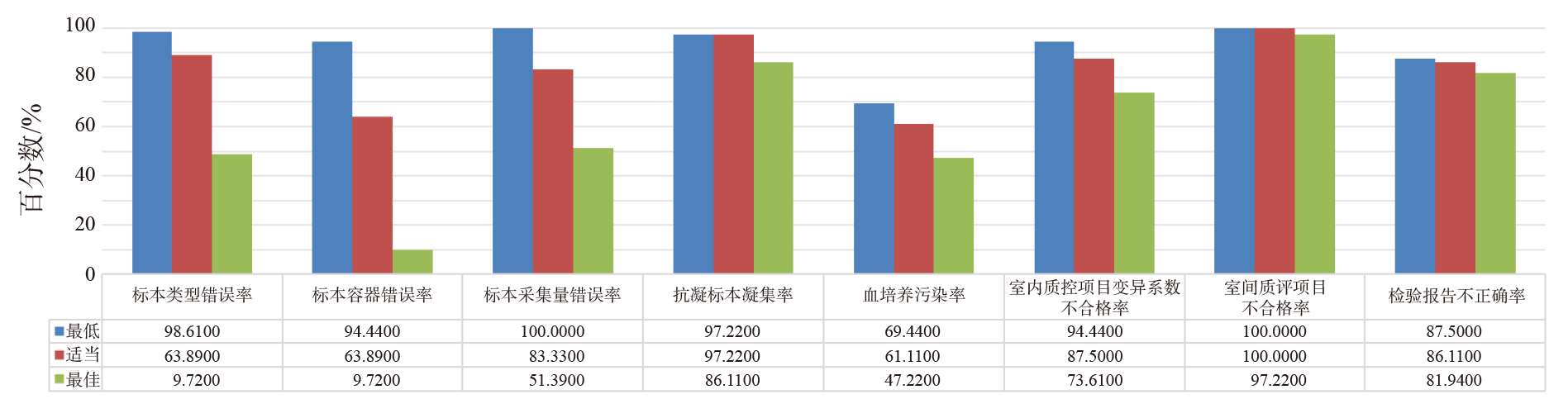
目的 分析上海地区三级公立医院临床实验室全过程质量指标运行情况,全面了解实验室的检验质量水平。方法 收集2020—2024年上海市72家三级公立医院临床实验室15项质量指标和信息系统建设数据。统计每年各项指标的P25、P50、P75及其对应的σ水平和5年间的变化,并将2024年各实验室15项质量指标的质量水平与国际临床化学和实验医学联合会(IFCC)患者安全和实验室差错工作组(WG-LEPS)推荐的质量规范进行比较。结果 72家实验室中,有69家采用信息系统采集质量指标。15项质量指标中,室内质控项目开展率、实验室间比对率的P50分别由2020年的96.85%(σ为3.4)和45.05%(σ为1.6)提高到2024年的98.99%(σ为3.8)和91.53%(σ为2.9);住院患者标本的检验前周转时间中位数和门诊患者标本的检验前周转时间中位数的P50分别由2020年的80和30 min缩短到2024年的68和25 min。检验前阶段的质量指标中,标本类型错误率、标本容器错误率、标本采集量错误率、抗凝标本凝集率的σ水平P50基本维持在5.0,血培养污染率的σ水平P50基本维持在4.0,急诊检验前周转时间中位数由2020年的23 min缩短到2024年的20 min。检验中和检验后阶段的质量指标中,室内质控项目变异系数不合格率、室间质评项目参加率、室间质评项目不合格率、检验报告不正确率、危急值通报率和危急值通报及时率的σ水平P50维持在6.0,住院、急诊和门诊标本实验室内周转时间中位数分别由2020年的123、52和100 min缩短到2024年的115、46和90 min。除血培养污染率外,80%以上的实验室质量指标满足IFCC推荐的最低质量水平要求。结论 上海市三级公立医院临床实验室质量水平总体优良,并呈现提升的趋势,但检验前阶段环节质量的控制管理仍需加强。质量指标的应用改进了临床实验室的检验质量水平,但仍需通过质量指标同质化和数据采集信息化进一步提高。

关键词: 临床实验室, 实验室差错, 质量指标, 质量规范

Abstract:

Objective To analyze the performance of quality indicators across the entire process in clinical laboratories of Shanghai's tertiary public hospitals,and to comprehensively assess the overall testing quality. Methods The data on 15 quality indicators and information system development from 72 tertiary public hospitals' clinical laboratories in Shanghai between 2020 and 2024 were collected. The P25,P50 and P75 values for each indicator,along with their corresponding σ levels and 5-year trends,were calculated. In 2024,the quality levels of these 15 indicators were compared against the quality standards recommended by the International Federation of Clinical Chemistry and Laboratory Medicine(IFCC)Working Group on Laboratory Errors and Patient Safety(WG-LEPS). Results Among the 72 laboratories,69 laboratories adopted information systems to collect quality data. Among levels of the 15 quality indicators,the P50 values for internal quality control implementation rate and interlaboratory comparison participation rate increased from 96.85% (σ=3.4) and 45.05% (σ=1.6) in 2020 to 98.99% (σ=3.8) and 91.53% (σ=2.9) in 2024,respectively. The medians of pre-analytical turn-around times for inpatient and outpatient specimens decreased from 80 and 30 min in 2020 to 68 and 25 min in 2024. For pre-analytical indicators,the P50 σ levels for specimen type error rate,specimen container error rate,specimen volume error rate and coagulation rate in anticoagulated specimens remained stable at 5.0. The blood culture contamination rate maintained a P50 σ level of 4.0. The median of pre-analytical turn-around time for emergency tests decreased from 23 min in 2020 to 20 min in 2024. For analytical and post-analytical indicators,the P50 σ levels for coefficient of variation failure rate in internal quality control,external quality assessment participation rate,external quality assessment failure rate,incorrect test report rate,critical value notification rate and timely critical value notification rate remained stable at 6.0. The median of laboratory turn-around times for inpatient,emergency and outpatient specimens decreased from 123,52 and 100 min in 2020 to 115,46 and 90 min in 2024,respectively. Except for blood culture contamination rate,more than 80% of laboratories met the minimum quality requirements recommended by IFCC. Conclusions The overall quality performance of clinical laboratories in Shanghai's tertiary public hospitals is excellent and shows an upward trend year by year. However,further strengthening of quality control in the pre-analytical phase remains necessary. Application of quality indicators has improved testing quality,but further enhancement of datum quality requires greater standardization of indicators and higher levels of informationalization in datum collection.

Key words: Clinical laboratory, Laboratory error, Quality indicator, Quality standard

中图分类号: