
Laboratory Medicine ›› 2026, Vol. 41 ›› Issue (10): 986-996.DOI: 10.3969/j.issn.1673-8640.2026.10.009
Previous Articles Next Articles
WANG Yanan, LIU Wenjing, GUO Junhua, ZHANG Xiaoyu, LI Qin, YANG Hua, AN Jie, ZHAO Xiufeng, ZHANG Renjie
Received:2024-11-04
Revised:2026-02-03
Online:2026-10-30
Published:2026-10-20
CLC Number:
WANG Yanan, LIU Wenjing, GUO Junhua, ZHANG Xiaoyu, LI Qin, YANG Hua, AN Jie, ZHAO Xiufeng, ZHANG Renjie. Correlation between serum pentraxin 3 and cardiac function classification,cardiac reserve function of patients with heart failure[J]. Laboratory Medicine, 2026, 41(10): 986-996.
Add to citation manager EndNote|Ris|BibTeX
URL: https://www.shjyyx.com/EN/10.3969/j.issn.1673-8640.2026.10.009
| 组别 | 例数 | 年龄/岁 | 性别 | 体重指数/(kg·m-2) | 病程/年 | |
|---|---|---|---|---|---|---|
| 男/[例(%)] | 女/[例(%)] | |||||
| 对照组 | 110 | 46.52±5.22 | 56(50.91) | 54(49.09) | 23.24±1.56 | |
| NYHA Ⅰ级组 | 67 | 45.35±5.32 | 30(44.78) | 37(55.22) | 23.03±1.51 | 4.02±0.61 |
| NYHA Ⅱ级组 | 68 | 51.87±5.61*# | 40(58.82) | 28(41.18) | 23.68±1.74# | 4.31±0.65# |
| NYHA Ⅲ级组 | 51 | 58.21±5.82*#△ | 26(50.98) | 25(49.02) | 24.65±1.78*#△ | 4.55±0.62#△ |
| NYHA Ⅳ级组 | 34 | 66.48±5.85*#△▲ | 18(52.94) | 16(47.06) | 25.64±1.97*#△▲ | 4.96±0.67#△▲ |
| 统计值 | 124.243 | 2.694 | 20.000 | 17.832 | ||
| P值 | 0.008 | 0.610 | 0.049 | 0.055 | ||
| 组别 | 呼吸频率/(次·min-1) | 吸烟史/[例(%)] | 饮酒史/[例(%)] | 糖尿病史/[例(%)] | 冠心病史/[例(%)] | |
| 对照组 | 16.66±2.31 | 58(52.73) | 65(59.09) | 34(30.91) | 36(32.73) | |
| NYHA Ⅰ级组 | 16.78±2.04 | 30(44.78) | 28(41.79)* | 29(43.28) | 27(40.30) | |
| NYHA Ⅱ级组 | 16.79±3.06 | 25(36.76)* | 31(45.59) | 36(52.94)* | 25(36.76) | |
| NYHA Ⅲ级组 | 16.70±2.96 | 28(54.91)△ | 24(47.06) | 31(60.78)* | 32(62.75)*#△ | |
| NYHA Ⅳ级组 | 16.57±2.63 | 17(50.00) | 22(64.71)# | 22(64.71)*# | 21(61.77)*#△ | |
| 统计值 | 0.064 | 5.669 | 6.426 | 16.118 | 13.996 | |
| P值 | 1.000 | 0.225 | 0.170 | 0.003 | 0.007 | |
| 组别 | 瓣膜病史/ [例(%)] | 肝胆疾病史/ [例(%)] | 高脂血症史/ [例(%)] | 高血压史/ [例(%)] | PTX3/ (ng·mL-1) | |
| 对照组 | 25(22.73) | 39(35.45) | 36(32.73) | 22(20.00) | 1.23±0.36 | |
| NYHA Ⅰ级组 | 18(26.87) | 37(55.22)* | 31(46.27) | 16(23.88) | 1.55±1.03* | |
| NYHA Ⅱ级组 | 32(47.06)*# | 28(41.18) | 31(45.59) | 25(36.76) | 3.65±1.26*# | |
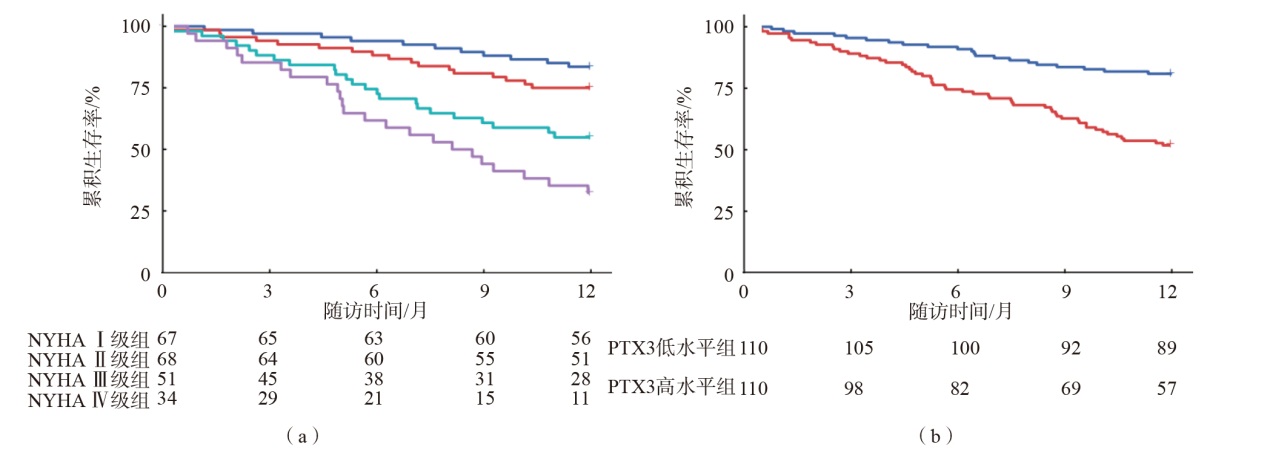
| NYHA Ⅲ级组 | 32(62.75)*# | 25(49.02) | 23(45.10) | 35(68.63)*#△ | 7.64±1.34*#△ | |
| NYHA Ⅳ级组 | 31(91.17)*#△▲ | 17(50.00) | 18(52.94)* | 30(88.24)*#△▲ | 14.36±1.64*#△▲ | |
| 统计值 | 32.582 | 7.450 | 4.975 | 41.868 | 1 196.454 | |
| P值 | <0.001 | 0.114 | 0.290 | <0.001 | 0.001 | |
| 组别 | 例数 | 心率/(次·min-1) | 收缩压/kPa | 舒张压/kPa | S1/S2比值 |
|---|---|---|---|---|---|
| 对照组 | 110 | 92.54±8.25 | 20.28±1.16 | 12.45±0.83 | 2.22±0.74 |
| NYHA Ⅰ级组 | 67 | 92.78±8.63 | 19.99±1.21 | 11.49±1.74* | 2.70±1.30* |
| NYHA Ⅱ级组 | 68 | 91.36±6.36 | 19.59±1.20* | 11.46±1.61* | 2.90±1.40* |
| NYHA Ⅲ级组 | 51 | 90.10±7.86 | 18.76±1.09*#△ | 10.67±1.59*#△ | 4.30±1.90*#△ |
| NYHA Ⅳ级组 | 34 | 88.36±7.08*#△ | 18.22±1.28*#△▲ | 10.42±1.87*#△ | 5.60 ±1.60*#△▲ |
| 统计值 | 2.690 | 28.654 | 19.829 | 54.034 | |
| P值 | 0.310 | 0.034 | 0.049 | 0.018 | |
| 组别 | D/S比值 | LVEF/% | CI/(L·min-1·m-2) | CO/(L·min-1) | BNP(pg/mL) |
| 对照组 | 1.66±0.37 | 58.53±4.52 | 2.58±0.46 | 4.12±0.55 | 82.21±7.64 |
| NYHA Ⅰ级组 | 1.50±0.30* | 53.13±4.21* | 2.35±0.42* | 3.84±0.52* | 121.54±10.25* |
| NYHA Ⅱ级组 | 1.40±0.30* | 50.33±4.05*# | 2.13±0.38*# | 3.49±0.46*# | 315.24±22.12*# |
| NYHA Ⅲ级组 | 1.20±0.20*#△ | 45.64±3.86*#△ | 2.03±0.35*# | 3.31±0.44*#△ | 1 362.51±362.11*#△ |
| NYHA Ⅳ级组 | 1.00±0.20*#△▲ | 38.12±3.51*#△▲ | 1.69±0.28*#△▲ | 3.06±0.35*#△▲ | 2 512.17±598.54*#△▲ |
| 统计值 | 40.308 | 192.002 | 40.296 | 46.213 | 6 726.554 |
| P值 | 0.025 | 0.005 | 0.025 | 0.021 | <0.001 |
| 项目 | β值 | 标准误 | Wald值 | P值 | OR①值(95%CI②) |
|---|---|---|---|---|---|
| 年龄 | 0.311 | 0.236 | 1.738 | 0.003 | 1.365(1.263~1.950) |
| 体重指数 | -0.014 | 0.325 | 0.002 | 0.096 | 0.986(0.658~1.025) |
| 糖尿病史 | 0.674 | 0.158 | 18.195 | 0.004 | 1.962(1.634~2.631) |
| 冠心病史 | 0.403 | 0.261 | 2.382 | 0.002 | 1.496(1.325~2.014) |
| 瓣膜病史 | 0.311 | 0.201 | 2.396 | 0.001 | 1.365(1.265~1.635) |
| 高血压史 | -0.280 | 0.275 | 1.035 | 0.067 | 0.756(0.532~1.968) |
| PTX3 | 0.312 | 0.237 | 1.794 | 0.002 | 1.369(1.234~1.967) |
| 心率 | -0.573 | 0.243 | 5.554 | 0.002 | 0.564(0.421~0.689) |
| 收缩压 | -0.473 | 0.184 | 6.614 | 0.005 | 0.623(0.531~0.845) |
| 舒张压 | -0.375 | 0.196 | 3.669 | 0.006 | 0.687(0.563~0.881) |
| S1/S2比值 | 0.427 | 0.203 | 4.416 | 0.002 | 1.532(1.239~1.952) |
| D/S比值 | -0.860 | 0.211 | 16.627 | 0.001 | 0.423(0.237~0.659) |
| LVEF | -0.697 | 0.234 | 8.876 | 0.002 | 0.498(0.289~0.712) |
| CI | -0.498 | 0.187 | 7.080 | 0.003 | 0.608(0.522~0.814) |
| CO | -0.607 | 0.192 | 9.994 | 0.002 | 0.545(0.354~0.762) |
| BNP | 0.767 | 0.213 | 12.978 | 0.001 | 2.154(1.784~2.536) |
| 项目 | 未校正模型 | 模型1 | 模型2 | |||||
|---|---|---|---|---|---|---|---|---|
| β值(95%CI) | P值 | β值(95%CI) | P值 | β值(95%CI) | P值 | |||
| 年龄/岁 | ||||||||
| ≥58 | 12.611(8.312~16.293) | <0.001 | 8.612(-5.613~12.548) | 0.121 | 7.629(-6.329~11.084) | 0.187 | ||
| <58 | 15.882(10.326~19.622) | <0.001 | 11.134(-6.326~15.217) | 0.105 | 9.613(-8.151~14.196) | 0.135 | ||
| P值 | 0.132 | 0.164 | 0.199 | |||||
| 糖尿病史 | ||||||||
| 无 | 6.231(3.384~8.512) | <0.001 | 5.321(-3.164~8.215) | 0.154 | 4.926(-5.612~8.321) | 0.174 | ||
| 有 | 7.312(5.661~9.623) | <0.001 | 6.052(-2.643~8.659) | 0.138 | 5.326(-3.952~8.642) | 0.152 | ||
| P值 | 0.152 | 0.187 | 0.231 | |||||
| 冠心病史 | ||||||||
| 无 | 6.326(4.125~8.956) | <0.001 | 6.032(-2.622~9.151) | 0.128 | 5.269(-4.158~8.619) | 0.153 | ||
| 有 | 8.124(6.333~11.254) | <0.001 | 7.263(-4.312~10.620) | 0.164 | 6.848(-5.063~10.263) | 0.189 | ||
| P值 | 0.123 | 0.159 | 0.187 | |||||
| 瓣膜病史 | ||||||||
| 无 | 5.263(2.132~8.642) | <0.001 | 4.122(-3.315~8.629) | 0.133 | 3.984(-2.612~5.684) | 0.169 | ||
| 有 | 8.613(6.187~11.296) | <0.001 | 5.946(-3.221~8.622) | 0.184 | 5.216(-4.363~9.621) | 0.211 | ||
| P值 | 0.164 | 0.198 | 0.235 | |||||
| 心率 | ||||||||
| ≤90 次·min-1 | 8.162(6.131~10.544) | <0.001 | 6.897(5.131~9.874) | 0.002 | 5.987(4.121~8.612) | 0.006 | ||
| > 90 次·min-1 | 6.187(4.654~9.152) | <0.001 | 5.163(2.154~8.121) | 0.043 | 3.231(-1.131~5.123) | 0.069 | ||
| P值 | 0.025 | 0.031 | 0.036 | |||||
| 收缩压 | ||||||||
| ≤18.67 kPa | 15.356(10.326~21.641) | <0.001 | 14.325(9.623~19.542) | 0.002 | 13.263(8.642~18.232) | 0.008 | ||
| > 18.67 kPa | 12.164(10.287~16.963) | <0.001 | 10.263(6.152~14.329) | 0.045 | 8.264(-2.645~12.154) | 0.079 | ||
| P值 | 0.021 | 0.036 | 0.041 | |||||
| 舒张压 | ||||||||
| ≤12.00 kPa | 18.645(14.296~22.316) | <0.001 | 15.231(11.485~19.652) | 0.004 | 12.629(8.312~16.318) | 0.009 | ||
| > 12.00 kPa | 14.233(10.298~18.423) | <0.001 | 11.296(8.312~15.485) | 0.048 | 8.316(-3.284~12.215) | 0.082 | ||
| P值 | 0.018 | 0.021 | 0.026 | |||||
| S1/S2比值 | ||||||||
| ≤3.50 | 2.165(1.131~3.616) | <0.001 | 1.652(1.131~2.265) | 0.036 | 1.264(-1.131~2.152) | 0.073 | ||
| > 3.50 | 2.651(2.031~3.951) | <0.001 | 2.136(1.563~2.741) | 0.002 | 1.649(1.231~2.412) | 0.005 | ||
| P值 | 0.008 | 0.015 | 0.022 | |||||
| 项目 | 未校正模型 | 模型1 | 模型2 | |||||
| β值(95%CI) | P值 | β值(95%CI) | P值 | β值(95%CI) | P值 | |||
| D/S比值 | ||||||||
| ≤1.30 | 1.563(1.163~2.256) | <0.001 | 1.287(0.896~1.682) | 0.005 | 1.105(0.712~1.536) | 0.010 | ||
| > 1.30 | 1.233(0.849~1.961) | <0.001 | 1.133(0.678~1.529) | 0.041 | 0.846(-1.231~1.569) | 0.088 | ||
| P值 | 0.010 | 0.016 | 0.025 | |||||
| LVEF | ||||||||
| ≤48.21% | 10.261(7.956~14.263) | <0.001 | 8.623(5.163~12.163) | 0.004 | 7.945(4.897~10.395) | 0.009 | ||
| > 48.21% | 12.694(8.623~16.487) | <0.001 | 9.487(7.623~12.039) | 0.039 | 6.419(-2.645~9.523) | 0.067 | ||
| P值 | 0.012 | 0.028 | 0.043 | |||||
| CI | ||||||||
| ≤2.11 L·min-1· m-2 | 1.874(1.431~2.412) | <0.001 | 1.645(1.329~2.231) | 0.002 | 1.487(1.231~2.031) | 0.006 | ||
| >2.11 L·min-1· m-2 | 1.946(1.533~2.396) | <0.001 | 1.784(1.439~2.352) | 0.032 | 1.564(-1.102~1.953) | 0.084 | ||
| P值 | 0.015 | 0.027 | 0.036 | |||||
| CO | ||||||||
| ≤3.49 L·min-1 | 2.132(1.684~2.548) | <0.001 | 1.764(1.431~2.213) | 0.002 | 1.512(1.136~1.879) | 0.007 | ||
| > 3.49 L·min-1 | 2.316(1.889~2.645) | <0.001 | 1.933(1.628~2.512) | 0.042 | 1.641(-1.231~2.051) | 0.076 | ||
| P值 | 0.012 | 0.026 | 0.037 | |||||
| BNP | ||||||||
| ≤946.35 pg·mL-1 | 26.942(20.163~32.487) | <0.001 | 22.487(16.329~27.548) | 0.037 | 19.345(-12.649~24.151) | 0.091 | ||
| > 946.35 pg·mL-1 | 23.498(17.512~28.542) | <0.001 | 20.123(16.498~24.218) | 0.003 | 16.485(11.284~20.316) | 0.008 | ||
| P值 | 0.011 | 0.029 | 0.041 | |||||
| 项目 | 未校正模型 | 模型1 | 模型2 | |||||
|---|---|---|---|---|---|---|---|---|
| β值(95%CI) | P值 | β值(95%CI) | P值 | β值(95%CI) | P值 | |||
| 心率 | -1.241(-2.619~2.374) | 0.004 | -0.856(-1.194~1.305) | 0.002 | -0.263(-0.904~1.004) | <0.001 | ||
| 收缩压 | -1.096(-4.552~4.630) | 0.011 | -0.852(-2.541~2.320) | <0.001 | -0.756(-0.974~1.024) | 0.002 | ||
| 舒张压 | -0.162(-0.261~0.956) | <0.001 | -0.136(-0.210~0.874) | 0.002 | -0.073(-0.103~0.274) | <0.001 | ||
| S1/S2比值 | 0.296(0.120~0.462) | 0.009 | 0.230(0.194~0.304) | <0.001 | 0.142(0.104~0.207) | <0.001 | ||
| D/S比值 | -0.195(-0.930~1.786) | <0.001 | -0.144(-0.821~1.251) | 0.002 | 0.053(-0.705~1.048) | <0.001 | ||
| LVEF | -1.651(-1.134~1.212) | <0.001 | -1.236(-1.956~-0.765) | <0.001 | -1.597(-1.956~-0.856) | <0.001 | ||
| CI | -1.985(-2.689~-1.211) | <0.001 | -1.626(-2.187~-1.102) | <0.001 | -1.231(-1.862~-0.764) | <0.001 | ||
| CO | -1.265(-0.874~-1.692) | <0.001 | -1.545(-2.031~-1.062) | <0.001 | -1.432(-1.956~-1.021) | <0.001 | ||
| BNP | 1.645(1.184~2.312) | <0.001 | 1.987(1.325~2.599) | <0.001 | 2.315(1.695~2.784) | <0.001 | ||
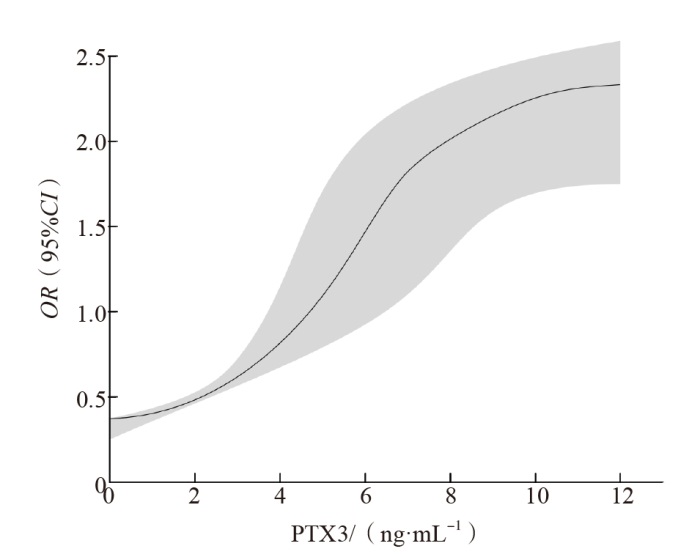
| 模型 | 因变量 | 自变量 | β值 | 标准误 | t值 | P值 |
|---|---|---|---|---|---|---|
| 模型1 | HF严重程度 | PTX3 | 0.231 | 0.017 | 6.987 | <0.001 |
| 模型2 | 心率 | PTX3 | 0.284 | 0.052 | 4.165 | <0.001 |
| 收缩压 | PTX3 | 0.174 | 0.049 | 4.679 | <0.001 | |
| 舒张压 | PTX3 | 0.201 | 0.046 | 3.456 | <0.001 | |
| S1/S2 | PTX3 | 0.185 | 0.016 | 4.591 | <0.001 | |
| D/S | PTX3 | 0.237 | 0.051 | 4.968 | <0.001 | |
| LVEF | PTX3 | 0.154 | 0.025 | 4.321 | <0.001 | |
| CI | PTX3 | 0.123 | 0.027 | 4.286 | <0.001 | |
| CO | PTX3 | 0.119 | 0.030 | 4.389 | <0.001 | |
| 模型3 | HF严重程度 | PTX3 | 0.132 | 0.048 | 3.878 | <0.001 |
| 心率 | 0.224 | 0.047 | 7.531 | <0.001 | ||
| HF严重程度 | PTX3 | 0.216 | 0.009 | 3.984 | <0.001 | |
| 收缩压 | 0.121 | 0.042 | 3.268 | <0.001 | ||
| HF严重程度 | PTX3 | 0.196 | 0.041 | 4.135 | <0.001 | |
| 舒张压 | 0.165 | 0.045 | 2.465 | <0.001 | ||
| HF严重程度 | PTX3 | 0.307 | 0.015 | 5.278 | <0.001 | |
| S1/S2 | 0.213 | 0.054 | 3.564 | <0.001 | ||
| HF严重程度 | PTX3 | 0.256 | 0.056 | 4.031 | <0.001 | |
| D/S | 0.234 | 0.057 | 5.061 | <0.001 | ||
| HF严重程度 | PTX3 | 0.285 | 0.038 | 3.842 | <0.001 | |
| LVEF | 0.136 | 0.041 | 4.326 | <0.001 | ||
| HF严重程度 | PTX3 | 0.254 | 0.052 | 3.884 | <0.001 | |
| CI | 0.187 | 0.046 | 4.315 | <0.001 | ||
| HF严重程度 | PTX3 | 0.205 | 0.038 | 2.869 | <0.001 | |
| CO | 0.196 | 0.031 | 4.252 | <0.001 |
| [1] | Zamorano J L, González Leal A. Advances in heart failure management[J]. Med Clin(Barc), 2024, 163(1):32-39. |
| [2] | Kagami K, Harada T, Yuasa N, et al. Impaired left atrial reserve function in heart failure with preserved ejection fraction[J]. Circ Cardiovasc Imaging, 2024, 17(8):e016549. |
| [3] |
Castiglione V, Aimo A, Vergaro G, et al. Biomarkers for the diagnosis and management of heart failure[J]. Heart Fail Rev, 2022, 27(2):625-643.
DOI |
| [4] | 曹明善, 王春娣, 胡小倩, 等. 正五聚蛋白3和心型脂肪酸结合蛋白及肌酸激酶同工酶水平与慢性心力衰竭患者治疗效果的关系及对心血管事件发生的预测研究[J]. 中国心血管病研究杂志, 2022, 20(6):537-541. |
| [5] | Xu Y, Hu Y, Geng Y, et al. Pentraxin 3 depletion(PTX3 KD) inhibited myocardial fibrosis in heart failure after myocardial infarction[J]. Aging(Albany NY), 2022, 14(9):4036-4049. |
| [6] |
Song Y K, Yuan H X, Jian Y P, et al. Pentraxin 3 in circulating microvesicles:a potential biomarker for acute heart failure after cardiac surgery with cardiopulmonary bypass[J]. J Cardiovasc Transl Res, 2022, 15(6):1414-1423.
DOI PMID |
| [7] | 中华医学会心血管病学分会, 中华心血管病杂志编辑委员会. 中国心力衰竭诊断和治疗指南2014[J]. 中华心血管病杂志, 2014, 42(2):98-122. |
| [8] | 周蓓蓓, 窦会, 冯玉玉, 等. 心力衰竭超声指数联合心脏标志物对老年心力衰竭患者心功能分级和预后的评估价值[J]. 中国老年学杂志, 2023, 43(21):5124-5127. |
| [9] | 中国血脂管理指南修订联合专家委员会, 李建军, 赵水平, 等. 中国血脂管理指南(2023年)[J]. 中国循环杂志, 2023, 38(3):237-271. |
| [10] | 中国高血压防治指南修订委员会, 高血压联盟(中国), 中国医疗保健国际交流促进会高血压分会, 等. 中国高血压防治指南(2024年修订版)[J]. 中华高血压杂志, 2024, 32(7):603-700. |
| [11] |
Villatore A, Monno A, Sciorati C, et al. Pentraxin 3 in myocarditis:proof-of-principle assessment as a diagnostic and prognostic biomarker[J]. J Cardiovasc Transl Res, 2024, 17(5):1048-1058.
DOI PMID |
| [12] | 燕建锋, 姚娟, 高洁, 等. 血清NEP、PTX3及H-FABP在慢性心力衰竭的表达水平及与疾病的相关性分析[J]. 现代生物医学进展, 2023, 23(2):309-312. |
| [13] |
Dimond M G, Ibrahim N E, Fiuzat M, et al. Left ventricular ejection fraction and the future of heart failure phenotyping[J]. JACC Heart Fail, 2024, 12(3):451-460.
DOI URL |
| [14] | 李金莲, 杨帆, 宁新惠. 沙库巴曲缬沙坦对老年射血分数保留型心力衰竭患者无创心功能和脉搏波传导速度的影响[J]. 中国老年学杂志, 2023, 43(10):2309-2312. |
| [15] | 薛迪, 吴江, 李璇, 等. 特征追踪心脏MRI定量评估非梗阻性肥厚型心肌病左房功能的应用研究[J]. 放射学实践, 2024, 39(4):479-487. |
| [16] | Scuderi S A, Ardizzone A, Salako A E, et al. Pentraxin 3:a main driver of inflammation and immune system dysfunction in the tumor microenvironment of glioblastoma[J]. Cancers(Basel), 2024, 16(9):1637. |
| [17] | 李汶玲, 陈娇娇. 血清前白蛋白和正五聚蛋白3水平对AMI患者PCI术后心力衰竭发生的预测价值[J]. 新疆医科大学学报, 2023, 46(5):643-647. |
| [18] |
Zhang H, Wang Y, Zhao Y, et al. PTX3 mediates the infiltration,migration,and inflammation-resolving-polarization of macrophages in glioblastoma[J]. CNS Neurosci Ther, 2022, 28(11):1748-1766.
DOI PMID |
| [19] |
Chen W, Zhuang Y S, Yang C X, et al. The protective role of the long pentraxin ptx3 in spontaneously hypertensive rats with heart failure[J]. Cardiovasc Toxicol, 2021, 21(10):808-819.
DOI PMID |
| [20] | Xu Y, Hu Y, Geng Y, et al. Pentraxin 3 depletion(PTX3 KD) inhibited myocardial fibrosis in heart failure after myocardial infarction[J]. Aging(Albany NY), 2022, 14(9):4036-4049. |
| Viewed | ||||||
|
Full text |
|
|||||
|
Abstract |
|
|||||
