检验医学 ›› 2026, Vol. 41 ›› Issue (10): 935-939.DOI: 10.3969/j.issn.1673-8640.2026.10.001

• 论著 •    下一篇

尘螨类型和组分与儿童过敏性鼻炎-哮喘疾病谱的相关性

陈蓉, 杨蔺, 潘秋辉, 甄妮, 沈蕙颖()   

  1. 上海交通大学医学院附属上海儿童医学中心检验科, 上海 200127
  • 收稿日期:2024-08-15 修回日期:2026-02-13 出版日期:2026-10-30 发布日期:2026-10-20
  • 通讯作者: 沈蕙颖,E-mail:carrol-1982@sohu.com。
  • 作者简介:陈 蓉,女,1982年生,主管技师,主要从事临床免疫学检验工作。
  • 基金资助:
    国家自然科学基金重大项目(82293662);国家自然科学基金青年项目(82302617)

Correlation between dust mite types and components and the disease spectrum of childhood allergic rhinitis and asthma

CHEN Rong, YANG Lin, PAN Qiuhui, ZHEN Ni, SHEN Huiying()   

  1. Department of Clinical Laboratory, Shanghai Children's Medical Center,Shanghai Jiao Tong University School of Medicine, Shanghai 200127, China
  • Received:2024-08-15 Revised:2026-02-13 Online:2026-10-30 Published:2026-10-20

摘要:

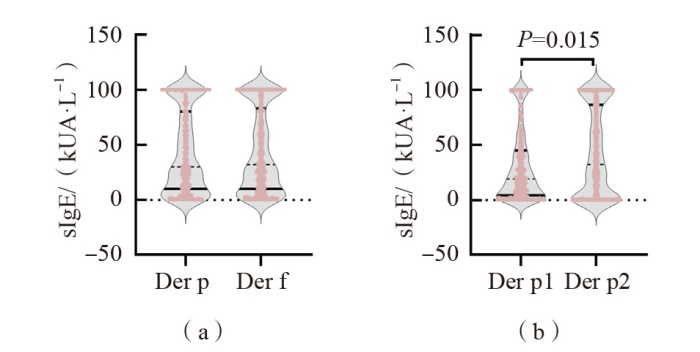
目的 探讨尘螨类型和组分与儿童过敏性鼻炎(AR)-哮喘(AS)疾病谱的关系。方法 选取2022年9月—2023年8月上海交通大学医学院附属上海儿童医学中心AR患儿306例、AS患儿101例、AR合并AS患儿28例。根据年龄将所有患儿分为婴幼儿(≤3岁)组、学龄前期(4~6岁)组、学龄期(5~12岁)组和青春期(13~18岁)组。收集所有患儿的临床资料,并检测血清尘螨总特异性免疫球蛋白E(sIgE)水平和不同尘螨类型[户尘螨(Der p)和粉尘螨(Der f)]、组分(Der p1、Der p2、Der p10)的sIgE水平。将总sIgE≥0.35 kUA·L-1的患儿纳入尘螨阳性组(303例),总sIgE<0.35 kUA·L-1的患儿纳入尘螨阴性组(132例)。根据ImmunoCAP血清sIgE分级标准对Der p1和Der p2阳性患儿的血清sIgE水平进行分级。采用Spearman相关分析评估尘螨阳性组不同类型、组分sIgE水平的相关性。采用有序Logistic回归分析评估尘螨组分与血清sIgE分级的关系。结果 尘螨阳性组与阴性组年龄分布差异有统计学意义(P=0.008),其中学龄期儿童尘螨阳性率最高。303例尘螨阳性患儿中,Der p和Der f的阳性率分别为97.69%、98.53%,有96.04%的患者Der p、Der f同时阳性;Der p1阳性率为86.80%,Der p2阳性率为73.60%,有66.00%的患者Der p1、Der p2同时阳性为66.00%。Der p sIgE与Der f sIgE呈强正相关(rs=0.924,P<0.000 1),Der p1 sIgE与Der p2 sIgE亦呈正相关(rs=0.600,P<0.000 1)。尘螨阳性患儿Der p sIgE水平与Der f sIgE水平差异无统计学意义(P>0.05),Der p1 sIgE水平显著低于Der p2 sIgE水平(P=0.015);Der p2组分诱发更高sIgE分级的概率是Der p1的3.64倍[比值比(OR)=3.64,95%可信区间(CI)为2.59~5.10,P<0.000 1]。结论 学龄期儿童是尘螨致敏的高发年龄段。Der p2的致敏等级高于Der p1。

关键词: 尘螨, 组分, 特异性免疫球蛋白E, 过敏性鼻炎, 哮喘

Abstract:

Objective To investigate the relationship between dust mite types and components and the disease spectrum of childhood allergic rhinitis(AR) and asthma(AS). Methods A total of 306 children with AR,101 children with AS and 28 children with AR combined with AS were enrolled from Shanghai Children's Medical Center of Shanghai Jiao Tong University School of Medicine from September 2022 to August 2023. All the children were classified into infant group(≤3 years old),preschool group(4-6 years old),school-age group(5-12 years old) and adolescent group(13-18 years old). The clinical data were collected,and the serum total specific immunoglobulin E(sIgE) levels and the sIgE levels of different dust mite types [Dermatophagoides pteronyssinus(Der p) and Dermatophagoides farinae(Der f)] and components(Der p1,Der p2,Der p10) were determined. Children with total sIgE ≥ 0.35 kUA·L-1 were included in dust mite positive group(303 cases),and children with total sIgE < 0.35 kUA·L-1 were included in dust mite negative group(132 cases). The serum sIgE levels of children with positive Der p1 and Der p2 were graded according to the ImmunoCAP serum sIgE grading standard. Spearman correlation analysis was used to evaluate the correlation of sIgE levels among different types and components of dust mites in dust mite positive group. Ordered Logistic regression analysis was used to evaluate the relationship between dust mite components and serum sIgE grading. Results There was statistical significance in age distribution between dust mite positive and negative groups(P=0.008). The positive rate of dust mites was the highest in school-age children. Among the 303 dust mite positive children,the positive rates of Der p and Der f were 97.69% and 98.53%,respectively,and the both positive rate of Der p and Der f was 96.04%. The positive rate of Der p1 was 86.80%,the positive rate of Der p2 was 73.60%,and the both positive rate of Der p1 and Der p2 was 66.00%. There was positive correlation between Der p and Der f sIgE levels(rs=0.924,P<0.000 1),and there was positive correlation between Der p1 and Der p2 sIgE levels(rs=0.600,P<0.000 1). There was no statistical significance in sIgE levels between Der p and Der f among dust mite positive children(P>0.05). The sIgE level of Der p1 was lower than that of Der p2(P=0.015). The probability of higher sIgE grading induced by Der p2 component was 3.64 times higher than that of Der p1 [odds ratio(OR)=3.64,95% confidence interval(CI) 2.59-5.10,P<0.000 1]. Conclusions School-age children are the high-risk age group for dust mite sensitization. The sensitization level of Der p2 is higher than that of Der p1.

Key words: Dust mite, Component, Specific immunoglobulin E, Allergic rhinitis, Asthma

中图分类号: