
检验医学 ›› 2026, Vol. 41 ›› Issue (4): 318-325.DOI: 10.3969/j.issn.1673-8640.2026.04.002
范咏冰, 石梦鸽, 曲林琳( )
)
收稿日期:2025-06-30
修回日期:2026-02-22
出版日期:2026-04-30
发布日期:2026-05-07
通讯作者:
曲林琳,E-mail:qull@jlu.edu.cn。
作者简介:范咏冰,女,2001年生,硕士,主要从事临床血液学检验工作。
FAN Yongbing, SHI Mengge, QU Linlin()
Received:2025-06-30
Revised:2026-02-22
Online:2026-04-30
Published:2026-05-07
摘要:
基因检测目前已广泛应用于结直肠癌的筛查、诊断、分型、监测和治疗方案选择。基质辅助激光解吸电离飞行时间质谱(MALDI-TOF MS)因其高通量、高灵敏度、高检测效率等优势逐渐成为检测核酸多态性的技术之一。文章简述核酸质谱的产生和发展,介绍MALDI-TOF MS检测核酸的原理和方法,同时对MALDI-TOF MS用于结直肠癌的检测靶点、项目、用途和临床价值进行综述。
中图分类号:
范咏冰, 石梦鸽, 曲林琳. MALDI-TOF MS在结直肠癌诊断和监测中的应用研究进展[J]. 检验医学, 2026, 41(4): 318-325.
FAN Yongbing, SHI Mengge, QU Linlin. Research progress on the application of MALDI-TOF MS in the diagnosis and monitoring of colorectal cancer[J]. Laboratory Medicine, 2026, 41(4): 318-325.
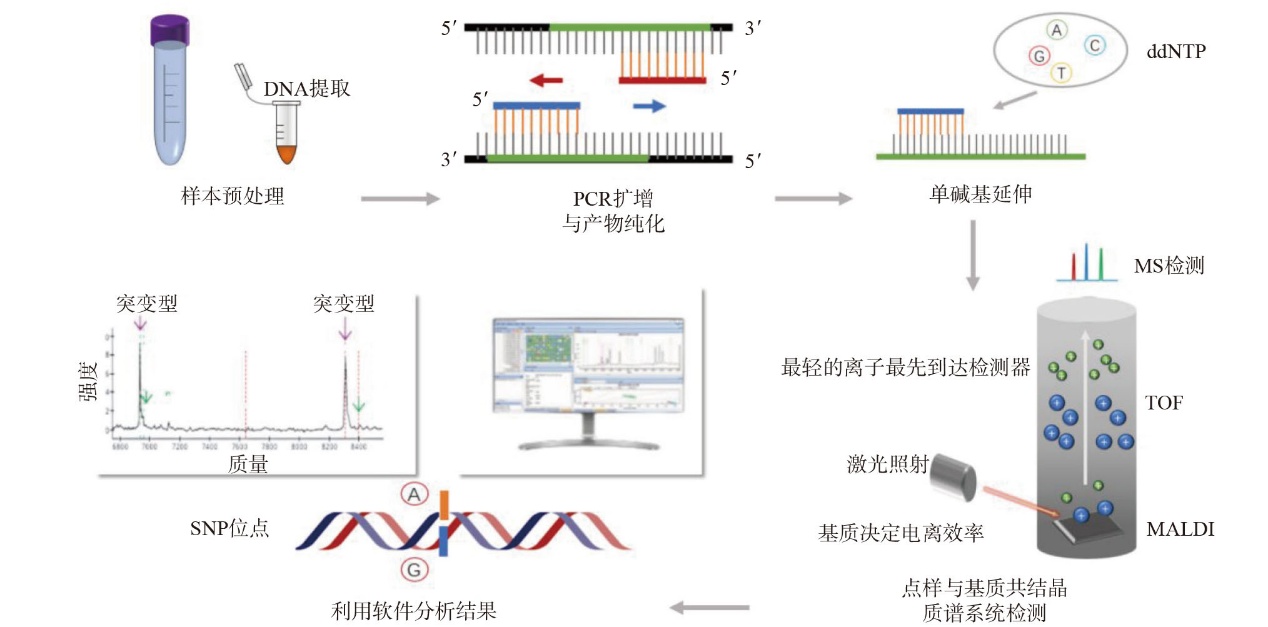
图1 MALDI-TOF MS原理和检测流程示意图
| 方法 | 靶点 | 样本类型 | 敏感性 | 特异性 | 检测成本 |
|---|---|---|---|---|---|
| MALDI-TOF MS[ | 多靶点(甲基化+SNP+ 突变) | 血液、粪便、组织 | 85%~92% (早期) | 90%~95% | 低(10~50元·样本-1) |
| 多靶点粪便DNA检测[ | KRAS突变+NDRG4/BMP3甲基化+血红蛋白 | 粪便 | 92% (晚期) | 87% | 中(约180美元·样本-1) |
| 实时荧光定量PCR[ | SEPT9甲基化 | 血液 | 73% | 80%~85% | 中(约10.4美元·样本-1) |
| 多靶点粪便FIT-DNA联合检测技术[ | 多甲基化标志物 | 粪便 | 92% | 88% | 高(57~224美元·样本-1) |
表1 结直肠癌常见筛查方法比较
| 方法 | 靶点 | 样本类型 | 敏感性 | 特异性 | 检测成本 |
|---|---|---|---|---|---|
| MALDI-TOF MS[ | 多靶点(甲基化+SNP+ 突变) | 血液、粪便、组织 | 85%~92% (早期) | 90%~95% | 低(10~50元·样本-1) |
| 多靶点粪便DNA检测[ | KRAS突变+NDRG4/BMP3甲基化+血红蛋白 | 粪便 | 92% (晚期) | 87% | 中(约180美元·样本-1) |
| 实时荧光定量PCR[ | SEPT9甲基化 | 血液 | 73% | 80%~85% | 中(约10.4美元·样本-1) |
| 多靶点粪便FIT-DNA联合检测技术[ | 多甲基化标志物 | 粪便 | 92% | 88% | 高(57~224美元·样本-1) |
| 文献 | 基因名称 | 类别 | 例数 | 样本类型 | 风险统计值 | 用途 | 临床意义 |
|---|---|---|---|---|---|---|---|
| WU等[ | lncRNA MIR155HG | SNP | 1 024例 | 外周血 | OR=1.32,95%CI为1.02~1.71,P=0.036 | 高风险评估 | 筛查 |
| LIU等[ | MMP2 | SNP | 1 326例 | 外周血 | OR=0.77,95%CI为0.60~0.98,P<0.05 | 低风险评估 | 筛查 |
| KIM等[ | PAUF | SNP | 831例 | 肿瘤组织 | OS:HR①=1.95,95%CI为1.42~2.67,P<0.000 1 DFS②:HR=1.59,95%CI为1.21~2.08,P<0.000 1 | 术后高风险评估 | 预后监测 |
| KIM等[ | TPST1 | SNP | 831例 | 肿瘤组织 | DFS:HR=2.65,95%CI为1.58~4.45,P=0.000 2 | 术后高风险评估 | 预后监测 |
| LI等[ | ADCY9 | SNP | 1 022例 | 外周血 | OR=3.54,95%CI为1.16~10.86,P=0.027 | 高风险评估 | 筛查 |
| CHEN等[ | PTGER4 | DNA甲基化 | 208例 | 肿瘤组织 | OS:HR=4.32,95%CI为1.80~10.50,P=0.007 | 术后高风险评估 | 预后监测 |
| CHEN等[ | ZNF43 | DNA甲基化 | 208例 | 肿瘤组织 | RFS:HR=2.33,95%CI为1.07~5.08,P<0.001 | 术后高风险评估 | 预后监测 |
| 文献 | 基因名称 | 类别 | 例数 | 样本类型 | 风险统计值 | 用途 | 临床意义 |
| LIN等[ | lncRNA DLX6-AS1 | DNA甲基化 | 433例 | 肿瘤组织 | OS:HR=1.64,95%CI为1.02~2.64,P=0.042 | 预测标志物 | 诊断、监测 |
| WU等[ | SMAD7 | SNP | 1 392例 | 外周血 | OR=1.31,95%CI为1.04~1.67,P=0.024 | 预测标志物 | 诊断、监测 |
| CEVIK等[ | PD-1/PDL-1 | SNP | 189例 | 外周血 | OR=0.068,95%CI为0.02~0.21,P<0.001 | 预后标志物 | 预后监测 |
| CHANG等[ | PRR相关基因 | SNP | 117例 | 肿瘤组织 | OS:HR=4.674,95%CI为1.42~16.04,P=0.011 | 预后标志物 | 预后监测 |
| CHEN等[ | ALOX5 | SNP | 300例 | 外周血 | OS:HR=3.32,95%CI为1.51~7.27,P=0.003 | 预测标志物 | 预后监测 |
| DOMINGUEZ-VALENTIN等[ | 致病性MMR相关基因 | SNP | 569例 | 外周血 | HR=1.49,95%CI为1.06~2.09,P=0.030 | 预测标志物 | 预测、诊断 |
表2 MALDI-TOF MS在结直肠癌核酸检测中的应用
| 文献 | 基因名称 | 类别 | 例数 | 样本类型 | 风险统计值 | 用途 | 临床意义 |
|---|---|---|---|---|---|---|---|
| WU等[ | lncRNA MIR155HG | SNP | 1 024例 | 外周血 | OR=1.32,95%CI为1.02~1.71,P=0.036 | 高风险评估 | 筛查 |
| LIU等[ | MMP2 | SNP | 1 326例 | 外周血 | OR=0.77,95%CI为0.60~0.98,P<0.05 | 低风险评估 | 筛查 |
| KIM等[ | PAUF | SNP | 831例 | 肿瘤组织 | OS:HR①=1.95,95%CI为1.42~2.67,P<0.000 1 DFS②:HR=1.59,95%CI为1.21~2.08,P<0.000 1 | 术后高风险评估 | 预后监测 |
| KIM等[ | TPST1 | SNP | 831例 | 肿瘤组织 | DFS:HR=2.65,95%CI为1.58~4.45,P=0.000 2 | 术后高风险评估 | 预后监测 |
| LI等[ | ADCY9 | SNP | 1 022例 | 外周血 | OR=3.54,95%CI为1.16~10.86,P=0.027 | 高风险评估 | 筛查 |
| CHEN等[ | PTGER4 | DNA甲基化 | 208例 | 肿瘤组织 | OS:HR=4.32,95%CI为1.80~10.50,P=0.007 | 术后高风险评估 | 预后监测 |
| CHEN等[ | ZNF43 | DNA甲基化 | 208例 | 肿瘤组织 | RFS:HR=2.33,95%CI为1.07~5.08,P<0.001 | 术后高风险评估 | 预后监测 |
| 文献 | 基因名称 | 类别 | 例数 | 样本类型 | 风险统计值 | 用途 | 临床意义 |
| LIN等[ | lncRNA DLX6-AS1 | DNA甲基化 | 433例 | 肿瘤组织 | OS:HR=1.64,95%CI为1.02~2.64,P=0.042 | 预测标志物 | 诊断、监测 |
| WU等[ | SMAD7 | SNP | 1 392例 | 外周血 | OR=1.31,95%CI为1.04~1.67,P=0.024 | 预测标志物 | 诊断、监测 |
| CEVIK等[ | PD-1/PDL-1 | SNP | 189例 | 外周血 | OR=0.068,95%CI为0.02~0.21,P<0.001 | 预后标志物 | 预后监测 |
| CHANG等[ | PRR相关基因 | SNP | 117例 | 肿瘤组织 | OS:HR=4.674,95%CI为1.42~16.04,P=0.011 | 预后标志物 | 预后监测 |
| CHEN等[ | ALOX5 | SNP | 300例 | 外周血 | OS:HR=3.32,95%CI为1.51~7.27,P=0.003 | 预测标志物 | 预后监测 |
| DOMINGUEZ-VALENTIN等[ | 致病性MMR相关基因 | SNP | 569例 | 外周血 | HR=1.49,95%CI为1.06~2.09,P=0.030 | 预测标志物 | 预测、诊断 |
| [1] | DUFFY M J, LAMERZ R, HAGLUND C, et al. Tumor markers in colorectal cancer,gastric cancer and gastrointestinal stromal cancers:European group on tumor markers 2014 guidelines update[J]. Int J Cancer, 2014, 134(11):2513-2522. |
| [2] | CHURCH T R, WANDELL M, LOFTON-DAY C, et al. Prospective evaluation of methylated SEPT9 in plasma for detection of asymptomatic colorectal cancer[J]. Gut, 2014, 63(2):317-325. |
| [3] | AMIN M B, GREENE F L, EDGE S B, et al. The eighth edition AJCC cancer staging manual:continuing to build a bridge from a population-based to a more "personalized" approach to cancer staging[J]. CA Cancer J Clin, 2017, 67(2):93-99. |
| [4] | 国家卫生健康委员会医政司, 中华医学会肿瘤学分会, 顾晋, 等. 中国结直肠癌诊疗规范(2023版)[J]. 消化肿瘤杂志, 2023,15(3):177-206. |
| [5] | WU J, LI G, WANG Z, et al. Circulating microRNA-21 is a potential diagnostic biomarker in gastric cancer[J]. Dis Markers, 2015, 2015:435656. |
| [6] | LECHNER A, WOLFF P, LEIZE-WAGNER E, et al. Characterization of post-transcriptional RNA modifications by sheathless capillary electrophoresis-high resolution mass spectrometry[J]. Anal Chem, 2020, 92(10):7363-7370. |
| [7] | 刘倩倩, 王春玥, 宋晨曦, 等. 基于超高效液相色谱-飞行时间质谱联用的冠心病非靶向代谢组学分析及代谢标记物的探索[J]. 中国循环杂志, 2019, 34(8):752-756. |
| [8] | 韩仁杰, 吴传城, 刘宝英, 等. SNP芯片联合飞行时间质谱筛检胃癌差异的消化道肿瘤相关基因3'UTR区SNPs的病例对照研究[C]//2018环境与健康学术会议——精准环境健康:跨学科合作的挑战论文汇编. 沈阳: 中国环境科学学会环境医学与健康分会,2018:237-238. |
| [9] | 黄盛文, 许吟, 吴娴, 等. 基质辅助激光解吸电离飞行时间质谱技术在新生儿β-地中海贫血筛查中的应用[J]. 临床检验杂志, 2015, 33(5):341-343. |
| [10] | 段薇. 串联质谱在新生儿遗传性代谢疾病筛查中的应用[J]. 中华检验医学杂志, 2007, 30(7):816-817. |
| [11] | NORDHOFF E, LUEBBERT C, THIELE G, et al. Rapid determination of short DNA sequences by the use of MALDI-MS[J]. Nucleic Acids Res, 2000, 28(20):E86. |
| [12] | JURINKE C, VAN DEN BOOM D, CANTOR C R, et al. The use of MassARRAY technology for high throughput genotyping[J]. Adv Biochem Eng Biotechnol, 2002, 77:57-74. |
| [13] | BERKENKAMP S, KIRPEKAR F, HILLENKAMP F. Infrared MALDI mass spectrometry of large nucleic acids[J]. Science, 1998, 281(5374):260-262. |
| [14] | SHAHGHOLI M, GARCIA B A, CHIU N H, et al. Sugar additives for MALDI matrices improve signal allowing the smallest nucleotide change (A:T) in a DNA sequence to be resolved[J]. Nucleic Acids Res, 2001, 29(19):E91. |
| [15] | ASARA J M, ALLISON J. Enhanced detection of oligonucleotides in UV MALDI MS using the tetraamine spermine as a matrix additive[J]. Anal Chem, 1999, 71(14):2866-2870. |
| [16] | 吴昕哲, 茆海丰, 杨晋, 等. MALDI-TOF MS直接靶板微滴生长测定法在CRKP快速检测中的应用[J]. 检验医学, 2024, 39(6):587-591. |
| [17] | GARRITSEN H S, FAN A X, BOSSE N, et al. Matrix-assisted laser desorption/ionization time-of-flight mass spectrometry for genotyping of human platelet-specific antigens[J]. Transfusion, 2009, 49(2):252-258. |
| [18] | 黄伟伦. 基于MALDI-TOF质谱的α-/β-地中海贫血基因快速分型[D]. 广州: 南方医科大学, 2023. |
| [19] | JIN W, YANG Z, TANG X, et al. Simultaneous quantification of SMN1 and SMN2 copy numbers by MALDI-TOF mass spectrometry for spinal muscular atrophy genetic testing[J]. Clin Chim Acta, 2022, 532:45-52. |
| [20] | HARIDAN U S, MOKHTAR U, MACHADO L R, et al. A comparison of assays for accurate copy number measurement of the low-affinity Fc gamma receptor genes FCGR3A and FCGR3B[J]. PLoS One, 2015, 10(1):e0116791. |
| [21] | CARVALHO HENRIQUES B, BUCHNER A, HU X, et al. Methodology for clinical genotyping of CYP2D6 and CYP2C19[J]. Transl Psychiatry, 2021, 11(1):596. |
| [22] | BOYLE J, STOCK C J. CYP2D6 expression in veterans experiencing opioid overdose:a postmortem review[J]. Pharmgenomics Pers Med, 2020, 13:289-293. |
| [23] | SCOTT S A, SCOTT E R, SEKI Y, et al. Development and analytical validation of a 29 gene clinical pharmacogenetic genotyping panel:multi-ethnic allele and copy number variant detection[J]. Clin Transl Sci, 2021, 14(1):204-213. |
| [24] | HERZOG J S, CHAVARRI-GUERRA Y, CASTILLO D, et al. Genetic epidemiology of BRCA1- and BRCA2-associated cancer across Latin America[J]. NPJ Breast Cancer, 2021, 7(1):107. |
| [25] | 尹俊发, 陈少坤, 张宁, 等. 核酸快速酶切及DNA损伤分析的色谱-质谱新方法研究[C]//中国化学会第22届全国色谱学术报告会及仪器展览会论文集(第一卷). 北京: 中国化学会,2019:160-161. |
| [26] | CLAUS R, WILOP S, HIELSCHER T, et al. A systematic comparison of quantitative high-resolution DNA methylation analysis and methylation-specific PCR[J]. Epigenetics, 2012, 7(7):772-780. |
| [27] | HO V, ASHBURY J E, TAYLOR S, et al. Quantification of gene-specific methylation of DNMT3B and MTHFR using sequenom EpiTYPER®[J]. Data Brief, 2015, 6:39-46. |
| [28] | WETZEL A, SCHOLTKA B, SCHUMACHER F, et al. Epigenetic DNA methylation of EBI3 modulates human interleukin-35 formation via NFkB signaling:a promising therapeutic option in ulcerative colitis[J]. Int J Mol Sci, 2021, 22(10):5329. |
| [29] | MOSKO M J, NAKORCHEVSKY A A, FLORES E, et al. Ultrasensitive detection of multiplexed somatic mutations using MALDI-TOF mass spectrometry[J]. J Mol Diagn, 2016, 18(1):23-31. |
| [30] | LAMY P J, VAN DER LEEST P, LOZANO N, et al. Mass spectrometry as a highly sensitive method for specific circulating tumor DNA analysis in NSCLC:a comparison study[J]. Cancers (Basel), 2020, 12(10):3002. |
| [31] | BOYSEN A K, PALLISGAARD N, ANDERSEN C S A, et al. Circulating tumor DNA as a marker of minimal residual disease following local treatment of metastases from colorectal cancer[J]. Acta Oncol, 2020, 59(12):1424-1429. |
| [32] | KRIEGSMANN M, ARENS N, ENDRIS V, et al. Detection of KRAS,NRAS and BRAF by mass spectrometry-a sensitive,reliable,fast and cost-effective technique[J]. Diagn Pathol, 2015, 10:132. |
| [33] | LADABAUM U, MANNALITHARA A, WENG Y, et al. Comparative effectiveness and cost-effectiveness of colorectal cancer screening with blood-based biomarkers (liquid biopsy) vs fecal tests or colonoscopy[J]. Gastroenterology, 2024, 167(2):378-391. |
| [34] | ØRNTOFT M B, NIELSEN H J, ØRNTOFT T F, et al. Performance of the colorectal cancer screening marker Sept9 is influenced by age,diabetes and arthritis:a nested case-control study[J]. BMC Cancer, 2015, 15:819. |
| [35] | XU H, CHEN H, HU J, et al. Feasibility of quantification based on novel evaluation with stool DNA and fecal immunochemical test for colorectal cancer detection[J]. BMC Gastroenterol, 2022, 22(1):384. |
| [36] | DOMINGUEZ-VALENTIN M, HAUPT S, SEPPÄLÄ T T, et al. Mortality by age,gene and gender in carriers of pathogenic mismatch repair gene variants receiving surveillance for early cancer diagnosis and treatment:a report from the prospective Lynch syndrome database[J]. EClinicalMedicine, 2023, 58:101909. |
| [37] | LAVACCHI D, FANCELLI S, ROVIELLO G, et al. Mutations matter:an observational study of the prognostic and predictive value of KRAS mutations in metastatic colorectal cancer[J]. Front Oncol, 2022, 12:1055019. |
| [38] | LIN S, GU S, QIAN S, et al. Genome-wide methylation profiling of lncRNAs reveals a novel progression-related and prognostic marker for colorectal cancer[J]. Front Oncol, 2022, 11:782077. |
| [39] | XIE R, YANG X, HE W, et al. LAMP-MS for locus-specific visual quantification of DNA 5 mC and RNA m6A using ultra-low input[J]. Angew Chem Int Ed Engl, 2025, 64(1):e202413872. |
| [40] | CREMOLINI C, DI BARTOLOMEO M, AMATU A, et al. BRAF codons 594 and 596 mutations identify a new molecular subtype of metastatic colorectal cancer at favorable prognosis[J]. Ann Oncol, 2015, 26(10):2092-2097. |
| [41] | SHIN S J, CHUN S M, KIM T I, et al. Feasibility of multiplexed gene mutation detection in plasma samples of colorectal cancer patients by mass spectrometric genotyping[J]. PLoS One, 2017, 12(5):e0176340. |
| [42] | TSAI H L, LIN C C, SUNG Y C, et al. The emergence of RAS mutations in patients with RAS wild-type mCRC receiving cetuximab as first-line treatment:a noninterventional,uncontrolled multicenter study[J]. Br J Cancer, 2023, 129(6):947-955. |
| [43] | TAT M, HEIAT M, KARBASI A, et al. Methylation of SEPT9 and LINC00473 genes in circulating cell-free DNA as a potential biomarker for the early detection of colorectal polyps[J]. Adv Biomed Res, 2025, 14:62. |
| [44] | WU Y, TONG Y, ZHANG H, et al. A novel dual-target Septin9 methylation assay for improved detection of early-stage colorectal cancer and high-grade intraepithelial neoplasia[J]. BMC Cancer, 2024, 24(1):916. |
| [45] | LU D C, ZHANG Q F, LI L, et al. Methylated Septin9 has moderate diagnostic value in colorectal cancer detection in Chinese population:a multicenter study[J]. BMC Gastroenterol, 2022, 22(1):232. |
| [46] | HE Y, LIU X Y, GONG R, et al. NK homeobox 2.2 functions as tumor suppressor in colorectal cancer due to DNA methylation[J]. J Cancer, 2020, 11(16):4791-4800. |
| [47] | CLEYLE J, HARDY M P, MINATI R, et al. Immunopeptidomic analyses of colorectal cancers with and without microsatellite instability[J]. Mol Cell Proteomics, 2022, 21(5):100228. |
| [48] | WU Y, XU J, TAN B, et al. SMAD7 gene polymorphisms and their influence on patients with colorectal cancer[J]. Cell Cycle, 2023, 22(21-22):2424-2435. |
| [49] | WEN R, ZHOU L, JIANG S, et al. DSTN hypomethylation promotes radiotherapy resistance of rectal cancer by activating the Wnt/β-Catenin signaling pathway[J]. Int J Radiat Oncol Biol Phys, 2023, 117(1):198-210. |
| [50] | LI D, WANG Y, DONG C, et al. CST1 inhibits ferroptosis and promotes gastric cancer metastasis by regulating GPX4 protein stability via OTUB1[J]. Oncogene, 2023, 42(2):83-98. |
| [51] | LIN C C, LIN J K, LIN T C, et al. The prognostic role of microsatellite instability,codon-specific KRAS,and BRAF mutations in colon cancer[J]. J Surg Oncol, 2014, 110(4):451-457. |
| [52] | BUTTERWORTH A S, HIGGINS J P, PHAROAH P. Relative and absolute risk of colorectal cancer for individuals with a family history:a meta-analysis[J]. Eur J Cancer, 2006, 42(2):216-227. |
| [53] | GARGALLO-PUYELO C J, LANAS Á, CARRERA-LASFUENTES P, et al. Familial colorectal cancer and genetic susceptibility:colorectal risk variants in first-degree relatives of patients with colorectal cancer[J]. Clin Transl Gastroenterol, 2021, 12(2):e00301. |
| [54] | WIN A K, DOWTY J G, CLEARY S P, et al. Risk of colorectal cancer for carriers of mutations in MUTYH,with and without a family history of cancer[J]. Gastroenterology, 2014, 146(5):1208-1211.e1-5. |
| [55] | LUO C Y, ZHANG Y H, LU M, et al. Research on applying genetic and environmental risk score in risk-adapted colorectal cancer screening[J]. Zhonghua Liu Xing Bing Xue Za Zhi, 2023, 44(6):999-1005. |
| [56] | CHEN C Y, WU J J, LIN Y J, et al. Significance of hypermethylation of tumor-suppressor genes PTGER4 and ZNF43 at CpG sites in the prognosis of colorectal cancer[J]. Int J Mol Sci, 2022, 23(18):10225. |
| [57] | MUTHUSAMI S, RAMACHANDRAN I K, BABU K N, et al. Role of inflammation in the development of colorectal cancer[J]. Endocr Metab Immune Disord Drug Targets, 2021, 21(1):77-90. |
| [58] | TAKAHASHI S, OKAMOTO K, TANAHASHI T, et al. S100P expression via DNA hypomethylation promotes cell growth in the sessile serrated adenoma/polyp-cancer sequence[J]. Digestion, 2021, 102(5):789-802. |
| [59] | ZHU L, ZHENG Y, WU T, et al. Immune-related genes STIM1,ITPKC and PELI1 polymorphisms are associated with risk of colorectal cancer[J]. Eur J Cancer Prev, 2021, 30(5):357-363. |
| [60] | CEVIK M, NAMAL E, DINC-SENER N, et al. Investigation of vascular endothelial growth factor polymorphisms on risk,metastasis,laterality,and prognosis of colorectal cancer in Turkish subjects[J]. Genet Test Mol Biomarkers, 2022, 26(5):298-306. |
| [61] | BYKANOVA M A, SOLODILOVA M A, AZAROVA I E, et al. Genetic variation at the catalytic subunit of glutamate cysteine ligase contributes to the susceptibility to sporadic colorectal cancer:a pilot study[J]. Mol Biol Rep, 2022, 49(7):6145-6154. |
| [62] | CHEN X, MAO D, LI D, et al. Identification and validation of a PD-L1-related signature from mass spectrometry in gastric cancer[J]. J Cancer Res Clin Oncol, 2023, 149(9):5871-5884. |
| [63] | FELIU J, GÁMEZ-POZO A, MARTÍNEZ-PÉREZ D, et al. Functional proteomics of colon cancer consensus molecular subtypes[J]. Br J Cancer, 2024, 130(10):1670-1678. |
| [64] | CHANG C L, HUANG K C, CHEN T W, et al. Impact of pattern recognition receptors on the prognosis of chemotherapy-treated rectal cancer patients[J]. In Vivo, 2023, 37(4):1552-1561. |
| [65] | WU H, HE G, HAN H, et al. Analysis of MIR155HG variants and colorectal cancer susceptibility in Han Chinese population[J]. Mol Genet Genomic Med, 2019, 7(8):e778. |
| [66] | ZHAN X, BAI F, LIN S, et al. C5orf66 rs4976270/rs639933 are associated with colorectal cancer risk in Southern Chinese Han population:a case-control study[J]. Digestion, 2022, 103(2):103-115. |
| [67] | KIM J G, CHAE Y S, LEE S J, et al. Genetic variation in microRNA-binding site and prognosis of patients with colorectal cancer[J]. J Cancer Res Clin Oncol, 2015, 141(1):35-41. |
| [68] | GARGALLO-PUYELO C J, AZNAR-GIMENO R, CARRERA-LASFUENTES P, et al. Predictive value of genetic risk scores in the development of colorectal adenomas[J]. Dig Dis Sci, 2022, 67(8):4049-4058. |
| [69] | SHARMA B, ANGURANA S, BHAT A, et al. Genetic analysis of colorectal carcinoma using high throughput single nucleotide polymorphism genotyping technique within the population of Jammu and Kashmir[J]. Mol Biol Rep, 2021, 48(8):5889-5895. |
| [70] | LIU X, YANG K, LI Z, et al. MMP2 polymorphisms and colorectal cancer susceptibility in a Chinese Han population[J]. Int J Gen Med, 2022, 15:6009-6019. |
| [71] | LI H, LIU Y, LIU J, et al. Assessment of ADCY9 polymorphisms and colorectal cancer risk in the Chinese Han population[J]. J Gene Med, 2021, 23(2):e3298. |
| [72] | CEVIK M, NAMAL E, INER-KOKSAL U, et al. Association of PD-1 and PDL-1 gene polymorphisms with colorectal cancer risk and prognosis[J]. Mol Biol Rep, 2022, 49(3):1827-1836. |
| [73] | CHEN H, YIN L, YANG J, et al. Genetic polymorphisms in genes regulating cell death and prognosis of patients with rectal cancer receiving postoperative chemoradiotherapy[J]. Cancer Biol Med, 2023, 20(4):297-316. |
| [1] | 翁文浩. 结直肠癌实验室诊断技术迭代:从早筛优化到MRD精准监测[J]. 检验医学, 2026, 41(4): 309-317. |
| [2] | 吕文航, 姚懿雯, 孙祖俊, 杨滇宇. 基于MHR构建的列线图模型对结直肠癌的诊断价值[J]. 检验医学, 2026, 41(4): 326-330. |
| [3] | 燕静, 董魁, 吴洁, 刘海涛. 血清sB7-H3、gp73及TAT-2联合检测在结直肠癌和管状腺瘤鉴别诊断中的价值[J]. 检验医学, 2026, 41(4): 331-336. |
| [4] | 曹传扬, 强光辉, 于宽勇. 结直肠癌患者术后化疗期FZD6 mRNA表达动态变化及对预后的预测价值[J]. 检验医学, 2026, 41(4): 337-345. |
| [5] | 陈学飞, 黄娟, 任圣洁, 闵向阳, 徐子真. 跨膜蛋白205对结直肠癌患者预后作用的研究[J]. 检验医学, 2026, 41(4): 346-354. |
| [6] | 胥俊越, 赵亚虹, 王梦阳, 张莎娜, 李奕, 贾淑静, 王志华, 郭为为, 蔡月, 曹司. 粪便SDC2甲基化联合m3基因检测在结直肠癌诊断中的临床价值[J]. 检验医学, 2026, 41(4): 355-361. |
| [7] | 傅婉玉, 肖珊珊, 江矞颖, 李燕青. 胎儿12号染色体拷贝数变异的遗传学分析和妊娠结局随访[J]. 检验医学, 2026, 41(2): 118-125. |
| [8] | 黄仁, 施卫忠, 卢仁泉, 郭林, 王砚春. Septin9基因甲基化和SDC2基因甲基化联合检测辅助诊断结直肠癌[J]. 检验医学, 2025, 40(6): 519-524. |
| [9] | 吴亚洲, 李汉华, 孟磊俊, 陈学飞, 孙钰涵, 翁文浩, 郑冰. 具核梭杆菌通过lncRNA XIST促进结直肠癌细胞化疗药物抵抗[J]. 检验医学, 2025, 40(5): 428-436. |
| [10] | 余佳杰, 张智智, 罗清琼, 柯星. 基于多种血清肿瘤标志物的深度学习模型用于评估早期结直肠肿瘤患病风险[J]. 检验医学, 2025, 40(3): 253-258. |
| [11] | 靳春雷, 胡辉, 刘姣, 杨慕枫, 单群达, 陈鹏龙. 单核苷酸多态性微阵列分析技术在不同产前诊断指征孕妇中的应用价值[J]. 检验医学, 2024, 39(9): 841-846. |
| [12] | 修宁宁, 邓沛汶, 潘俊均, 卢玉玲. 紫红红球菌致血流感染1例报道[J]. 检验医学, 2024, 39(8): 820-822. |
| [13] | 李莎, 陶卫群, 黄婵, 陈远华, 蓝文静, 林淑兴. ADORA2A基因多态性与精神分裂症患者攻击行为的相关性[J]. 检验医学, 2024, 39(6): 548-556. |
| [14] | 吴昕哲, 茆海丰, 杨晋, 左春磊, 金丹婷. MALDI-TOF MS直接靶板微滴生长测定法在CRKP快速检测中的应用[J]. 检验医学, 2024, 39(6): 587-591. |
| [15] | 郑慧, 陈颖秀, 叶绿茵, 卢仁泉, 郭林. 结直肠癌患者外周血T淋巴细胞亚群与肿瘤进展的关系[J]. 检验医学, 2024, 39(4): 330-335. |
| 阅读次数 | ||||||
|
全文 |
|
|||||
|
摘要 |
|
|||||

