检验医学 ›› 2026, Vol. 41 ›› Issue (1): 28-33.DOI: 10.3969/j.issn.1673-8640.2026.01.005

• 论著 • 上一篇    下一篇

柳州地区2 002例男性不育患者Y染色体AZF基因微缺失分析

钟鑫1, 陈丽竹2, 袁德健2, 覃宋强2, 黄钧3, 黄诚3, 张玲2, 谢莉2, 韦小妮2, 钟青燕3, 唐宁1()   

  1. 1.广州市妇女儿童医疗中心柳州医院综合实验中心,广西 柳州 545001
    2.广州市妇女儿童医疗中心柳州医院医学遗传科,广西 柳州 545001
    3.柳州市妇幼保健院(广西妇产疾病临床医学研究中心)医学遗传科 柳州市地中海贫血精准防治重点实验室,广西 柳州 545000
  • 收稿日期:2024-09-04 修回日期:2025-03-03 出版日期:2026-01-30 发布日期:2026-01-30
  • 通讯作者: 唐宁
  • 作者简介:唐 宁,E-mail:tn825@126.com
    钟 鑫,男,1994年生,学士,主管技师,主要从事医学遗传学和分子诊断相关工作;
    陈丽竹,女,1992年生,硕士,主管技师,主要从事医学遗传学和分子诊断相关工作。第一联系人:

    钟鑫和陈丽竹对本研究具有同等贡献,并列为第一作者。

  • 基金资助:
    国家自然科学基金项目(82460332);国家自然科学基金项目(82060284);广西壮族自治区自然科学基金项目(2020GXNSFBA297155);广西壮族自治区卫生健康委员会自筹经费科研课题(Z20190789)

Analysis of Y chromosome AZF gene microdeletions in 2 002 male infertile patients from Liuzhou

ZHONG Xin1, CHEN Lizhu2, YUAN Dejian2, QIN Songqiang2, HUANG Jun3, HUANG Cheng3, ZHANG Ling2, XIE Li2, WEI Xiaoni2, ZHONG Qingyan3, TANG Ning1()   

  1. 1. Comprehensive Laboratory Center,Liuzhou Hospital of Guangzhou Women and Children's Medical Center,Liuzhou 545001,Guangxi,China
    2. Department of Medical Genetics,Liuzhou Hospital of Guangzhou Women and Children's Medical Center,Liuzhou 545001,Guangxi,China
    3. Department of Medical Genetics,Liuzhou Maternal and Child Health Care Hospital,Guangxi Clinical Research Center for Obstetric and Gynecologic Diseases,Liuzhou Key Laboratory for Precision Prevention and Control of Thalassemia,Liuzhou 545000,Guangxi,China
  • Received:2024-09-04 Revised:2025-03-03 Online:2026-01-30 Published:2026-01-30
  • Contact: TANG Ning

摘要:

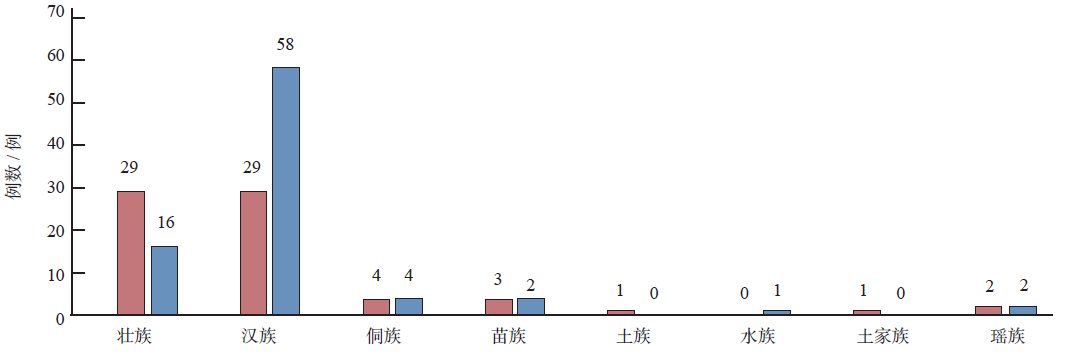
目的 分析柳州地区男性不育患者Y染色体无精子因子(AZF)基因微缺失类型特征,为临床诊疗相关疾病提供参考。方法 选取2018年4月—2023年6月柳州市妇幼保健院和广州市妇女儿童医疗中心柳州医院原发性男性不育患者2 002例,进行Y染色体AZF基因微缺失检测、染色体核型分析、精液常规检测和精子DNA碎片率检测。结果 共检出Y染色体AZF基因微缺失152例(7.59%),其中基础位点缺失69例、扩展位点缺失83例。152例Y染色体AZF基因微缺失患者中,壮族45例(基础位点缺失29例、扩展位点缺失16例)、汉族87例(基础位点缺失29例、扩展位点缺失58例)、其他民族20例(基础位点缺失11例、扩展位点缺失9例)。有12例Y染色体AZF基因扩展位点缺失的患者精液常规检测结果正常。1 762例行染色体核型分析的患者中,仅检出32例(1.82%)Y染色体异常,其中13例检出Y染色体AZF基因微缺失。875例行精子DNA碎片率检测的患者中,有244例精子碎片率>30%,其中21例(8.61%)检出Y染色体微缺失;有631例精子碎片率<30%,其中32例(5.07%)检出Y染色体微缺失。结论 AZF基因微缺失检测可提高男性异常Y染色体的检出率,但无法确定男性不育的病因,建议采用多种检测方法进行辅助诊断。

关键词: 无精子因子基因, Y染色体, 核型分析, 精子DNA碎片, 不育

Abstract:

Objective To investigate the characteristics of Y chromosome azoospermia factor (AZF) gene microdeletions in male infertile patients in Liuzhou,and to provide a reference for clinical diagnosis and treatment. Methods A total of 2 002 male infertile patients at Liuzhou Maternal and Child Health Care Hospital and Liuzhou Hospital of Guangzhou Women and Children's Medical Center from April 2018 to June 2023 were enrolled. Y chromosome AZF gene microdeletions,karyotype analysis,semen routine examination and sperm DNA fragmentation rate determination were performed. Results Totally,152 cases(7.59%)were determined with Y chromosome AZF gene microdeletions,including 69 cases of basic site deletions and 83 cases of extended site deletions. Among the 152 patients with Y chromosome AZF gene microdeletions,45 cases were of the Zhuang ethnicity(29 cases of basic site deletions and 16 cases of extended site deletions),87 cases were of the Han ethnicity(29 cases of basic site deletions and 58 cases of extended site deletions)and 20 cases were of other ethnicities(11 cases of basic site deletions and 9 cases of extended site deletions). Among the 12 patients with Y chromosome AZF gene extended site deletions,the semen routine examination results were normal. Among the 1 762 patients who underwent karyotype analysis,only 32 cases(1.82%)had Y chromosome abnormalities,and 13 cases were positive for Y chromosome AZF gene microdeletions. Among the 875 patients who underwent sperm fragmentation rate determination,244 patients had sperm fragmentation rates >30%,and 21 cases(8.61%)were determined with Y chromosome microdeletions. Totally,631 patients had sperm fragmentation rate <30%,and 32 cases (5.07%) were determined with Y chromosome microdeletions. Conclusions AZF gene microdeletion determination can increase the determination rate of abnormal Y chromosomes in males,but it can not determine the cause of male infertility. Multiple determination methods should be used for auxiliary diagnosis.

Key words: Azoospermia factor gene, Y chromosome, Karyotype analysis, Sperm DNA fragmentation, Infertility, Male

中图分类号: