
Laboratory Medicine ›› 2026, Vol. 41 ›› Issue (8): 737-743.DOI: 10.3969/j.issn.1673-8640.2026.08.003
Previous Articles Next Articles
CHEN Yun1, HU Lijie2, WANG Tingting3, YE Shengqian1
Received:2025-05-26
Revised:2026-01-30
Online:2026-08-30
Published:2026-08-24
CLC Number:
CHEN Yun, HU Lijie, WANG Tingting, YE Shengqian. Relationship between serum PRDX1 and TSG-6 levels in children with refractory Mycoplasmal pneumoniae pneumonia and the disease condition and prognosis[J]. Laboratory Medicine, 2026, 41(8): 737-743.
Add to citation manager EndNote|Ris|BibTeX
URL: https://www.shjyyx.com/EN/10.3969/j.issn.1673-8640.2026.08.003
| 组别 | 例数 | 性别 | 年龄/岁 | BMI/ (kg·m-2) | |
|---|---|---|---|---|---|
| 男/例 | 女/例 | ||||
| 正常对照组 | 105 | 52 | 53 | 6.05±0.78 | 18.63±2.74 |
| GMPP组 | 100 | 49 | 51 | 6.11±0.64 | 18.41±3.07 |
| RMPP组 | 103 | 55 | 48 | 6.24±1.27 | 18.25±3.86 |
| 统计值 | 0.473 | 1.111 | 0.357 | ||
| P值 | 0.789 | 0.330 | 0.700 | ||
| 组别 | 例数 | 性别 | 年龄/岁 | BMI/ (kg·m-2) | |
|---|---|---|---|---|---|
| 男/例 | 女/例 | ||||
| 正常对照组 | 105 | 52 | 53 | 6.05±0.78 | 18.63±2.74 |
| GMPP组 | 100 | 49 | 51 | 6.11±0.64 | 18.41±3.07 |
| RMPP组 | 103 | 55 | 48 | 6.24±1.27 | 18.25±3.86 |
| 统计值 | 0.473 | 1.111 | 0.357 | ||
| P值 | 0.789 | 0.330 | 0.700 | ||
| 组别 | 例数 | PRDX1/(ng·mL-1) | TSG-6/(ng·mL-1) |
|---|---|---|---|
| 正常对照组 | 105 | 6.15±1.07 | 0.48±0.07 |
| GMPP组 | 100 | 7.73±1.08* | 0.72±0.11* |
| RMPP组 | 103 | 9.84±2.43*# | 1.65±0.38*# |
| 统计值 | 129.768 | 732.557 | |
| P值 | <0.001 | <0.001 |
| 组别 | 例数 | PRDX1/(ng·mL-1) | TSG-6/(ng·mL-1) |
|---|---|---|---|
| 正常对照组 | 105 | 6.15±1.07 | 0.48±0.07 |
| GMPP组 | 100 | 7.73±1.08* | 0.72±0.11* |
| RMPP组 | 103 | 9.84±2.43*# | 1.65±0.38*# |
| 统计值 | 129.768 | 732.557 | |
| P值 | <0.001 | <0.001 |
| 组别 | 例数 | 性别 | 年龄/岁 | BMI/(kg·m-2) | 发病至入院时间/d | 居住环境 | |||||
|---|---|---|---|---|---|---|---|---|---|---|---|
| 男/[例(%)] | 女/[例(%)] | 乡镇/[例(%)] | 城市/[例(%)] | ||||||||
| 轻症组 | 59 | 32(54.24) | 27(45.76) | 6.18±0.75 | 18.17±1.95 | 2.25±0.34 | 24(40.68) | 35(59.32) | |||
| 重症组 | 44 | 23(52.27) | 21(47.73) | 6.32±0.79 | 18.36±2.03 | 2.37±0.39 | 20(45.45) | 24(54.55) | |||
| 统计值 | 0.039 | 0.909 | 0.478 | 1.630 | 0.235 | ||||||
| P值 | 0.843 | 0.366 | 0.634 | 0.106 | 0.628 | ||||||
| 组别 | 早产儿/ [例(%)] | 先天性气道发育异常/[例(%)] | 病变范围 | 病变类型 | PRDX1/(ng·mL-1) | TSG-6/(ng·mL-1) | |||||
| 单肺叶/ [例(%)] | ≥2个肺叶/[例(%)] | 大片状阴影/[例(%)] | 云絮状或斑片状阴影/[例(%)] | ||||||||
| 轻症组 | 8(13.56) | 4(6.78) | 34(57.63) | 25(42.37) | 30(50.85) | 29(49.15) | 8.79±1.04 | 1.51±0.17 | |||
| 重症组 | 5(11.36) | 2(4.55) | 9(20.45) | 35(79.55) | 34(77.27) | 10(22.73) | 11.25±1.36 | 1.86±0.21 | |||
| 统计值 | 0.110 | 0.003 | 14.321 | 7.481 | 10.009 | 9.058 | |||||
| P值 | 0.740 | 0.957 | <0.001 | 0.006 | <0.001 | <0.001 | |||||
| 组别 | 例数 | 性别 | 年龄/岁 | BMI/(kg·m-2) | 发病至入院时间/d | 居住环境 | |||||
|---|---|---|---|---|---|---|---|---|---|---|---|
| 男/[例(%)] | 女/[例(%)] | 乡镇/[例(%)] | 城市/[例(%)] | ||||||||
| 轻症组 | 59 | 32(54.24) | 27(45.76) | 6.18±0.75 | 18.17±1.95 | 2.25±0.34 | 24(40.68) | 35(59.32) | |||
| 重症组 | 44 | 23(52.27) | 21(47.73) | 6.32±0.79 | 18.36±2.03 | 2.37±0.39 | 20(45.45) | 24(54.55) | |||
| 统计值 | 0.039 | 0.909 | 0.478 | 1.630 | 0.235 | ||||||
| P值 | 0.843 | 0.366 | 0.634 | 0.106 | 0.628 | ||||||
| 组别 | 早产儿/ [例(%)] | 先天性气道发育异常/[例(%)] | 病变范围 | 病变类型 | PRDX1/(ng·mL-1) | TSG-6/(ng·mL-1) | |||||
| 单肺叶/ [例(%)] | ≥2个肺叶/[例(%)] | 大片状阴影/[例(%)] | 云絮状或斑片状阴影/[例(%)] | ||||||||
| 轻症组 | 8(13.56) | 4(6.78) | 34(57.63) | 25(42.37) | 30(50.85) | 29(49.15) | 8.79±1.04 | 1.51±0.17 | |||
| 重症组 | 5(11.36) | 2(4.55) | 9(20.45) | 35(79.55) | 34(77.27) | 10(22.73) | 11.25±1.36 | 1.86±0.21 | |||
| 统计值 | 0.110 | 0.003 | 14.321 | 7.481 | 10.009 | 9.058 | |||||
| P值 | 0.740 | 0.957 | <0.001 | 0.006 | <0.001 | <0.001 | |||||
| 组别 | 例数 | 性别 | 年龄/岁 | BMI/(kg·m-2) | 发病至入院时间/d | 居住环境 | |||||
|---|---|---|---|---|---|---|---|---|---|---|---|
| 男/[例(%)] | 女/[例(%)] | 乡镇/[例(%)] | 城市/[例(%)] | ||||||||
| 预后良好组 | 68 | 36(52.94) | 32(47.06) | 6.17±0.73 | 18.15±1.98 | 2.31±0.32 | 32(47.06) | 36(52.94) | |||
| 预后不良组 | 35 | 19(54.29) | 16(45.71) | 6.37±0.72 | 18.45±2.14 | 2.28±0.37 | 12(34.29) | 23(65.71) | |||
| 统计值 | 0.017 | 1.329 | 0.69 | 0.407 | 1.541 | ||||||
| P值 | 0.897 | 0.187 | 0.491 | 0.685 | 0.215 | ||||||
| 组别 | 早产儿/ [例(%)] | 先天性气道发育异常/[例(%)] | 病变范围 | 病变类型 | PRDX1/(ng·mL-1) | TSG-6/(ng·mL-1) | |||||
| 单肺叶/ [例(%)] | ≥2个肺叶/[例(%)] | 大片状阴影/[例(%)] | 云絮状或斑片状阴影/[例(%)] | ||||||||
| 预后良好组 | 9(13.24) | 4(5.88) | 39(57.35) | 29(42.65) | 36(52.94) | 32(47.06) | 9.21±1.12 | 1.55±0.19 | |||
| 预后不良组 | 4(11.43) | 2(5.71) | 4(11.43) | 31(88.57) | 28(80.00) | 7(20.00) | 11.06±1.31 | 1.87±0.23 | |||
| 统计值 | 0.003 | 0.168 | 18.195 | 7.191 | 7.118 | 7.077 | |||||
| P值 | 0.795 | 0.682 | <0.001 | 0.007 | <0.001 | <0.001 | |||||
| 组别 | 例数 | 性别 | 年龄/岁 | BMI/(kg·m-2) | 发病至入院时间/d | 居住环境 | |||||
|---|---|---|---|---|---|---|---|---|---|---|---|
| 男/[例(%)] | 女/[例(%)] | 乡镇/[例(%)] | 城市/[例(%)] | ||||||||
| 预后良好组 | 68 | 36(52.94) | 32(47.06) | 6.17±0.73 | 18.15±1.98 | 2.31±0.32 | 32(47.06) | 36(52.94) | |||
| 预后不良组 | 35 | 19(54.29) | 16(45.71) | 6.37±0.72 | 18.45±2.14 | 2.28±0.37 | 12(34.29) | 23(65.71) | |||
| 统计值 | 0.017 | 1.329 | 0.69 | 0.407 | 1.541 | ||||||
| P值 | 0.897 | 0.187 | 0.491 | 0.685 | 0.215 | ||||||
| 组别 | 早产儿/ [例(%)] | 先天性气道发育异常/[例(%)] | 病变范围 | 病变类型 | PRDX1/(ng·mL-1) | TSG-6/(ng·mL-1) | |||||
| 单肺叶/ [例(%)] | ≥2个肺叶/[例(%)] | 大片状阴影/[例(%)] | 云絮状或斑片状阴影/[例(%)] | ||||||||
| 预后良好组 | 9(13.24) | 4(5.88) | 39(57.35) | 29(42.65) | 36(52.94) | 32(47.06) | 9.21±1.12 | 1.55±0.19 | |||
| 预后不良组 | 4(11.43) | 2(5.71) | 4(11.43) | 31(88.57) | 28(80.00) | 7(20.00) | 11.06±1.31 | 1.87±0.23 | |||
| 统计值 | 0.003 | 0.168 | 18.195 | 7.191 | 7.118 | 7.077 | |||||
| P值 | 0.795 | 0.682 | <0.001 | 0.007 | <0.001 | <0.001 | |||||
| 项目 | β值 | 标准误 | Wald值 | OR值(95%CI) | P值 |
|---|---|---|---|---|---|
| PRDX1 | 1.048 | 0.362 | 8.376 | 2.851(1.402~5.796) | 0.004 |
| TSG-6 | 1.081 | 0.342 | 9.987 | 2.947(1.508~5.761) | 0.002 |
| 项目 | β值 | 标准误 | Wald值 | OR值(95%CI) | P值 |
|---|---|---|---|---|---|
| PRDX1 | 1.048 | 0.362 | 8.376 | 2.851(1.402~5.796) | 0.004 |
| TSG-6 | 1.081 | 0.342 | 9.987 | 2.947(1.508~5.761) | 0.002 |
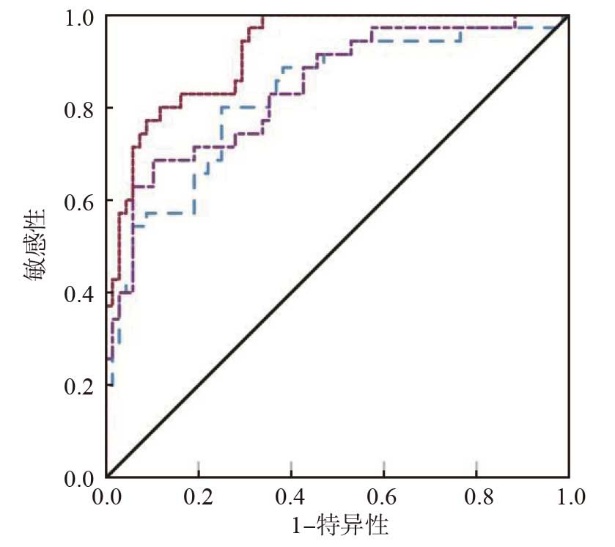
| 项目 | AUC(95%CI) | 最佳临界值 | 敏感性/% | 特异性/% | Youden指数 |
|---|---|---|---|---|---|
| PRDX1 | 0.824(0.736~0.892) | 10.13 ng·mL-1 | 80.00 | 75.00 | 0.550 |
| TSG-6 | 0.840(0.755~0.905) | 1.78 ng·mL-1 | 68.57 | 89.71 | 0.583 |
| 联合检测 | 0.923(0.853~0.966) | 0.456 | 77.14 | 91.18 | 0.683 |
| 项目 | AUC(95%CI) | 最佳临界值 | 敏感性/% | 特异性/% | Youden指数 |
|---|---|---|---|---|---|
| PRDX1 | 0.824(0.736~0.892) | 10.13 ng·mL-1 | 80.00 | 75.00 | 0.550 |
| TSG-6 | 0.840(0.755~0.905) | 1.78 ng·mL-1 | 68.57 | 89.71 | 0.583 |
| 联合检测 | 0.923(0.853~0.966) | 0.456 | 77.14 | 91.18 | 0.683 |
| [1] | 翟斌, 韩梅. 肺炎支原体肺炎患儿血清miR-21、miR-146a表达变化及其与炎症因子的相关性[J]. 检验医学, 2024, 39(8):787-792. |
| [2] | Chen Y, Jia X, Gao Y, et al. Increased macrolide resistance rate of Mycoplasma pneumoniae correlated with epidemic in Beijing,China in 2023[J]. Front Microbiol, 2024, 15(1):1449511. |
| [3] | Gao L W, Yin J, Hu Y H, et al. The epidemiology of paediatric Mycoplasma pneumoniae pneumonia in North China:2006 to 2016[J]. Epidemiol Infect, 2019, 147(1):e192. |
| [4] | Huang X, Huang D, Wang W, et al. Prevalence,risk factors,and early prediction of refractory pneumonia caused by Mycoplasma pneumoniae in children:a systematic review and meta-analysis[J]. Eur J Pediatr, 2026, 185(3):144. |
| [5] | Ding G, Zhang X, Vinturache A, et al. Challenges in the treatment of pediatric Mycoplasma pneumoniae pneumonia[J]. Eur J Pediatr, 2024, 183(7):3001-3011. |
| [6] | Chen Q, Hu T, Wu L, et al. Clinical features and biomarkers for early prediction of refractory Mycoplasma pneumoniae pneumonia in children[J]. Emerg Med Int, 2024, 2024(1):9328177. |
| [7] | Rhee S G, Woo H A. Multiple functions of 2-Cys peroxiredoxins,Ⅰ and Ⅱ,and their regulations via post-translational modifications[J]. Free Radic Biol Med, 2020, 152(1):107-115. |
| [8] | Elko E A, Cunniff B, Seward D J, et al. Peroxiredoxins and beyond;redox systems regulating lung physiology and disease[J]. Antioxid Redox Signal, 2019, 31(14):1070-1091. |
| [9] | Day A J, Milner C M. TSG-6:a multifunctional protein with anti-inflammatory and tissue-protective properties[J]. Matrix Biol, 2019, 78(2):60-83. |
| [10] | Bryan C, Sammour I, Guerra K, et al. TNFα-stimulated protein 6(TSG-6) reduces lung inflammation in an experimental model of bronchopulmonary dysplasia[J]. Pediatr Res, 2019, 85(3):390-397. |
| [11] | 中华医学会儿科学分会呼吸学组, 中华儿科杂志编辑委员会, 中国医药教育协会儿科专业委员会. 儿童社区获得性肺炎管理指南(2024修订)[J]. 中华儿科杂志, 2024, 62(10):920-930. |
| [12] | 中华人民共和国国家卫生健康委员会. 儿童肺炎支原体肺炎诊疗指南(2023年版)[J]. 新发传染病电子杂志, 2024, 9(1):73-79. |
| [13] | Luna C M, Blanzaco D, Niederman M S, et al. Resolution of ventilator-associated pneumonia:prospective evaluation of the clinical pulmonary infection score as an early clinical predictor of outcome[J]. Crit Care Med, 2003, 31(3):676-682. |
| [14] | 中华医学会儿科学分会呼吸学组,《中华实用儿科临床杂志》编辑委员会. 儿童肺炎支原体肺炎诊治专家共识(2015年版)[J]. 中华实用儿科临床杂志, 2015, 30(17):1304-1308. |
| [15] | Meyer Sauteur P M, Theiler M, Bueffcher M, et al. Frequency and clinical presentation of mucocutaneous disease due to Mycoplasma pneumoniae infection in children with community-acquired pneumonia[J]. JAMA Dermatol, 2020, 156(2):144-150. |
| [16] | Sun H N, Ren C X, Lee D H, et al. PRDX1 negatively regulates bleomycin-induced pulmonary fibrosis via inhibiting the epithelial-mesenchymal transition and lung fibroblast proliferation in vitro and in vivo[J]. Cell Mol Biol Lett, 2023, 28(1):48-53. |
| [17] | He Y, Peng Y, Tao L, et al. Peroxiredoxin-1 aggravates lipopolysaccharide-induced septic shock via promoting inflammation[J]. Biochem Biophys Res Commun, 2020, 527(4):861-865. |
| [18] | Li J, Li P, Yuan S, et al. Pulchinenoside B4 alleviates DSS-induced colitis by inhibiting CD1d-dependent NLRP3 inflammasome activation in macrophages[J]. Int Immunopharmacol, 2025, 148(1):114118-114125. |
| [19] | Li S, Zhang Y, Lu R, et al. Peroxiredoxin 1 aggravates acute kidney injury by promoting inflammation through Mincle/Syk/NF-κB signaling[J]. Kidney Int, 2023, 104(2):305-323. |
| [20] | Xu C, Feng C, Huang P, et al. TNFα and IFNγ rapidly activate PI3K-AKT signaling to drive glycolysis that confers mesenchymal stem cells enhanced anti-inflammatory property[J]. Stem Cell Res Ther, 2022, 13(1):491-502. |
| [21] | Su W, Nong Q, Wu J, et al. Anti-inflammatory protein TSG-6 secreted by BMSCs attenuates silica-induced acute pulmonary inflammation by inhibiting NLRP3 inflammasome signaling in macrophages[J]. Int J Biol Macromol, 2023, 253(3):126651. |
| [22] | Yang S, Liang X, Song J, et al. A novel therapeutic approach for inflammatory bowel disease by exosomes derived from human umbilical cord mesenchymal stem cells to repair intestinal barrier via TSG-6[J]. Stem Cell Res Ther, 2021, 12(1):315-321. |
| [23] | Lu B, Xing L, Zhu X Y, et al. Tumor necrosis factor-stimulated gene-6 inhibits endoplasmic reticulum stress in the ischemic mouse kidney[J]. iScience, 2024, 27(12):111454-111462. |
| [24] | Ding Y, Gong P, Jiang J, et al. Mesenchymal stem/stromal cells primed by inflammatory cytokines alleviate psoriasis-like inflammation via the TSG-6-neutrophil axis[J]. Cell Death Dis, 2022, 13(11):996. |
| Viewed | ||||||
|
Full text |
|
|||||
|
Abstract |
|
|||||
