
Laboratory Medicine ›› 2026, Vol. 41 ›› Issue (10): 966-972.DOI: 10.3969/j.issn.1673-8640.2026.10.006
Previous Articles Next Articles
WANG Ruijuan1, HE Ying1, LIU Suhui1, SHANG Miao1, FENG Jinliang2
Received:2025-03-18
Revised:2025-11-27
Online:2026-10-30
Published:2026-10-20
CLC Number:
WANG Ruijuan, HE Ying, LIU Suhui, SHANG Miao, FENG Jinliang. Correlation between serum FABP4,PON-1 and LCN2 in patients with acute myeloid leukemia and disease recurrence[J]. Laboratory Medicine, 2026, 41(10): 966-972.
Add to citation manager EndNote|Ris|BibTeX
URL: https://www.shjyyx.com/EN/10.3969/j.issn.1673-8640.2026.10.006
| 组别 | 例数 | FABP4/(pg·mL-1) | PON-1/(ng·mL-1) | LCN2/(pg·mL-1) |
|---|---|---|---|---|
| 健康对照组 | 116 | 33.51±3.38 | 32.09±3.24 | 76.57±7.69 |
| ALL组 | 116 | 46.28±5.33# | 21.78±2.51# | 94.23±11.56# |
| AML组 | 114 | 64.01±6.47*# | 15.22±1.56*# | 132.47±13.28*# |
| t值 | 992.965 | 1 294.434 | 763.643 | |
| P值 | <0.001 | <0.001 | <0.001 |
| 组别 | 例数 | 年龄 | 性别 | 脾肿大/ [例(%)] | 髓外病变/ [例(%)] | ||||
|---|---|---|---|---|---|---|---|---|---|
| <60岁/[例(%)] | ≥60岁/[例(%)] | 男/[例(%)] | 女/[例(%)] | ||||||
| 高水平组 | 61 | 47(77.05) | 14(22.95) | 34(55.74) | 27(44.26) | 36(59.02) | 22(36.07) | ||
| 低水平组 | 53 | 39(73.58) | 14(26.42) | 29(54.72) | 24(45.28) | 31(58.49) | 18(33.96) | ||
| χ2值 | 0.184 | 0.012 | 0.003 | 0.055 | |||||
| P值 | 0.668 | 0.913 | 0.955 | 0.814 | |||||
| 组别 | FAB分型 | 血红蛋白 | 白细胞计数 | ||||||
| M1~M3/ [例(%)] | M4~M5/ [例(%)] | M6/ [例(%)] | ≥80 g·L-1/ [例(%)] | <80 g·L-1/ [例(%)] | ≥30×109L-1/ [例(%)] | <30×109L-1/ [例(%)] | |||
| 高水平组 | 17(27.87) | 20(32.79) | 24(39.34) | 35(57.38) | 26(42.62) | 34(55.74) | 27(44.26) | ||
| 低水平组 | 24(45.28) | 16(30.19) | 13(24.53) | 29(54.72) | 24 (45.28) | 23(43.40) | 30(56.60) | ||
| χ2值 | 4.37 | 0.081 | 1.728 | ||||||
| P值 | 0.112 | 0.775 | 0.189 | ||||||
| 组别 | 血小板计数 | 骨髓原始细胞比例 | 预后危险分层 | ||||||
| ≥50×109L-1/ [例(%)] | <50×109L-1/ [例(%)] | ≥70%/ [例(%)] | <70%/ [例(%)] | 低危/ [例(%)] | 中危/ [例(%)] | 高危/ [例(%)] | |||
| 高水平组 | 29(47.54) | 32(52.46) | 35(57.38) | 26(42.62) | 11(18.03) | 14(22.95) | 36(59.02) | ||
| 低水平组 | 21(39.62) | 32(60.38) | 31(58.49) | 22(41.51) | 30(56.60) | 15(28.30) | 8(15.09) | ||
| χ2值 | 0.722 | 0.014 | 26.225 | ||||||
| P值 | 0.395 | 0.904 | <0.001 | ||||||
| 组别 | 例数 | 年龄 | 性别 | 脾肿大/ [例(%)] | 髓外病变/ [例(%)] | ||||
|---|---|---|---|---|---|---|---|---|---|
| <60岁/[例(%)] | ≥60岁/[例(%)] | 男/[例(%)] | 女/[例(%)] | ||||||
| 高水平组 | 54 | 39(72.22) | 15(27.78) | 32(59.26) | 22(40.74) | 31(57.41) | 17(31.48) | ||
| 低水平组 | 60 | 47(78.33) | 13(21.67) | 31(51.67) | 29(48.33) | 36(60.00) | 23(38.33) | ||
| χ2值 | 0.573 | 0.663 | 0.079 | 0.586 | |||||
| P值 | 0.449 | 0.416 | 0.779 | 0.444 | |||||
| 组别 | FAB分型 | 血红蛋白 | 白细胞计数 | ||||||
| M1~M3/ [例(%)] | M4~M5/ [例(%)] | M6/ [例(%)] | ≥80 g·L-1/ [例(%)] | <80 g·L-1/ [例(%)] | ≥30×109L-1/ [例(%)] | <30×109L-1/ [例(%)] | |||
| 高水平组 | 23(42.59) | 18(33.33) | 13(24.07) | 30(55.56) | 24(44.44) | 25(46.30) | 29(53.70) | ||
| 低水平组 | 18(30.00) | 18(30.00) | 24(40.00) | 34(56.67) | 26(43.33) | 32(53.33) | 28(46.67) | ||
| χ2值 | 3.574 | 0.014 | 0.563 | ||||||
| P值 | 0.167 | 0.905 | 0.453 | ||||||
| 组别 | 血小板计数 | 骨髓原始细胞比例 | 预后危险分层 | ||||||
| ≥50×109L-1/ [例(%)] | <50×109L-1/ [例(%)] | ≥70%/ [例(%)] | <70%/ [例(%)] | 低危/ [例(%)] | 中危/ [例(%)] | 高危/ [例(%)] | |||
| 高水平组 | 21(38.89) | 33(61.11) | 30(55.56) | 24(44.44) | 29(53.70) | 15(27.78) | 10(18.52) | ||
| 低水平组 | 29(48.33) | 31(51.67) | 36(60.00) | 24(40.00) | 12(20.00) | 14(23.33) | 34(56.67) | ||
| χ2值 | 1.03 | 0.23 | 19.914 | ||||||
| P值 | 0.31 | 0.631 | <0.001 | ||||||
| 组别 | 例数 | 年龄 | 性别 | 脾肿大/ [例(%)] | 髓外病变/ [例(%)] | ||||
|---|---|---|---|---|---|---|---|---|---|
| <60岁/[例(%)] | ≥60岁/[例(%)] | 男/[例(%)] | 女/[例(%)] | ||||||
| 高水平组 | 59 | 44(74.58) | 15(25.42) | 36(61.02) | 23(38.98) | 37(62.71) | 21(35.59) | ||
| 低水平组 | 55 | 42(76.36) | 13(23.64) | 27(49.09) | 28(50.91) | 30(54.55) | 19(34.55) | ||
| χ2值 | 0.049 | 1.638 | 0.783 | 0.014 | |||||
| P值 | 0.825 | 0.201 | 0.376 | 0.907 | |||||
| 组别 | FAB分型 | 血红蛋白 | 血细胞计数 | ||||||
| M1~M3/ [例(%)] | M4~M5/ [例(%)] | M6/ [例(%)] | ≥80 g·L-1/ [例(%)] | <80 g·L-1/ [例(%)] | ≥30×109L-1/ [例(%)] | <30×109L-1/ [例(%)] | |||
| 高水平组 | 17(28.81) | 21(35.59) | 21(35.59) | 35(59.32) | 24(40.68) | 31(52.54) | 28(47.46) | ||
| 低水平组 | 24(43.64) | 15(27.27) | 16(29.09) | 29(52.73) | 26(47.27) | 26(47.27) | 29(52.73) | ||
| χ2值 | 2.734 | 0.503 | 0.316 | ||||||
| P值 | 0.255 | 0.478 | 0.574 | ||||||
| 组别 | 血小板计数 | 骨髓原始细胞比例 | 预后危险分层 | ||||||
| ≥50×109L-1/ [例(%)] | <50×109L-1/ [例(%)] | ≥70%/ [例(%)] | <70%/ [例(%)] | 低危/ [例(%)] | 中危/ [例(%)] | 高危/ [例(%)] | |||
| 高水平组 | 24(40.68) | 35(59.32) | 36(61.02) | 23(38.98) | 32(54.24) | 17(28.81) | 10(16.95) | ||
| 低水平组 | 26(47.27) | 29(52.73) | 30(54.55) | 25(45.45) | 9(16.36) | 12(21.82) | 34(61.82) | ||
| χ2值 | 0.503 | 0.489 | 26.748 | ||||||
| P值 | 0.478 | 0.484 | <0.001 | ||||||
| 组别 | 例数 | FABP4/(pg·mL-1) | PON-1/(ng·mL-1) | LCN2/(pg·mL-1) |
|---|---|---|---|---|
| 缓解组 | 72 | 61.24±6.16 | 15.88±1.61 | 126.75±12.71 |
| 复发组 | 42 | 68.76±6.92 | 14.08±1.42 | 142.27±14.29 |
| t值 | 6.006 | 6.008 | 6.005 | |
| P值 | <0.001 | <0.001 | <0.001 |
| 组别 | 例数 | FABP4/(pg·mL-1) | PON-1/(ng·mL-1) | LCN2/(pg·mL-1) |
|---|---|---|---|---|
| 缓解组 | 72 | 61.24±6.16 | 15.88±1.61 | 126.75±12.71 |
| 复发组 | 42 | 68.76±6.92 | 14.08±1.42 | 142.27±14.29 |
| t值 | 6.006 | 6.008 | 6.005 | |
| P值 | <0.001 | <0.001 | <0.001 |
| 组别 | 例数 | 年龄 | 性别 | 脾肿大/ [例(%)] | 髓外病变/ [例(%)] | ||||
|---|---|---|---|---|---|---|---|---|---|
| <60岁/[例(%)] | ≥60岁/[例(%)] | 男/[例(%)] | 女/[例(%)] | ||||||
| 缓解组 | 72 | 53(73.61) | 19(26.39) | 36(50.00) | 36(50.00) | 41(56.94) | 21(29.17) | ||
| 复发组 | 42 | 33(78.57) | 9(21.43) | 27(64.29) | 15(35.71) | 26(61.90) | 19(45.24) | ||
| χ2值 | 0.352 | 2.19 | 0.269 | 3.008 | |||||
| P值 | 0.553 | 0.139 | 0.604 | 0.083 | |||||
| 组别 | FAB分型 | 血红蛋白 | 白细胞计数 | ||||||
| M1~M3/ [例(%)] | M4~M5/ [例(%)] | M6/ [例(%)] | ≥80 g·L-1/ [例(%)] | <80 g·L-1/ [例(%)] | ≥30×109L-1/ [例(%)] | <30×109L-1/ [例(%)] | |||
| 缓解组 | 26(36.11) | 21(29.17) | 25(34.72) | 36(50.00) | 36(50.00) | 37(51.39) | 35(48.61) | ||
| 复发组 | 15(35.71) | 15(35.71) | 12(28.57) | 28(66.67) | 14(33.33) | 20(47.62) | 22(52.38) | ||
| χ2值 | 0.67 | 2.993 | 0.151 | ||||||
| P值 | 0.715 | 0.084 | 0.698 | ||||||
| 组别 | 血小板计数 | 骨髓原始细胞比率 | 预后危险分层 | ||||||
| ≥50×109L-1/ [例(%)] | <50×109L-1/ [例(%)] | ≥70%/ [例(%)] | <70%/ [例(%)] | 低危/ [例(%)] | 中危/ [例(%)] | 高危/ [例(%)] | |||
| 缓解组 | 29(40.28) | 43(59.72) | 40(55.56) | 32(44.44) | 12(16.67) | 21(29.17) | 39(54.17) | ||
| 复发组 | 21(50.00) | 21(50.00) | 26(61.90) | 16(38.10) | 29(69.05) | 8(19.05) | 5(11.90) | ||
| χ2值 | 1.018 | 0.439 | 33.58 | ||||||
| P值 | 0.313 | 0.508 | 0 | ||||||
| 自变量 | β值 | 标准误 | Wald值 | P值 | OR①值(95%CI②) |
|---|---|---|---|---|---|
| FABP4 | 0.935 | 0.261 | 12.842 | <0.001 | 2.548(1.528~4.250) |
| PON-1 | -0.338 | 0.089 | 14.446 | <0.001 | 0.713(0.599~0.849) |
| LCN2 | 0.862 | 0.241 | 12.807 | <0.001 | 2.369(1.477~3.799) |
| 预后危险分层 | 1.417 | 0.425 | 11.110 | <0.001 | 4.123(1.792~9.484) |
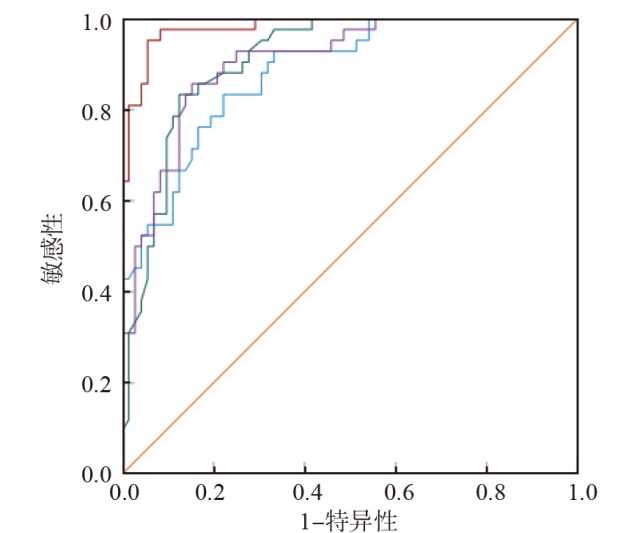
| 指标 | AUC(95%CI) | 最佳临界值 | 敏感性/% | 特异性/% | Youden指数 |
|---|---|---|---|---|---|
| FABP4 | 0.883(0.809~0.936) | 64.85 pg·mL-1 | 83.33 | 77.78 | 0.611 |
| PON-1 | 0.910(0.842~0.956) | 15.12 ng·mL-1 | 83.33 | 87.50 | 0.708 |
| LCN2 | 0.906(0.837~0.953) | 137.99 pg·mL-1 | 85.71 | 84.72 | 0.704 |
| 联合检测 | 0.978(0.937~0.998) | 0.472 | 95.24 | 94.44 | 0.897 |
| [1] | Newell L F, Cook R J. Advances in acute myeloid leukemia[J]. BMJ, 2021,375:n2026. |
| [2] |
Short N J, Konopleva M, Kadia T M, et al. Advances in the treatment of acute myeloid leukemia:new drugs and new challenges[J]. Cancer Discov, 2020, 10(4):506-525.
DOI URL |
| [3] |
Sasaki K, Ravandi F, Kadia T M, et al. De novo acute myeloid leukemia:a population-based study of outcome in the United States based on the surveillance,epidemiology,and end results(SEER) database,1980 to 2017[J]. Cancer, 2021, 127(12):2049-2061.
DOI PMID |
| [4] |
Shimony S, Stahl M, Stone R M. Acute myeloid leukemia:2023 update on diagnosis,risk-stratification,and management[J]. Am J Hematol,2023, 98(3):502-526.
DOI URL |
| [5] |
Sun N, Zhao X. Therapeutic implications of fabp4 in cancer:an emerging target to tackle cancer[J]. Front Pharmacol, 2022, 13:948610.
DOI URL |
| [6] | 王麓璐, 张学思, 潘静, 等. 乳腺癌患者血清钙黏蛋白S100A10、脂肪酸转运蛋白-4水平与临床病理特征及复发的相关性[J]. 疑难病杂志, 2023, 22(5):453-457. |
| [7] | 汪佳玲, 张静娟, 陈舒月, 等. 血清睾酮、PON-1、PKM2与子宫内膜癌患者临床病理特征和预后的关系[J]. 现代生物医学进展, 2024, 24(22):4308-4310. |
| [8] | 阎靖芳, 贾林梓, 王军, 等. 血清脂质运载蛋白2和血管生成素样蛋白2水平与甲状腺乳头状癌患者病理参数及预后的关系[J]. 中国医药, 2024, 19(11):1682-1686. |
| [9] | 成人急性髓系白血病(非急性早幼粒细胞白血病)中国诊疗指南(2017年版)[J]. 中华血液学杂志, 2017, 38(3):177-182. |
| [10] | 中国抗癌协会血液肿瘤专业委员会, 中华医学会血液学分会白血病淋巴瘤学组, 邱录贵, 等. 中国成人急性淋巴细胞白血病诊断与治疗指南(2021年版)[J]. 中华血液学杂志, 2021, 42(9):705-716. |
| [11] |
Döhner H, Estey E H, Amadori S, et al. Diagnosis and management of acute myeloid leukemia in adults:recommendations from an international expert panel,on behalf of the European Leukemia Net[J]. Blood, 2010, 115(3):453-474.
DOI URL |
| [12] | 复发难治性急性髓系白血病中国诊疗指南(2017年版)[J]. 中华血液学杂志, 2017, 38(3):183-184. |
| [13] | Pelcovits A, Niroula R. Acute myeloid leukemia:a review[J]. R I Med J(2013), 2020, 103(3):38-40. |
| [14] |
Tazi Y, Arango-ossa J E, Zhou Y, et al. Unified classification and risk-stratification in acute myeloid leukemia[J]. Nat Commun, 2022, 13(1):4622.
DOI PMID |
| [15] |
Rautenberg C, Germing U, Haas R, et al. Relapse of acute myeloid leukemia after allogeneic stem cell transplantation:prevention,detection,and treatment[J]. Int J Mol Sci, 2019, 20(1):228.
DOI URL |
| [16] | Verma S, Singh A, Yadav G, et al. Serum tumor necrosis factor-alpha levels in acute leukemia and its prognostic significance[J]. Cureus, 2022, 14(5):e24835. |
| [17] |
Mukherjee A, Chiang C Y, Daifotis H A, et al. Adipocyte-induced FABP4 expression in ovarian cancer cells promotes metastasis and mediates carboplatin resistance[J]. Cancer Res, 2020, 80(8):1748-1761.
DOI PMID |
| [18] |
Kolli V, Frucci E, Da Cunha I W, et al. Evidence of the role of inflammation and the hormonal environment in the pathogenesis of adrenal myelolipomas in congenital adrenal hyperplasia[J]. Int J Mol Sci, 2024, 25(5):2543.
DOI URL |
| [19] |
Yan F, Shen N, Pang J X, et al. A vicious loop of fatty acid-binding protein 4 and DNA methyltransferase 1 promotes acute myeloid leukemia and acts as a therapeutic target[J]. Leukemia, 2018, 32(4):865-873.
DOI URL |
| [20] | Medina-díaz I M, Ponce-ruíz N, Rojas-garcía A E, et al. The relationship between cancer and paraoxonase 1[J]. Antioxidants(Basel), 2022, 11(4):697. |
| [21] |
Rafeeinia A, Asadikaram G, Karimi Darabi M, et al. Organochlorine pesticides,oxidative stress biomarkers,and leukemia:a case-control study[J]. J Investig Med, 2023, 71(3):295-306.
DOI URL |
| [22] | Thompson E W, Demissei B G, Smith A M, et al. Paraoxonase-1 activity in breast cancer patients treated with doxorubicin with or without trastuzumab[J]. JACC Basic Transl Sci, 2021, 7(1):1-10. |
| [23] |
Deng Y, Chen D, Gao F, et al. Exosomes derived from microRNA-138-5p-overexpressing bone marrow-derived mesenchymal stem cells confer neuroprotection to astrocytes following ischemic stroke via inhibition of LCN2[J]. J Biol Eng, 2019, 13:71.
DOI PMID |
| [24] |
Tian C, Zheng M, Lan X, et al. Silencing LCN2 enhances RSL3-induced ferroptosis in T cell acute lymphoblastic leukemia[J]. Gene, 2023, 879:147597.
DOI URL |
| [25] | Tillmann S, Olschok K, Schröder S K, et al. The unfolded protein response is a major driver of LCN2 expression in BCR-ABL- and JAK2V617F-positive MPN[J]. Cancers(Basel), 2021, 13(16):4210. |
| Viewed | ||||||
|
Full text |
|
|||||
|
Abstract |
|
|||||
