
Laboratory Medicine ›› 2026, Vol. 41 ›› Issue (1): 34-40.DOI: 10.3969/j.issn.1673-8640.2026.01.006
Previous Articles Next Articles
TIAN Xiangquan1, FAN Zhongcai2( )
)
Received:2024-06-13
Revised:2025-03-26
Online:2026-01-30
Published:2026-01-30
Contact:
FAN Zhongcai
CLC Number:
TIAN Xiangquan, FAN Zhongcai. Role of monoamine oxidase in assessing the severity of coronary artery lesions in ACS patients of different ages[J]. Laboratory Medicine, 2026, 41(1): 34-40.
Add to citation manager EndNote|Ris|BibTeX
URL: https://www.shjyyx.com/EN/10.3969/j.issn.1673-8640.2026.01.006
| 组别 | 例数 | 年龄/岁 | 性别 | 吸烟史/ [例(%)] | 糖尿病史/ [例(%)] | 高血压史/ [例(%)] | 体重指数/ (kg·m-2) | |
|---|---|---|---|---|---|---|---|---|
| 男/[例(%)] | 女/[例(%)] | |||||||
| 对照组 | 242 | 57.46±15.27 | 126(52.07) | 116(47.93) | 118(48.76) | 125(51.65) | 109(45.04) | 23.76±3.52 |
| ACS组 | 262 | 55.28±14.21 | 116(44.27) | 146(55.73) | 129(49.24) | 153(58.40) | 135(51.53) | 24.35±3.24 |
| 统计值 | 1.660 | 1.749 | 0.011 | 2.313 | 2.119 | 1.959 | ||
| P值 | 0.097 | 0.080 | 0.914 | 0.128 | 0.145 | 0.051 | ||
| 组别 | 例数 | 年龄/岁 | 性别 | 吸烟史/ [例(%)] | 糖尿病史/ [例(%)] | 高血压史/ [例(%)] | 体重指数/ (kg·m-2) | |
|---|---|---|---|---|---|---|---|---|
| 男/[例(%)] | 女/[例(%)] | |||||||
| 对照组 | 242 | 57.46±15.27 | 126(52.07) | 116(47.93) | 118(48.76) | 125(51.65) | 109(45.04) | 23.76±3.52 |
| ACS组 | 262 | 55.28±14.21 | 116(44.27) | 146(55.73) | 129(49.24) | 153(58.40) | 135(51.53) | 24.35±3.24 |
| 统计值 | 1.660 | 1.749 | 0.011 | 2.313 | 2.119 | 1.959 | ||
| P值 | 0.097 | 0.080 | 0.914 | 0.128 | 0.145 | 0.051 | ||
| 组别 | 例数 | HDL-C/(mmol·L-1) | LDL-C/(mmol·L-1) | TG/(mmol·L-1) | TC/(mmol·L-1) | MAO/(U·L-1) | ||||
|---|---|---|---|---|---|---|---|---|---|---|
| 对照组 | 242 | 1.27±0.29 | 2.45±0.46 | 2.19±0.62 | 3.46±0.78 | 1.86±0.42 | ||||
| ACS组 | 262 | 1.31±0.36 | 2.57±0.61 | 2.26±0.71 | 3.65±0.89 | 3.82±0.88 | ||||
| 统计值 | 1.367 | 2.478 | 1.175 | 2.540 | 31.490 | |||||
| P值 | 0.172 | 0.014 | 0.241 | 0.011 | <0.001 | |||||
| 组别 | cTnI/(μg·L-1) | hs-CRP/(mg·L-1) | FBG/(mmol·L-1) | NT-proBNP/(ng·L-1) | ||||||
| 对照组 | 0.46±0.08 | 3.69±0.84 | 6.48±1.74 | 424.12(327.54,456.84) | ||||||
| ACS组 | 1.95±0.71 | 9.41±1.67 | 6.96±1.82 | 1 085.72(887.02,1 231.77) | ||||||
| 统计值 | 32.450 | 47.970 | 3.021 | -18.931 | ||||||
| P值 | <0.001 | <0.001 | 0.003 | <0.001 | ||||||
| 组别 | 例数 | HDL-C/(mmol·L-1) | LDL-C/(mmol·L-1) | TG/(mmol·L-1) | TC/(mmol·L-1) | MAO/(U·L-1) | ||||
|---|---|---|---|---|---|---|---|---|---|---|
| 对照组 | 242 | 1.27±0.29 | 2.45±0.46 | 2.19±0.62 | 3.46±0.78 | 1.86±0.42 | ||||
| ACS组 | 262 | 1.31±0.36 | 2.57±0.61 | 2.26±0.71 | 3.65±0.89 | 3.82±0.88 | ||||
| 统计值 | 1.367 | 2.478 | 1.175 | 2.540 | 31.490 | |||||
| P值 | 0.172 | 0.014 | 0.241 | 0.011 | <0.001 | |||||
| 组别 | cTnI/(μg·L-1) | hs-CRP/(mg·L-1) | FBG/(mmol·L-1) | NT-proBNP/(ng·L-1) | ||||||
| 对照组 | 0.46±0.08 | 3.69±0.84 | 6.48±1.74 | 424.12(327.54,456.84) | ||||||
| ACS组 | 1.95±0.71 | 9.41±1.67 | 6.96±1.82 | 1 085.72(887.02,1 231.77) | ||||||
| 统计值 | 32.450 | 47.970 | 3.021 | -18.931 | ||||||
| P值 | <0.001 | <0.001 | 0.003 | <0.001 | ||||||
| 组别 | 例数 | MAO/(U·L-1) |
|---|---|---|
| 对照组 | ||
| 男 | 126 | 1.68±0.43 |
| 女 | 116 | 1.72±0.41 |
| t值 | 0.739 | |
| P值 | 0.461 | |
| ACS组 | ||
| 男 | 116 | 3.98±0.87 |
| 女 | 146 | 4.14±0.91 |
| t值 | 1.441 | |
| P值 | 0.151 |
| 组别 | 例数 | MAO/(U·L-1) |
|---|---|---|
| 对照组 | ||
| 男 | 126 | 1.68±0.43 |
| 女 | 116 | 1.72±0.41 |
| t值 | 0.739 | |
| P值 | 0.461 | |
| ACS组 | ||
| 男 | 116 | 3.98±0.87 |
| 女 | 146 | 4.14±0.91 |
| t值 | 1.441 | |
| P值 | 0.151 |
| 组别 | 例数 | MAO/(U·L-1) |
|---|---|---|
| 对照组 | ||
| 青年患者 | 58 | 1.24±0.32 |
| 中年患者 | 96 | 1.35±0.39 |
| 老年患者 | 88 | 2.67±0.57*# |
| F值 | 256.50 | |
| P值 | <0.001 | |
| ACS组 | ||
| 青年患者 | 66 | 3.07±0.81 |
| 中年患者 | 103 | 3.45±0.76* |
| 老年患者 | 93 | 4.50±0.91*# |
| F值 | 67.00 | |
| P值 | <0.001 |
| 组别 | 例数 | MAO/(U·L-1) |
|---|---|---|
| 对照组 | ||
| 青年患者 | 58 | 1.24±0.32 |
| 中年患者 | 96 | 1.35±0.39 |
| 老年患者 | 88 | 2.67±0.57*# |
| F值 | 256.50 | |
| P值 | <0.001 | |
| ACS组 | ||
| 青年患者 | 66 | 3.07±0.81 |
| 中年患者 | 103 | 3.45±0.76* |
| 老年患者 | 93 | 4.50±0.91*# |
| F值 | 67.00 | |
| P值 | <0.001 |
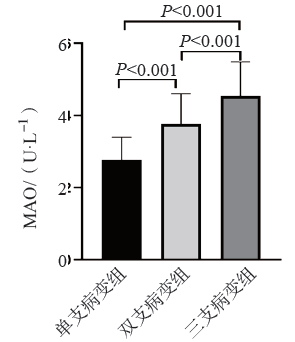
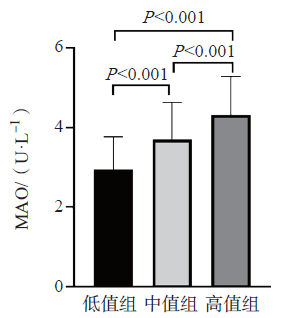
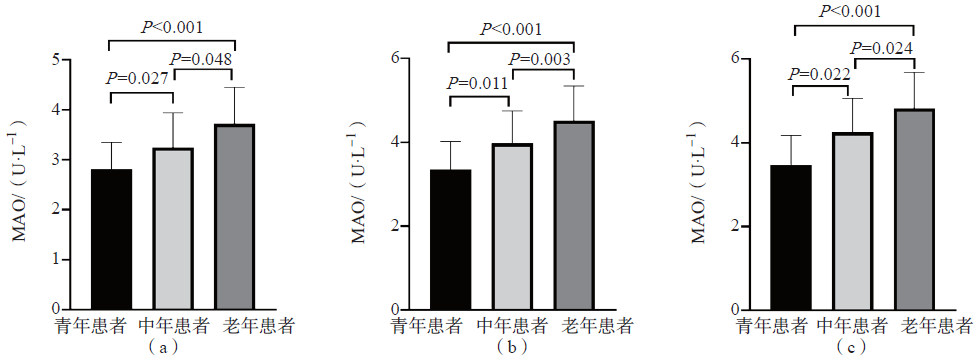
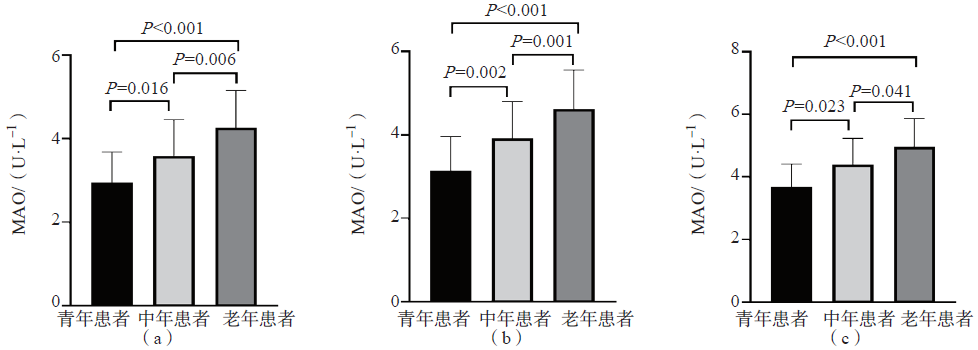
| 组别 | cTnI | hs-CRP | Gensini评分 | |||||
|---|---|---|---|---|---|---|---|---|
| r值 | P值 | r值 | P值 | r值 | P值 | |||
| ACS组 | 0.79 | <0.05 | 0.71 | <0.05 | 0.82 | <0.05 | ||
| 青年患者 | 0.51 | <0.05 | 0.47 | <0.05 | 0.53 | <0.05 | ||
| 中年患者 | 0.71 | <0.05 | 0.66 | <0.05 | 0.85 | <0.05 | ||
| 老年患者 | 0.84 | <0.05 | 0.73 | <0.05 | 0.78 | <0.05 | ||
| 组别 | cTnI | hs-CRP | Gensini评分 | |||||
|---|---|---|---|---|---|---|---|---|
| r值 | P值 | r值 | P值 | r值 | P值 | |||
| ACS组 | 0.79 | <0.05 | 0.71 | <0.05 | 0.82 | <0.05 | ||
| 青年患者 | 0.51 | <0.05 | 0.47 | <0.05 | 0.53 | <0.05 | ||
| 中年患者 | 0.71 | <0.05 | 0.66 | <0.05 | 0.85 | <0.05 | ||
| 老年患者 | 0.84 | <0.05 | 0.73 | <0.05 | 0.78 | <0.05 | ||
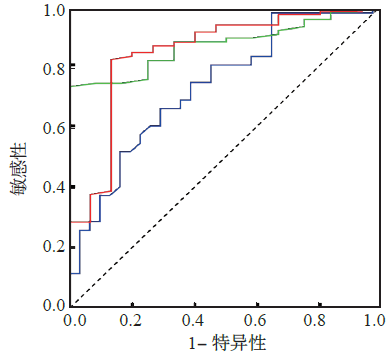
| ACS患者 | AUC(95%CI) | 最佳临界值 | 敏感性/% | 特异性/% | Youden指数 |
|---|---|---|---|---|---|
| 青年患者 | 0.732(0.611~0.852) | 3.25 U·L-1 | 61.3 | 59.5 | 0.208 |
| 中年患者 | 0.843(0.730~0.958) | 3.86 U·L-1 | 82.7 | 64.8 | 0.475 |
| 老年患者 | 0.867(0.791~0.942) | 4.54 U·L-1 | 87.6 | 71.2 | 0.588 |
| ACS患者 | AUC(95%CI) | 最佳临界值 | 敏感性/% | 特异性/% | Youden指数 |
|---|---|---|---|---|---|
| 青年患者 | 0.732(0.611~0.852) | 3.25 U·L-1 | 61.3 | 59.5 | 0.208 |
| 中年患者 | 0.843(0.730~0.958) | 3.86 U·L-1 | 82.7 | 64.8 | 0.475 |
| 老年患者 | 0.867(0.791~0.942) | 4.54 U·L-1 | 87.6 | 71.2 | 0.588 |
| [1] |
TIMMIS A, KAZAKIEWICZ D, TOWNSEND N, et al. Global epidemiology of acute coronary syndromes[J]. Nat Rev Cardiol, 2023, 20(11):778-788.
DOI |
| [2] |
BEVAN G, PANDEY A, GRIGGS S, et al. Neighborhood-level social vulnerability and prevalence of cardiovascular risk factors and coronary heart disease[J]. Curr Probl Cardiol, 2023, 48(8):101182.
DOI URL |
| [3] |
DZAYE O, RAZAVI A C, DARDARI Z A, et al. Modeling the recommended age for initiating coronary artery calcium testing among at-risk young adults[J]. J Am Coll Cardiol, 2021, 78(16):1573-1583.
DOI PMID |
| [4] |
SKALIDIS I, NOIRCLERC N, MEIER D, et al. Head-to-head comparison of two angiography-derived fractional flow reserve techniques in patients with high-risk acute coronary syndrome:a multicenter prospective study[J]. Int J Cardiol, 2024, 399:131663.
DOI URL |
| [5] |
代地林, 吴园, 包明威. 单胺氧化酶A介导的活性氧簇在心血管疾病中的作用[J]. 生物技术进展, 2023, 13(4):542-546.
DOI |
| [6] |
AMER A, HEGAZI A H, ALSHEKH M K, et al. Design,synthesis,molecular modelling and in vitro screening of monoamine oxidase inhibitory activities of novel quinazolyl hydrazine derivatives[J]. R Soc Open Sci, 2020, 7(4):200050.
DOI URL |
| [7] |
SANTIN Y, RESTA J, PARINI A, et al. Monoamine oxidases in age-associated diseases:new perspectives for old enzymes[J]. Ageing Res Rev, 2021, 66:101256.
DOI URL |
| [8] | KONG P, CUI Z Y, HUANG X F, et al. Inflammation and atherosclerosis:signaling pathways and therapeutic intervention[J]. Signal Transduct Target Ther, 2022, 7(1):131. |
| [9] | 张新超, 于学忠, 陈凤英, 等. 急性冠状动脉综合征急诊快速诊治指南(2019)[J]. 临床急诊杂志, 2019, 20(4):253-262. |
| [10] | RUDNICKA E, NAPIERAŁA P, PODFIGURNA A, et al. The World Health Organization (WHO) approach to healthy ageing[J]. Maturitas, 2020,139:6-11. |
| [11] | HILVO M, LÄÄPERI M, JYLHÄ A, et al. Prior myocardial infarction,coronary artery disease extent,diabetes mellitus,and CERT2 score for risk stratification in stable coronary artery disease[J]. Eur J Prev Cardiol, 2022, 29(4):e159-e162. |
| [12] |
CHARACH L, BLATT A, JONAS M, et al. Using the Gensini score to estimate severity of STEMI,NSTEMI,unstable angina,and anginal syndrome[J]. Medicine (Baltimore), 2021, 100(41):e27331.
DOI URL |
| [13] |
滑世轩, 代淑阳, 李冰洁, 等. 血脂正常冠心病患者炎症因子水平与病情严重程度的关系[J]. 检验医学, 2023, 38(1):66-68.
DOI |
| [14] |
JONES D N, RAGHANTI M A. The role of monoamine oxidase enzymes in the pathophysiology of neurological disorders[J]. J Chem Neuroanat, 2021, 114:101957.
DOI PMID |
| [15] |
KALUDERCIC N, ARUSEI R J, DI LISA F. Recent advances on the role of monoamine oxidases in cardiac pathophysiology[J]. Basic Res Cardiol, 2023, 118(1):41.
DOI PMID |
| [16] |
WANG Y, ANESI J, MAIER M C, et al. Sympathetic nervous system and atherosclerosis[J]. Int J Mol Sci, 2023, 24(17):13132.
DOI URL |
| [17] |
NIVETA J P S, JOHN C M, AROCKIASAMY S. Monoamine oxidase mediated oxidative stress:a potential molecular and biochemical crux in the pathogenesis of obesity[J]. Mol Biol Rep, 2024, 51(1):29.
DOI |
| [18] |
DI SANTE M, ANTONUCCI S, PONTAROLLO L, et al. Monoamine oxidase A-dependent ROS formation modulates human cardiomyocyte differentiation through AKT and WNT activation[J]. Basic Res Cardiol, 2023, 118(1):4.
DOI PMID |
| [19] |
王椿淇, 刘磊, 刘洋, 等. 血清单胺氧化酶与儿童青少年肥胖之间的关系研究[J]. 中国儿童保健杂志, 2021, 29(2):151-155.
DOI |
| [20] |
WANG S H, TSAI F C, LIN H H, et al. Inhibition of monoamine oxidase B reduces atherosclerosis and fatty liver in mice[J]. Clin Sci (Lond), 2023, 137(1):17-30.
DOI URL |
| [21] |
OSTADKARAMPOUR M, PUTNINS E E. Monoamine oxidase inhibitors:a review of their anti-inflammatory therapeutic potential and mechanisms of action[J]. Front Pharmacol, 2021, 12:676239.
DOI URL |
| [22] | 田丽, 朱国斌. 非ST段抬高急性冠状动脉综合征病人血浆单胺氧化酶与GRACE评分的相关性[J]. 中西医结合心脑血管病杂志, 2020, 18(23):4032-4035. |
| [23] |
TJORA H L, STEIRO O T, LANGORGEN J, et al. Diagnostic performance of novel troponin algorithms for the rule-out of non-st-elevation acute coronary syndrome[J]. Clin Chem, 2022, 68(2):291-302.
DOI PMID |
| [24] |
PATEL S M, QAMAR A, GIUGLIANO R P, et al. Association of serial high-sensitivity cardiac troponin T with subsequent cardiovascular events in patients stabilized after acute coronary syndrome:a secondary analysis from IMPROVE-IT[J]. JAMA Cardiol, 2022, 7(12):1199-1206.
DOI URL |
| [25] |
马建国, 朱小林, 丁永广, 等. RDW和心肌标志物预测冠状动脉粥样硬化患者发生急性心肌梗死的价值[J]. 检验医学, 2022, 37(12):1164-1168.
DOI |
| Viewed | ||||||
|
Full text |
|
|||||
|
Abstract |
|
|||||
