
Laboratory Medicine ›› 2026, Vol. 41 ›› Issue (10): 973-979.DOI: 10.3969/j.issn.1673-8640.2026.10.007
Previous Articles Next Articles
CHEN Chen1, XU Zhanlei1, QIAN Hongwei2, ZHAO Peipei2, JING Huarong2, LI Ruicheng2( )
Received:2026-02-08
Revised:2026-06-16
Online:2026-10-30
Published:2026-10-20
CLC Number:
CHEN Chen, XU Zhanlei, QIAN Hongwei, ZHAO Peipei, JING Huarong, LI Ruicheng. Analysis of related factors for concurrent cardiorenal dysfunction in newly diagnosed patients with multiple myeloma[J]. Laboratory Medicine, 2026, 41(10): 973-979.
Add to citation manager EndNote|Ris|BibTeX
URL: https://www.shjyyx.com/EN/10.3969/j.issn.1673-8640.2026.10.007
| 组别 | 例数 | 性别 | 年龄/岁 | DS分期 | ||||
|---|---|---|---|---|---|---|---|---|
| 男/[例(%)] | 女/[例(%)] | Ⅰ期/[例(%)] | Ⅱ期/[例(%)] | Ⅲ期/[例(%)] | ||||
| 心肾功能正常组 | 91 | 57(62.6) | 34(37.4) | 64.0(56.5,71.0) | 3(3.3) | 9(9.9) | 79(86.8) | |
| SOD组 | 74 | 53(71.6) | 21(28.4) | 67.5(60.0,72.0) | 3(4.1) | 4(5.4) | 67(90.5) | |
| CRD组 | 70 | 38(54.3) | 32(45.7) | 63.5(55.0,70.0) | 0(0.0) | 3(4.3) | 67(95.7) | |
| 统计值 | 4.644 | 4.2 | 5.121 | |||||
| P值 | 0.098 | 0.122 | 0.275 | |||||
| 组别 | M蛋白类型 | |||||||
| IgG/[例(%)] | IgA/[例(%)] | IgD/[例(%)] | 轻链型/[例(%)] | 不分泌/[例(%)] | 阴性/[例(%)] | |||
| 心肾功能正常组 | 54(60.0) | 14(15.6) | 0(0.0) | 17(18.9) | 4(4.4) | 1(1.1) | ||
| SOD组 | 41(55.4) | 15(20.3) | 2(2.7) | 15(20.3) | 0(0.0) | 1(1.3) | ||
| CRD组 | 25(35.7) | 11(15.7) | 1(1.4) | 33(47.2) | 0(0.0) | 0(0.0) | ||
| 统计值 | 28.65 | 28.65 | ||||||
| P值 | 0.001 | 0.001 | ||||||
| 组别 | ISS分期 | Hb/(g·L-1) | ||||||
| Ⅰ期/[例(%)] | Ⅱ期/[例(%)] | Ⅲ期/[例(%)] | ||||||
| 心肾功能正常组 | 21(23.3) | 37(41.1) | 32(35.6) | 103.0(82.5,122.0) | ||||
| SOD组 | 4(5.4) | 14(18.9) | 56(75.7) | 84.5(70.0,101.0)*** | ||||
| CRD组 | 0(0.0) | 3(4.3) | 67(95.7) | 71.5(61.3,86.0)***## | ||||
| 统计值 | 69.805 | 52.946 | ||||||
| P值 | <0.001 | <0.001 | ||||||
| 组别 | Alb/(g·L-1) | 钙/(mmol·L-1) | LDH/(U·L-1) | β2-MG/(mg·L-1) | ||||
| 心肾功能正常组 | 36.3(31.8,40.9) | 2.3(2.1,2.5) | 182.0(141.5,231.0) | 4.1(3.1,6.2) | ||||
| SOD组 | 33.5(27.5,37.8)* | 2.2(2.1,2.4) | 189.0(148.0,254.0) | 10.0(5.8,15.8)*** | ||||
| CRD组 | 36.5(33.7,39.8)# | 2.5(2.3,2.9)***### | 248.5(178.0,337.0)**# | 25.7(17.8,33.8)***### | ||||
| 统计值 | 9.933 | 20.988 | 11.613 | 125.12 | ||||
| P值 | 0.007 | <0.001 | 0.003 | <0.001 | ||||
| 组别 | M蛋白定量/(g·L-1) | NT-proBNP/(pg·mL-1) | SCr/(μmol·L-1) | |||||
| 心肾功能正常组 | 29.4(0.8,50.0) | 195.0(96.4,354.8) | 71.0(62.5,87.5) | |||||
| SOD组 | 30.7(3.4,56.4) | 2 075.0(1 102.5,4 365.0)*** | 119.2(72.0,178.6)*** | |||||
| CRD组 | 12.5(1.6,39.3) | 3 250.0(1 750.0,11 125.0)***# | 362.3(270.6,607.6)***### | |||||
| 统计值 | 3.084 | 151.267 | 140.701 | |||||
| P值 | 0.214 | <0.001 | <0.001 | |||||
| 项目 | NT-proBNP | SCr | |||
|---|---|---|---|---|---|
| r值 | P值 | r值 | P值 | ||
| Hb | 0.203 | 0.092 | -0.005 | 0.969 | |
| Alb | -0.341 | 0.004 | 0.346 | 0.004 | |
| 钙 | -0.156 | 0.198 | -0.170 | 0.159 | |
| LDH | 0.401 | 0.001 | 0.215 | 0.089 | |
| β2-MG | 0.068 | 0.589 | 0.382 | 0.002 | |
| 项目 | NT-proBNP | SCr | |||
|---|---|---|---|---|---|
| r值 | P值 | r值 | P值 | ||
| Hb | 0.203 | 0.092 | -0.005 | 0.969 | |
| Alb | -0.341 | 0.004 | 0.346 | 0.004 | |
| 钙 | -0.156 | 0.198 | -0.170 | 0.159 | |
| LDH | 0.401 | 0.001 | 0.215 | 0.089 | |
| β2-MG | 0.068 | 0.589 | 0.382 | 0.002 | |
| 项目 | 单因素分析 | 多因素分析 | |||||||||
|---|---|---|---|---|---|---|---|---|---|---|---|
| β值 | 标准误 | Wald值 | P值 | OR值(95% CI) | β值 | 标准误 | Wald值 | P值 | OR值(95% CI) | ||
| Hb | -0.042 | 0.008 | 29.036 | <0.001 | 0.959(0.944~0.974) | -0.027 | 0.011 | 6.059 | 0.014 | 0.973(0.953~0.995) | |
| Alb | 0.036 | 0.021 | 2.874 | 0.090 | 1.037(0.994~1.081) | ||||||
| 钙 | 1.417 | 0.332 | 18.188 | <0.001 | 4.124(2.150~7.908) | 1.158 | 0.466 | 6.178 | 0.013 | 3.184(1.277~7.934) | |
| LDH | 0.003 | 0.001 | 7.541 | 0.006 | 1.003(1.001~1.005) | 0.002 | 0.001 | 3.930 | 0.047 | 1.002(1.000~1.005) | |
| β2-MG | 0.140 | 0.021 | 46.354 | <0.001 | 1.151(1.105~1.198) | 0.107 | 0.023 | 21.976 | <0.001 | 1.113(1.064~1.163) | |
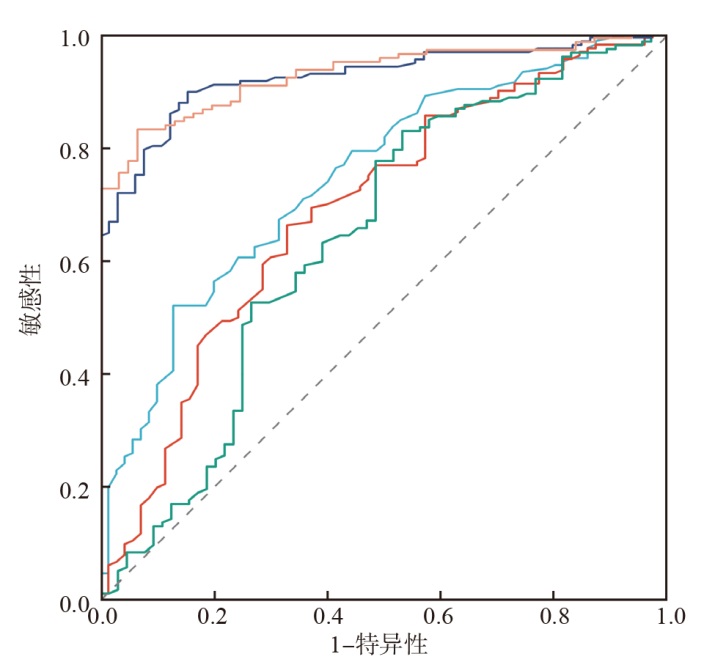
| 指标 | AUC(95%CI) | 最佳临界值 | 敏感性/% | 特异性/% | 阳性预测值/% | 阴性预测值/% | 约登指数 |
|---|---|---|---|---|---|---|---|
| Hb | 0.747(0.680~0.814) | 94.5 g·L-1 | 87.1 | 52.1 | 43.6 | 90.5 | 0.393 |
| 钙 | 0.690(0.614~0.766) | 2.4 mmol·L-1 | 67.1 | 66.3 | 46.5 | 82.2 | 0.334 |
| LDH | 0.642(0.555~0.729) | 261.5 U·L-1 | 46.9 | 82.9 | 53.6 | 78.8 | 0.298 |
| β2-MG | 0.925(0.891~0.959) | 16.4 mg·L-1 | 84.6 | 89.8 | 77.5 | 93.4 | 0.744 |
| 联合检测 | 0.929(0.895~0.962) | 0.2 | 93.4 | 83.2 | 70.4 | 96.7 | 0.767 |
| [1] |
Li X, Wang H, Li Y, et al. The effects of daratumumab on bone disease in patients with newly diagnosed multiple myeloma:a multi-center retrospective study[J]. BMC Cancer, 2025, 25(1):1880.
DOI |
| [2] |
Plummer C, Driessen C, Szabo Z, et al. Management of cardiovascular risk in patients with multiple myeloma[J]. Blood Cancer J, 2019, 9(3):26.
DOI PMID |
| [3] |
Savuliak H R, Bardash V O, Maksymets T A, et al. Clinical and laboratory correlates of kidney function in multiple myeloma patients[J]. Wiad Lek, 2025, 78(6):1019-1025.
DOI PMID |
| [4] |
Wang L, Liu C, Song H, et al. Update on kidney injury caused by multiple myeloma[J]. Ann Hematol, 2024, 103(12):5007-5018.
DOI PMID |
| [5] |
Dimopoulos M A, Sonneveld P, Leung N, et al. International Myeloma Working Group recommendations for the diagnosis and management of myeloma-related renal impairment[J]. J Clin Oncol, 2016, 34(13):1544-1557.
DOI PMID |
| [6] | Sawalha K, Fancher A J, Vallurupalli S, et al. Significant reduction in peak left ventricular global longitudinal strain in multiple myeloma patients:a pilot random awareness analysis[J]. Cureus, 2025, 17(3):e80509. |
| [7] |
Gerov V, Gerova D, Micheva I, et al. Dynamics of bone disease biomarkers dickkopf-1 and sclerostin in patients with multiple myeloma[J]. J Clin Med, 2023, 12(13):4440.
DOI URL |
| [8] |
Niu J, Yu J, Huang H, et al. Cystatin C and eGFRCKD-EPI-CysC:novel biomarkers for renal impairment diagnosis and two-year progression-free survival in multiple myeloma[J]. Scand J Clin Lab Invest, 2023, 83(8):599-603.
DOI URL |
| [9] |
Rajkumar S V, Dimopoulos M A, Palumbo A, et al. International Myeloma Working Group updated criteria for the diagnosis of multiple myeloma[J]. Lancet Oncol, 2014, 15(12):e538-e548.
DOI URL |
| [10] |
Mueller C, McDonald K, De Boer R A, et al. Heart Failure Association of the European Society of Cardiology practical guidance on the use of natriuretic peptide concentrations[J]. Eur J Heart Fail, 2019, 21(6):715-731.
DOI PMID |
| [11] | 中国医师协会血液科医师分会, 中华医学会血液学分会, 中国医师协会多发性骨髓瘤专业委员会 中国多发性骨髓瘤诊治指南(2017年修订)[J]. 中华内科杂志, 2017, 56(11):866-870. |
| [12] |
D'Agostino M, Cairns D A, Lahuerta J J, et al. Second Revision of the International Staging System(R2-ISS)for overall survival in multiple myeloma:a European Myeloma Network(EMN)report within the HARMONY project[J]. J Clin Oncol, 2022, 40(29):3406-3418.
DOI URL |
| [13] |
Hu B Y, Yang Z G, Tang S S, et al. The impact of anemia on left ventricular function and deformation in patients with essential hypertension:a cardiac magnetic resonance study[J]. Quant Imaging Med Surg, 2025, 15(2):1332-1345.
DOI URL |
| [14] | Naas S, Schiffer M, Schödel J. Hypoxia and renal fibrosis[J]. Am J Physiol Cell Physiol, 2023, 325(4):C999-C1016. |
| [15] | Wang Y, Yu X. Stabilizing hypoxia-inducible factor to manage anemia in chronic kidney disease:from basic theory to clinical study[J]. Kidney Dis(Basel), 2024, 10(2):132-142. |
| [16] |
Martínez Mateu J G, Losada González G P, Munar Vila M A, et al. Multiple myeloma,severe hypercalcaemia,acute renal failure and multiple organ failure due to calcinosis[J]. Nefrologia, 2011, 31(2):233-234.
DOI PMID |
| [17] |
Moysés-neto M, Guimarães F M, Ayoub F H, et al. Acute renal failure and hypercalcemia[J]. Ren Fail, 2006, 28(2):153-159.
DOI URL |
| [18] | Zhai S, Zhao Q, Wang J, et al. A characteristic electrocardiographic manifestation suggests hypercalcemia[J]. Diagnostics(Basel), 2025, 15(23):3034. |
| [19] |
Viol Ferreira Lopes M A, Higashi F, Crusoe E Q, et al. Impact of the lactate dehydrogenase in association with the international staging system prognostic score in multiple myeloma patients treated in real life[J]. Hematol Transfus Cell Ther, 2023, 45(2):259-265.
DOI URL |
| [20] |
Liu Y, Wen L, Chen H, et al. Serum lactate dehydrogenase can be used as a factor for re-evaluating first-relapsed multiple myeloma[J]. Acta Haematol, 2020, 143(6):559-566.
DOI URL |
| [21] |
He H, Liu J, Jiang H, et al. High serum lactate dehydrogenase adds prognostic value to cardiac biomarker staging system for light chain amyloidosis[J]. J Cancer, 2019, 10(23):5622-5627.
DOI PMID |
| [22] |
Chawla Y, Anderson E I, Smith M, et al. Lactate metabolism in clonal plasma cells and its therapeutic implications in multiple myeloma patients with elevated serum LDH levels[J]. Cancer Metab, 2025, 13(1):9.
DOI PMID |
| [23] |
Wei P, Hou J, Yu R, et al. Development and validation of an LDH-focused nomogram for the early prediction of heart failure in patients with acute ST-elevation myocardial infarction after percutaneous coronary intervention[J]. Lipids Health Dis, 2025, 24(1):233.
DOI PMID |
| [24] | Brigic L, Mušija E, Kadi F, et al. Role of lactate dehydrogenase as a biomarker of early cardiac remodeling:a cross-sectional study[J]. Cureus, 2024, 16(9):e68906. |
| [25] | Haslett J J, Patel J K, Kittleson M M. Beta 2-microglobulin:case report of a rare cause of cardiac amyloidosis[J]. Eur Heart J Case Rep, 2023, 7(5):ytad239. |
| [26] |
Morris A D, Smith R N, Stone J R. The pathology and changing epidemiology of dialysis-related cardiac beta-2 microglobulin amyloidosis[J]. Cardiovasc Pathol, 2019, 42:30-35.
DOI PMID |
| [27] | Fang H, Zhang Q, Jin L. Association of beta-2-microglobulin with cardiovascular and all-cause mortality in the general and non-CKD population[J]. Medicine(Baltimore), 2023, 102(11):e33202. |
| [28] | Carlisi M, Mancuso S, Lo Presti R, et al. High output heart failure in multiple myeloma:pathogenetic considerations[J]. Cancers(Basel), 2022, 14(3):610. |
| [29] |
Park J, Choi Y J, Lim H J, et al. NT-proBNP as a biomarker in MGUS and multiple myeloma:a retrospective analysis[J]. J Clin Med, 2025, 14(18):6381.
DOI URL |
| [30] |
Fontes Oliveira M, Naaktgeboren W R, Hua A, et al. Optimising cardiovascular care of patients with multiple myeloma[J]. Heart, 2021, 107(22):1774-1782.
DOI PMID |
| [1] | SUN Changming, WANG Liping, ZHAO Weichuan, PIAO Zongfang, GUO Yiqun. Application of plasma AT in renal injury and prognosis evaluation of multiple myeloma patients [J]. Laboratory Medicine, 2026, 41(6): 597-602. |
| [2] | SHAO Yu, WANG Pin, ZHOU Mo. Role of serum lncRNA HOTTIP and lncRNA HULC expression in multiple myeloma monitoring and prognosis judgement [J]. Laboratory Medicine, 2026, 41(3): 258-264. |
| [3] | WANG Bing, YANG Yuwei, LIU Junmei, LI Yanqiu, PENG Bi. Application of reticulocyte hemoglobin content in diagnosing thalassemia in children [J]. Laboratory Medicine, 2026, 41(1): 47-51. |
| [4] | ZHOU Chaoqiong, CHEN Ting, KONG Lirui, MA Chunyu. Clinical role of gene mutation types and MCV,MCH levels in patients with thalassemia in Pidu District of Chengdu City [J]. Laboratory Medicine, 2026, 41(1): 52-57. |
| [5] | WANG Li, TANG Ling, JIN Yaxiong, ZHANG Junlong, GAO Xuedan, NIU Qian. Roles of LDH,MO# and LMR in differential diagnosis of RA-ILD [J]. Laboratory Medicine, 2025, 40(6): 525-533. |
| [6] | DAI Jingwen, YANG Shuo, WANG Chong, SUN Lin, GU Meixiu, XIAN Jingrong, PAN Baishen, WANG Beili, ZHANG Chunyan, GUO Wei. Role of preoperative mean corpuscular hemoglobin concentration for predicting postoperative recurrence in intrahepatic cholangiocarcinoma patients [J]. Laboratory Medicine, 2025, 40(4): 344-349. |
| [7] | ZHANG Lan, ZHU Jianfeng, PAN Baishen, CHEN Pu, WANG Beili, GUO Wei. Prognostic value of circulating plasma cells determined by morphology in newly diagnosed multiple myeloma [J]. Laboratory Medicine, 2025, 40(1): 15-19. |
| [8] | SHEN Ximin, ZHANG Lei, QUAN Heng, NIU Ziguang, XIA Dongge, ZHANG Rulin. Clinical significance of serum lncRNA NEAT1 for multiple myeloma patients with kidney injury [J]. Laboratory Medicine, 2025, 40(1): 32-36. |
| [9] | WANG Yawen, ZHANG Yingying, NIU Wenyan. Influence of glycated hemoglobin A1c on pathogens of urinary tract infection in patients with type 2 diabetes mellitus [J]. Laboratory Medicine, 2024, 39(9): 895-899. |
| [10] | GONG Jingkai, OU Yuanzhu, YU Xiaoxuan, GE Danhong, LIN Feiran. Influence of hemoglobin,bilirubin,chylomicrons and calcium dobesilate on 3 determination systems [J]. Laboratory Medicine, 2024, 39(8): 749-758. |
| [11] | MA Liyuan, YU Xiaohui, ZHANG Ningyu. Relation between peripheral blood cell score combined with IL-32 and prognosis of patients undergoing surgical treatment for multiple myeloma [J]. Laboratory Medicine, 2024, 39(5): 458-463. |
| [12] | SONG Beiling, WU Jiong, HU Jiahua, WANG Yufei. Influence of common hemoglobin variants on different glycated hemoglobin determination systems [J]. Laboratory Medicine, 2024, 39(12): 1219-1223. |
| [13] | ZHAO Qiang, XU Xiuwen, HAN Jiaojiao, SONG Ying, MIAO Yingbo, ZHU Peichao, ZHOU Wei, LIN Shiyang, TONG Lanfei, CHE Yiming, JIN Lei, XU Chong. Effect of different preservation methods on stability of samples in external quality assessment of paroxysmal nocturnal hemoglobinuria by flow cytometry [J]. Laboratory Medicine, 2024, 39(11): 1048-1052. |
| [14] | ZHENG Zhiyou, LI Xingzhao, XIE Yage. Changes and clinical significance of HbA1c,NT-proBNP,Hcy,SOD and TC levels in patients with diabetes cardiomyopathy [J]. Laboratory Medicine, 2023, 38(3): 282-286. |
| [15] | ZHAO Yanhong, FU Lin, LIU Biao, XIAO Meifang. Reference interval of lactate dehydrogenase among 3-14-year-old population in Hainan [J]. Laboratory Medicine, 2023, 38(11): 1041-1043. |
| Viewed | ||||||
|
Full text |
|
|||||
|
Abstract |
|
|||||
