
检验医学 ›› 2026, Vol. 41 ›› Issue (10): 966-972.DOI: 10.3969/j.issn.1673-8640.2026.10.006
王瑞娟1, 贺莹1, 刘苏慧1, 尚淼1, 冯金梁2
收稿日期:2025-03-18
修回日期:2025-11-27
出版日期:2026-10-30
发布日期:2026-10-20
作者简介:王瑞娟,女,1983年生,硕士,副主任医师,主要从事血液系统疾病基础和临床研究。
基金资助:WANG Ruijuan1, HE Ying1, LIU Suhui1, SHANG Miao1, FENG Jinliang2
Received:2025-03-18
Revised:2025-11-27
Online:2026-10-30
Published:2026-10-20
摘要:
目的 分析急性髓系白血病(AML)患者血清脂肪酸结合蛋白4(FABP4)、对氧磷酶-1(PON-1)、脂质运载蛋白2(LCN2)水平与疾病病理特征和复发的关系。方法 选取2023年1月—2024年1月南阳市中心医院AML患者114例(AML组)、急性淋巴细胞白血病(ALL)116例患者(ALL组)、116名健康体检者16名(健康对照组)。根据复发评估结果,将AML组细分为缓解组(72例)、复发组(42例)。采用酶联免疫吸附试验检测所有研究对象血清FABP4、PON-1、LCN2水平,比较各组各项指标差异。采用多因素Logistic回归分析评估AML患者治疗后复发的危险因素;采用受试者工作特征(ROC)曲线评估血清FABP4、PON-1、LCN2水平判断AML患者治疗后复发的效能。结果 健康对照组、ALL组、AML组血清FABP4、LCN2水平依次升高,PON-1水平依次降低(P<0.05);血清FABP4、PON-1、LCN2高表达(>均值)组与FABP4、PON-1、LCN2低表达(≤均值)组预后危险分层和差异有统计学意义(P<0.05);复发组血清FABP4、LCN2水平高于缓解组,PON-1水平低于缓解组(P<0.05);复发组、缓解组预后危险分层差异有统计学意义(P<0.05);血清FABP4、LCN2升高、预后高危风险分层血清和PON-1降低是AML患者治疗后复发的独立危险因素(P<0.05);血清FABP4、PON-1、LCN2单独和联合判断AML患者治疗后复发的曲线下面积(AUC)分别为0.883、0.910、0.906、0.978,联合使用效能优于单项使用(Z值分别为3.431、3.263、3.106,P<0.05)。结论 AML患者血清FABP4、LCN2水平升高,PON-1水平降低,与患者临床病理特征和治疗后复发有一定关系;3项指标联合判断AML患者治疗后复发具有一定价值。
中图分类号:
王瑞娟, 贺莹, 刘苏慧, 尚淼, 冯金梁. 血清FABP4、PON-1、LCN2与急性髓系白血病复发的相关性[J]. 检验医学, 2026, 41(10): 966-972.
WANG Ruijuan, HE Ying, LIU Suhui, SHANG Miao, FENG Jinliang. Correlation between serum FABP4,PON-1 and LCN2 in patients with acute myeloid leukemia and disease recurrence[J]. Laboratory Medicine, 2026, 41(10): 966-972.
| 组别 | 例数 | FABP4/(pg·mL-1) | PON-1/(ng·mL-1) | LCN2/(pg·mL-1) |
|---|---|---|---|---|
| 健康对照组 | 116 | 33.51±3.38 | 32.09±3.24 | 76.57±7.69 |
| ALL组 | 116 | 46.28±5.33# | 21.78±2.51# | 94.23±11.56# |
| AML组 | 114 | 64.01±6.47*# | 15.22±1.56*# | 132.47±13.28*# |
| t值 | 992.965 | 1 294.434 | 763.643 | |
| P值 | <0.001 | <0.001 | <0.001 |
表1 ALL组、AML组、健康对照组血清FABP4、PON-1、LCN2水平比较
| 组别 | 例数 | FABP4/(pg·mL-1) | PON-1/(ng·mL-1) | LCN2/(pg·mL-1) |
|---|---|---|---|---|
| 健康对照组 | 116 | 33.51±3.38 | 32.09±3.24 | 76.57±7.69 |
| ALL组 | 116 | 46.28±5.33# | 21.78±2.51# | 94.23±11.56# |
| AML组 | 114 | 64.01±6.47*# | 15.22±1.56*# | 132.47±13.28*# |
| t值 | 992.965 | 1 294.434 | 763.643 | |
| P值 | <0.001 | <0.001 | <0.001 |
| 组别 | 例数 | 年龄 | 性别 | 脾肿大/ [例(%)] | 髓外病变/ [例(%)] | ||||
|---|---|---|---|---|---|---|---|---|---|
| <60岁/[例(%)] | ≥60岁/[例(%)] | 男/[例(%)] | 女/[例(%)] | ||||||
| 高水平组 | 61 | 47(77.05) | 14(22.95) | 34(55.74) | 27(44.26) | 36(59.02) | 22(36.07) | ||
| 低水平组 | 53 | 39(73.58) | 14(26.42) | 29(54.72) | 24(45.28) | 31(58.49) | 18(33.96) | ||
| χ2值 | 0.184 | 0.012 | 0.003 | 0.055 | |||||
| P值 | 0.668 | 0.913 | 0.955 | 0.814 | |||||
| 组别 | FAB分型 | 血红蛋白 | 白细胞计数 | ||||||
| M1~M3/ [例(%)] | M4~M5/ [例(%)] | M6/ [例(%)] | ≥80 g·L-1/ [例(%)] | <80 g·L-1/ [例(%)] | ≥30×109L-1/ [例(%)] | <30×109L-1/ [例(%)] | |||
| 高水平组 | 17(27.87) | 20(32.79) | 24(39.34) | 35(57.38) | 26(42.62) | 34(55.74) | 27(44.26) | ||
| 低水平组 | 24(45.28) | 16(30.19) | 13(24.53) | 29(54.72) | 24 (45.28) | 23(43.40) | 30(56.60) | ||
| χ2值 | 4.37 | 0.081 | 1.728 | ||||||
| P值 | 0.112 | 0.775 | 0.189 | ||||||
| 组别 | 血小板计数 | 骨髓原始细胞比例 | 预后危险分层 | ||||||
| ≥50×109L-1/ [例(%)] | <50×109L-1/ [例(%)] | ≥70%/ [例(%)] | <70%/ [例(%)] | 低危/ [例(%)] | 中危/ [例(%)] | 高危/ [例(%)] | |||
| 高水平组 | 29(47.54) | 32(52.46) | 35(57.38) | 26(42.62) | 11(18.03) | 14(22.95) | 36(59.02) | ||
| 低水平组 | 21(39.62) | 32(60.38) | 31(58.49) | 22(41.51) | 30(56.60) | 15(28.30) | 8(15.09) | ||
| χ2值 | 0.722 | 0.014 | 26.225 | ||||||
| P值 | 0.395 | 0.904 | <0.001 | ||||||
表2 不同血清FABP4水平AML患者临床病理特征比较
| 组别 | 例数 | 年龄 | 性别 | 脾肿大/ [例(%)] | 髓外病变/ [例(%)] | ||||
|---|---|---|---|---|---|---|---|---|---|
| <60岁/[例(%)] | ≥60岁/[例(%)] | 男/[例(%)] | 女/[例(%)] | ||||||
| 高水平组 | 61 | 47(77.05) | 14(22.95) | 34(55.74) | 27(44.26) | 36(59.02) | 22(36.07) | ||
| 低水平组 | 53 | 39(73.58) | 14(26.42) | 29(54.72) | 24(45.28) | 31(58.49) | 18(33.96) | ||
| χ2值 | 0.184 | 0.012 | 0.003 | 0.055 | |||||
| P值 | 0.668 | 0.913 | 0.955 | 0.814 | |||||
| 组别 | FAB分型 | 血红蛋白 | 白细胞计数 | ||||||
| M1~M3/ [例(%)] | M4~M5/ [例(%)] | M6/ [例(%)] | ≥80 g·L-1/ [例(%)] | <80 g·L-1/ [例(%)] | ≥30×109L-1/ [例(%)] | <30×109L-1/ [例(%)] | |||
| 高水平组 | 17(27.87) | 20(32.79) | 24(39.34) | 35(57.38) | 26(42.62) | 34(55.74) | 27(44.26) | ||
| 低水平组 | 24(45.28) | 16(30.19) | 13(24.53) | 29(54.72) | 24 (45.28) | 23(43.40) | 30(56.60) | ||
| χ2值 | 4.37 | 0.081 | 1.728 | ||||||
| P值 | 0.112 | 0.775 | 0.189 | ||||||
| 组别 | 血小板计数 | 骨髓原始细胞比例 | 预后危险分层 | ||||||
| ≥50×109L-1/ [例(%)] | <50×109L-1/ [例(%)] | ≥70%/ [例(%)] | <70%/ [例(%)] | 低危/ [例(%)] | 中危/ [例(%)] | 高危/ [例(%)] | |||
| 高水平组 | 29(47.54) | 32(52.46) | 35(57.38) | 26(42.62) | 11(18.03) | 14(22.95) | 36(59.02) | ||
| 低水平组 | 21(39.62) | 32(60.38) | 31(58.49) | 22(41.51) | 30(56.60) | 15(28.30) | 8(15.09) | ||
| χ2值 | 0.722 | 0.014 | 26.225 | ||||||
| P值 | 0.395 | 0.904 | <0.001 | ||||||
| 组别 | 例数 | 年龄 | 性别 | 脾肿大/ [例(%)] | 髓外病变/ [例(%)] | ||||
|---|---|---|---|---|---|---|---|---|---|
| <60岁/[例(%)] | ≥60岁/[例(%)] | 男/[例(%)] | 女/[例(%)] | ||||||
| 高水平组 | 54 | 39(72.22) | 15(27.78) | 32(59.26) | 22(40.74) | 31(57.41) | 17(31.48) | ||
| 低水平组 | 60 | 47(78.33) | 13(21.67) | 31(51.67) | 29(48.33) | 36(60.00) | 23(38.33) | ||
| χ2值 | 0.573 | 0.663 | 0.079 | 0.586 | |||||
| P值 | 0.449 | 0.416 | 0.779 | 0.444 | |||||
| 组别 | FAB分型 | 血红蛋白 | 白细胞计数 | ||||||
| M1~M3/ [例(%)] | M4~M5/ [例(%)] | M6/ [例(%)] | ≥80 g·L-1/ [例(%)] | <80 g·L-1/ [例(%)] | ≥30×109L-1/ [例(%)] | <30×109L-1/ [例(%)] | |||
| 高水平组 | 23(42.59) | 18(33.33) | 13(24.07) | 30(55.56) | 24(44.44) | 25(46.30) | 29(53.70) | ||
| 低水平组 | 18(30.00) | 18(30.00) | 24(40.00) | 34(56.67) | 26(43.33) | 32(53.33) | 28(46.67) | ||
| χ2值 | 3.574 | 0.014 | 0.563 | ||||||
| P值 | 0.167 | 0.905 | 0.453 | ||||||
| 组别 | 血小板计数 | 骨髓原始细胞比例 | 预后危险分层 | ||||||
| ≥50×109L-1/ [例(%)] | <50×109L-1/ [例(%)] | ≥70%/ [例(%)] | <70%/ [例(%)] | 低危/ [例(%)] | 中危/ [例(%)] | 高危/ [例(%)] | |||
| 高水平组 | 21(38.89) | 33(61.11) | 30(55.56) | 24(44.44) | 29(53.70) | 15(27.78) | 10(18.52) | ||
| 低水平组 | 29(48.33) | 31(51.67) | 36(60.00) | 24(40.00) | 12(20.00) | 14(23.33) | 34(56.67) | ||
| χ2值 | 1.03 | 0.23 | 19.914 | ||||||
| P值 | 0.31 | 0.631 | <0.001 | ||||||
表3 不同血清PON-1水平AML患者临床病理特征比较
| 组别 | 例数 | 年龄 | 性别 | 脾肿大/ [例(%)] | 髓外病变/ [例(%)] | ||||
|---|---|---|---|---|---|---|---|---|---|
| <60岁/[例(%)] | ≥60岁/[例(%)] | 男/[例(%)] | 女/[例(%)] | ||||||
| 高水平组 | 54 | 39(72.22) | 15(27.78) | 32(59.26) | 22(40.74) | 31(57.41) | 17(31.48) | ||
| 低水平组 | 60 | 47(78.33) | 13(21.67) | 31(51.67) | 29(48.33) | 36(60.00) | 23(38.33) | ||
| χ2值 | 0.573 | 0.663 | 0.079 | 0.586 | |||||
| P值 | 0.449 | 0.416 | 0.779 | 0.444 | |||||
| 组别 | FAB分型 | 血红蛋白 | 白细胞计数 | ||||||
| M1~M3/ [例(%)] | M4~M5/ [例(%)] | M6/ [例(%)] | ≥80 g·L-1/ [例(%)] | <80 g·L-1/ [例(%)] | ≥30×109L-1/ [例(%)] | <30×109L-1/ [例(%)] | |||
| 高水平组 | 23(42.59) | 18(33.33) | 13(24.07) | 30(55.56) | 24(44.44) | 25(46.30) | 29(53.70) | ||
| 低水平组 | 18(30.00) | 18(30.00) | 24(40.00) | 34(56.67) | 26(43.33) | 32(53.33) | 28(46.67) | ||
| χ2值 | 3.574 | 0.014 | 0.563 | ||||||
| P值 | 0.167 | 0.905 | 0.453 | ||||||
| 组别 | 血小板计数 | 骨髓原始细胞比例 | 预后危险分层 | ||||||
| ≥50×109L-1/ [例(%)] | <50×109L-1/ [例(%)] | ≥70%/ [例(%)] | <70%/ [例(%)] | 低危/ [例(%)] | 中危/ [例(%)] | 高危/ [例(%)] | |||
| 高水平组 | 21(38.89) | 33(61.11) | 30(55.56) | 24(44.44) | 29(53.70) | 15(27.78) | 10(18.52) | ||
| 低水平组 | 29(48.33) | 31(51.67) | 36(60.00) | 24(40.00) | 12(20.00) | 14(23.33) | 34(56.67) | ||
| χ2值 | 1.03 | 0.23 | 19.914 | ||||||
| P值 | 0.31 | 0.631 | <0.001 | ||||||
| 组别 | 例数 | 年龄 | 性别 | 脾肿大/ [例(%)] | 髓外病变/ [例(%)] | ||||
|---|---|---|---|---|---|---|---|---|---|
| <60岁/[例(%)] | ≥60岁/[例(%)] | 男/[例(%)] | 女/[例(%)] | ||||||
| 高水平组 | 59 | 44(74.58) | 15(25.42) | 36(61.02) | 23(38.98) | 37(62.71) | 21(35.59) | ||
| 低水平组 | 55 | 42(76.36) | 13(23.64) | 27(49.09) | 28(50.91) | 30(54.55) | 19(34.55) | ||
| χ2值 | 0.049 | 1.638 | 0.783 | 0.014 | |||||
| P值 | 0.825 | 0.201 | 0.376 | 0.907 | |||||
| 组别 | FAB分型 | 血红蛋白 | 血细胞计数 | ||||||
| M1~M3/ [例(%)] | M4~M5/ [例(%)] | M6/ [例(%)] | ≥80 g·L-1/ [例(%)] | <80 g·L-1/ [例(%)] | ≥30×109L-1/ [例(%)] | <30×109L-1/ [例(%)] | |||
| 高水平组 | 17(28.81) | 21(35.59) | 21(35.59) | 35(59.32) | 24(40.68) | 31(52.54) | 28(47.46) | ||
| 低水平组 | 24(43.64) | 15(27.27) | 16(29.09) | 29(52.73) | 26(47.27) | 26(47.27) | 29(52.73) | ||
| χ2值 | 2.734 | 0.503 | 0.316 | ||||||
| P值 | 0.255 | 0.478 | 0.574 | ||||||
| 组别 | 血小板计数 | 骨髓原始细胞比例 | 预后危险分层 | ||||||
| ≥50×109L-1/ [例(%)] | <50×109L-1/ [例(%)] | ≥70%/ [例(%)] | <70%/ [例(%)] | 低危/ [例(%)] | 中危/ [例(%)] | 高危/ [例(%)] | |||
| 高水平组 | 24(40.68) | 35(59.32) | 36(61.02) | 23(38.98) | 32(54.24) | 17(28.81) | 10(16.95) | ||
| 低水平组 | 26(47.27) | 29(52.73) | 30(54.55) | 25(45.45) | 9(16.36) | 12(21.82) | 34(61.82) | ||
| χ2值 | 0.503 | 0.489 | 26.748 | ||||||
| P值 | 0.478 | 0.484 | <0.001 | ||||||
表4 不同血清LCN2水平AML患者临床病理特征比较
| 组别 | 例数 | 年龄 | 性别 | 脾肿大/ [例(%)] | 髓外病变/ [例(%)] | ||||
|---|---|---|---|---|---|---|---|---|---|
| <60岁/[例(%)] | ≥60岁/[例(%)] | 男/[例(%)] | 女/[例(%)] | ||||||
| 高水平组 | 59 | 44(74.58) | 15(25.42) | 36(61.02) | 23(38.98) | 37(62.71) | 21(35.59) | ||
| 低水平组 | 55 | 42(76.36) | 13(23.64) | 27(49.09) | 28(50.91) | 30(54.55) | 19(34.55) | ||
| χ2值 | 0.049 | 1.638 | 0.783 | 0.014 | |||||
| P值 | 0.825 | 0.201 | 0.376 | 0.907 | |||||
| 组别 | FAB分型 | 血红蛋白 | 血细胞计数 | ||||||
| M1~M3/ [例(%)] | M4~M5/ [例(%)] | M6/ [例(%)] | ≥80 g·L-1/ [例(%)] | <80 g·L-1/ [例(%)] | ≥30×109L-1/ [例(%)] | <30×109L-1/ [例(%)] | |||
| 高水平组 | 17(28.81) | 21(35.59) | 21(35.59) | 35(59.32) | 24(40.68) | 31(52.54) | 28(47.46) | ||
| 低水平组 | 24(43.64) | 15(27.27) | 16(29.09) | 29(52.73) | 26(47.27) | 26(47.27) | 29(52.73) | ||
| χ2值 | 2.734 | 0.503 | 0.316 | ||||||
| P值 | 0.255 | 0.478 | 0.574 | ||||||
| 组别 | 血小板计数 | 骨髓原始细胞比例 | 预后危险分层 | ||||||
| ≥50×109L-1/ [例(%)] | <50×109L-1/ [例(%)] | ≥70%/ [例(%)] | <70%/ [例(%)] | 低危/ [例(%)] | 中危/ [例(%)] | 高危/ [例(%)] | |||
| 高水平组 | 24(40.68) | 35(59.32) | 36(61.02) | 23(38.98) | 32(54.24) | 17(28.81) | 10(16.95) | ||
| 低水平组 | 26(47.27) | 29(52.73) | 30(54.55) | 25(45.45) | 9(16.36) | 12(21.82) | 34(61.82) | ||
| χ2值 | 0.503 | 0.489 | 26.748 | ||||||
| P值 | 0.478 | 0.484 | <0.001 | ||||||
| 组别 | 例数 | FABP4/(pg·mL-1) | PON-1/(ng·mL-1) | LCN2/(pg·mL-1) |
|---|---|---|---|---|
| 缓解组 | 72 | 61.24±6.16 | 15.88±1.61 | 126.75±12.71 |
| 复发组 | 42 | 68.76±6.92 | 14.08±1.42 | 142.27±14.29 |
| t值 | 6.006 | 6.008 | 6.005 | |
| P值 | <0.001 | <0.001 | <0.001 |
表5 复发组、缓解组血清FABP4、PON-1、LCN2水平对比
| 组别 | 例数 | FABP4/(pg·mL-1) | PON-1/(ng·mL-1) | LCN2/(pg·mL-1) |
|---|---|---|---|---|
| 缓解组 | 72 | 61.24±6.16 | 15.88±1.61 | 126.75±12.71 |
| 复发组 | 42 | 68.76±6.92 | 14.08±1.42 | 142.27±14.29 |
| t值 | 6.006 | 6.008 | 6.005 | |
| P值 | <0.001 | <0.001 | <0.001 |
| 组别 | 例数 | 年龄 | 性别 | 脾肿大/ [例(%)] | 髓外病变/ [例(%)] | ||||
|---|---|---|---|---|---|---|---|---|---|
| <60岁/[例(%)] | ≥60岁/[例(%)] | 男/[例(%)] | 女/[例(%)] | ||||||
| 缓解组 | 72 | 53(73.61) | 19(26.39) | 36(50.00) | 36(50.00) | 41(56.94) | 21(29.17) | ||
| 复发组 | 42 | 33(78.57) | 9(21.43) | 27(64.29) | 15(35.71) | 26(61.90) | 19(45.24) | ||
| χ2值 | 0.352 | 2.19 | 0.269 | 3.008 | |||||
| P值 | 0.553 | 0.139 | 0.604 | 0.083 | |||||
| 组别 | FAB分型 | 血红蛋白 | 白细胞计数 | ||||||
| M1~M3/ [例(%)] | M4~M5/ [例(%)] | M6/ [例(%)] | ≥80 g·L-1/ [例(%)] | <80 g·L-1/ [例(%)] | ≥30×109L-1/ [例(%)] | <30×109L-1/ [例(%)] | |||
| 缓解组 | 26(36.11) | 21(29.17) | 25(34.72) | 36(50.00) | 36(50.00) | 37(51.39) | 35(48.61) | ||
| 复发组 | 15(35.71) | 15(35.71) | 12(28.57) | 28(66.67) | 14(33.33) | 20(47.62) | 22(52.38) | ||
| χ2值 | 0.67 | 2.993 | 0.151 | ||||||
| P值 | 0.715 | 0.084 | 0.698 | ||||||
| 组别 | 血小板计数 | 骨髓原始细胞比率 | 预后危险分层 | ||||||
| ≥50×109L-1/ [例(%)] | <50×109L-1/ [例(%)] | ≥70%/ [例(%)] | <70%/ [例(%)] | 低危/ [例(%)] | 中危/ [例(%)] | 高危/ [例(%)] | |||
| 缓解组 | 29(40.28) | 43(59.72) | 40(55.56) | 32(44.44) | 12(16.67) | 21(29.17) | 39(54.17) | ||
| 复发组 | 21(50.00) | 21(50.00) | 26(61.90) | 16(38.10) | 29(69.05) | 8(19.05) | 5(11.90) | ||
| χ2值 | 1.018 | 0.439 | 33.58 | ||||||
| P值 | 0.313 | 0.508 | 0 | ||||||
表6 复发组、缓解组临床特征比较
| 组别 | 例数 | 年龄 | 性别 | 脾肿大/ [例(%)] | 髓外病变/ [例(%)] | ||||
|---|---|---|---|---|---|---|---|---|---|
| <60岁/[例(%)] | ≥60岁/[例(%)] | 男/[例(%)] | 女/[例(%)] | ||||||
| 缓解组 | 72 | 53(73.61) | 19(26.39) | 36(50.00) | 36(50.00) | 41(56.94) | 21(29.17) | ||
| 复发组 | 42 | 33(78.57) | 9(21.43) | 27(64.29) | 15(35.71) | 26(61.90) | 19(45.24) | ||
| χ2值 | 0.352 | 2.19 | 0.269 | 3.008 | |||||
| P值 | 0.553 | 0.139 | 0.604 | 0.083 | |||||
| 组别 | FAB分型 | 血红蛋白 | 白细胞计数 | ||||||
| M1~M3/ [例(%)] | M4~M5/ [例(%)] | M6/ [例(%)] | ≥80 g·L-1/ [例(%)] | <80 g·L-1/ [例(%)] | ≥30×109L-1/ [例(%)] | <30×109L-1/ [例(%)] | |||
| 缓解组 | 26(36.11) | 21(29.17) | 25(34.72) | 36(50.00) | 36(50.00) | 37(51.39) | 35(48.61) | ||
| 复发组 | 15(35.71) | 15(35.71) | 12(28.57) | 28(66.67) | 14(33.33) | 20(47.62) | 22(52.38) | ||
| χ2值 | 0.67 | 2.993 | 0.151 | ||||||
| P值 | 0.715 | 0.084 | 0.698 | ||||||
| 组别 | 血小板计数 | 骨髓原始细胞比率 | 预后危险分层 | ||||||
| ≥50×109L-1/ [例(%)] | <50×109L-1/ [例(%)] | ≥70%/ [例(%)] | <70%/ [例(%)] | 低危/ [例(%)] | 中危/ [例(%)] | 高危/ [例(%)] | |||
| 缓解组 | 29(40.28) | 43(59.72) | 40(55.56) | 32(44.44) | 12(16.67) | 21(29.17) | 39(54.17) | ||
| 复发组 | 21(50.00) | 21(50.00) | 26(61.90) | 16(38.10) | 29(69.05) | 8(19.05) | 5(11.90) | ||
| χ2值 | 1.018 | 0.439 | 33.58 | ||||||
| P值 | 0.313 | 0.508 | 0 | ||||||
| 自变量 | β值 | 标准误 | Wald值 | P值 | OR①值(95%CI②) |
|---|---|---|---|---|---|
| FABP4 | 0.935 | 0.261 | 12.842 | <0.001 | 2.548(1.528~4.250) |
| PON-1 | -0.338 | 0.089 | 14.446 | <0.001 | 0.713(0.599~0.849) |
| LCN2 | 0.862 | 0.241 | 12.807 | <0.001 | 2.369(1.477~3.799) |
| 预后危险分层 | 1.417 | 0.425 | 11.110 | <0.001 | 4.123(1.792~9.484) |
表7 AML患者治疗后复发的危险因素
| 自变量 | β值 | 标准误 | Wald值 | P值 | OR①值(95%CI②) |
|---|---|---|---|---|---|
| FABP4 | 0.935 | 0.261 | 12.842 | <0.001 | 2.548(1.528~4.250) |
| PON-1 | -0.338 | 0.089 | 14.446 | <0.001 | 0.713(0.599~0.849) |
| LCN2 | 0.862 | 0.241 | 12.807 | <0.001 | 2.369(1.477~3.799) |
| 预后危险分层 | 1.417 | 0.425 | 11.110 | <0.001 | 4.123(1.792~9.484) |
| 指标 | AUC(95%CI) | 最佳临界值 | 敏感性/% | 特异性/% | Youden指数 |
|---|---|---|---|---|---|
| FABP4 | 0.883(0.809~0.936) | 64.85 pg·mL-1 | 83.33 | 77.78 | 0.611 |
| PON-1 | 0.910(0.842~0.956) | 15.12 ng·mL-1 | 83.33 | 87.50 | 0.708 |
| LCN2 | 0.906(0.837~0.953) | 137.99 pg·mL-1 | 85.71 | 84.72 | 0.704 |
| 联合检测 | 0.978(0.937~0.998) | 0.472 | 95.24 | 94.44 | 0.897 |
表8 血清FABP4、PON-1、LCN2水平判断AML患者治疗后复发的效能
| 指标 | AUC(95%CI) | 最佳临界值 | 敏感性/% | 特异性/% | Youden指数 |
|---|---|---|---|---|---|
| FABP4 | 0.883(0.809~0.936) | 64.85 pg·mL-1 | 83.33 | 77.78 | 0.611 |
| PON-1 | 0.910(0.842~0.956) | 15.12 ng·mL-1 | 83.33 | 87.50 | 0.708 |
| LCN2 | 0.906(0.837~0.953) | 137.99 pg·mL-1 | 85.71 | 84.72 | 0.704 |
| 联合检测 | 0.978(0.937~0.998) | 0.472 | 95.24 | 94.44 | 0.897 |
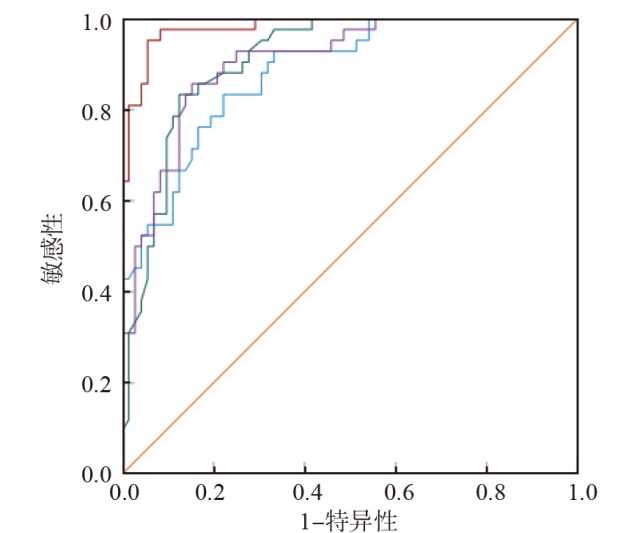
图1 血清FABP4、PON-1、LCN2单项检测和联合检测判断AML患者治疗后复发的ROC曲线 注: FABP4; PON-1; LCN2; 联合检测; 参考线。
| [1] | Newell L F, Cook R J. Advances in acute myeloid leukemia[J]. BMJ, 2021,375:n2026. |
| [2] |
Short N J, Konopleva M, Kadia T M, et al. Advances in the treatment of acute myeloid leukemia:new drugs and new challenges[J]. Cancer Discov, 2020, 10(4):506-525.
DOI URL |
| [3] |
Sasaki K, Ravandi F, Kadia T M, et al. De novo acute myeloid leukemia:a population-based study of outcome in the United States based on the surveillance,epidemiology,and end results(SEER) database,1980 to 2017[J]. Cancer, 2021, 127(12):2049-2061.
DOI PMID |
| [4] |
Shimony S, Stahl M, Stone R M. Acute myeloid leukemia:2023 update on diagnosis,risk-stratification,and management[J]. Am J Hematol,2023, 98(3):502-526.
DOI URL |
| [5] |
Sun N, Zhao X. Therapeutic implications of fabp4 in cancer:an emerging target to tackle cancer[J]. Front Pharmacol, 2022, 13:948610.
DOI URL |
| [6] | 王麓璐, 张学思, 潘静, 等. 乳腺癌患者血清钙黏蛋白S100A10、脂肪酸转运蛋白-4水平与临床病理特征及复发的相关性[J]. 疑难病杂志, 2023, 22(5):453-457. |
| [7] | 汪佳玲, 张静娟, 陈舒月, 等. 血清睾酮、PON-1、PKM2与子宫内膜癌患者临床病理特征和预后的关系[J]. 现代生物医学进展, 2024, 24(22):4308-4310. |
| [8] | 阎靖芳, 贾林梓, 王军, 等. 血清脂质运载蛋白2和血管生成素样蛋白2水平与甲状腺乳头状癌患者病理参数及预后的关系[J]. 中国医药, 2024, 19(11):1682-1686. |
| [9] | 成人急性髓系白血病(非急性早幼粒细胞白血病)中国诊疗指南(2017年版)[J]. 中华血液学杂志, 2017, 38(3):177-182. |
| [10] | 中国抗癌协会血液肿瘤专业委员会, 中华医学会血液学分会白血病淋巴瘤学组, 邱录贵, 等. 中国成人急性淋巴细胞白血病诊断与治疗指南(2021年版)[J]. 中华血液学杂志, 2021, 42(9):705-716. |
| [11] |
Döhner H, Estey E H, Amadori S, et al. Diagnosis and management of acute myeloid leukemia in adults:recommendations from an international expert panel,on behalf of the European Leukemia Net[J]. Blood, 2010, 115(3):453-474.
DOI URL |
| [12] | 复发难治性急性髓系白血病中国诊疗指南(2017年版)[J]. 中华血液学杂志, 2017, 38(3):183-184. |
| [13] | Pelcovits A, Niroula R. Acute myeloid leukemia:a review[J]. R I Med J(2013), 2020, 103(3):38-40. |
| [14] |
Tazi Y, Arango-ossa J E, Zhou Y, et al. Unified classification and risk-stratification in acute myeloid leukemia[J]. Nat Commun, 2022, 13(1):4622.
DOI PMID |
| [15] |
Rautenberg C, Germing U, Haas R, et al. Relapse of acute myeloid leukemia after allogeneic stem cell transplantation:prevention,detection,and treatment[J]. Int J Mol Sci, 2019, 20(1):228.
DOI URL |
| [16] | Verma S, Singh A, Yadav G, et al. Serum tumor necrosis factor-alpha levels in acute leukemia and its prognostic significance[J]. Cureus, 2022, 14(5):e24835. |
| [17] |
Mukherjee A, Chiang C Y, Daifotis H A, et al. Adipocyte-induced FABP4 expression in ovarian cancer cells promotes metastasis and mediates carboplatin resistance[J]. Cancer Res, 2020, 80(8):1748-1761.
DOI PMID |
| [18] |
Kolli V, Frucci E, Da Cunha I W, et al. Evidence of the role of inflammation and the hormonal environment in the pathogenesis of adrenal myelolipomas in congenital adrenal hyperplasia[J]. Int J Mol Sci, 2024, 25(5):2543.
DOI URL |
| [19] |
Yan F, Shen N, Pang J X, et al. A vicious loop of fatty acid-binding protein 4 and DNA methyltransferase 1 promotes acute myeloid leukemia and acts as a therapeutic target[J]. Leukemia, 2018, 32(4):865-873.
DOI URL |
| [20] | Medina-díaz I M, Ponce-ruíz N, Rojas-garcía A E, et al. The relationship between cancer and paraoxonase 1[J]. Antioxidants(Basel), 2022, 11(4):697. |
| [21] |
Rafeeinia A, Asadikaram G, Karimi Darabi M, et al. Organochlorine pesticides,oxidative stress biomarkers,and leukemia:a case-control study[J]. J Investig Med, 2023, 71(3):295-306.
DOI URL |
| [22] | Thompson E W, Demissei B G, Smith A M, et al. Paraoxonase-1 activity in breast cancer patients treated with doxorubicin with or without trastuzumab[J]. JACC Basic Transl Sci, 2021, 7(1):1-10. |
| [23] |
Deng Y, Chen D, Gao F, et al. Exosomes derived from microRNA-138-5p-overexpressing bone marrow-derived mesenchymal stem cells confer neuroprotection to astrocytes following ischemic stroke via inhibition of LCN2[J]. J Biol Eng, 2019, 13:71.
DOI PMID |
| [24] |
Tian C, Zheng M, Lan X, et al. Silencing LCN2 enhances RSL3-induced ferroptosis in T cell acute lymphoblastic leukemia[J]. Gene, 2023, 879:147597.
DOI URL |
| [25] | Tillmann S, Olschok K, Schröder S K, et al. The unfolded protein response is a major driver of LCN2 expression in BCR-ABL- and JAK2V617F-positive MPN[J]. Cancers(Basel), 2021, 13(16):4210. |
| [1] | 林佳菲, 陈小松, 吴蓓颖, 金丽兰, 林琳. 基于不同危险分层策略的21基因复发风险评分在ER阳性、HER-2阴性Luminal型早期IDC患者中的预后评估价值[J]. 检验医学, 2026, 41(6): 566-574. |
| [2] | 万颜婕, 王乾印, 丁鑫. 血清EpCAM、sE-Cad和FAM64A mRNA对卵巢癌患者腹腔镜根治术后复发转移的预测价值[J]. 检验医学, 2026, 41(5): 446-451. |
| [3] | 陈学飞, 黄娟, 任圣洁, 闵向阳, 徐子真. 跨膜蛋白205对结直肠癌患者预后作用的研究[J]. 检验医学, 2026, 41(4): 346-354. |
| [4] | 刘星星, 杨寒, 尹迪. 术前血清lncRNA CDKN2B-AS1、miR-383-5p在甲状腺癌N分期和术后复发评估中的价值[J]. 检验医学, 2026, 41(2): 163-168. |
| [5] | 司海燕, 韩凝, 丁春梅, 王琳. APL伴PML::RARα融合治疗缓解后继发AML伴KMT2A::SEPT9融合1例报道[J]. 检验医学, 2026, 41(2): 202-204. |
| [6] | 郭媛媛, 宋辉, 张琳. 血清轴突导向因子4D、纤维蛋白原/白蛋白比值与急性髓系白血病患者预后的相关性[J]. 检验医学, 2025, 40(8): 769-774. |
| [7] | 代靖雯, 杨烁, 王冲, 孙林, 顾梅秀, 鲜敬荣, 潘柏申, 王蓓丽, 张春燕, 郭玮. 术前平均血红蛋白浓度预测肝内胆管癌患者术后复发[J]. 检验医学, 2025, 40(4): 344-349. |
| [8] | 李越, 李莉, 杨晨. 不同流产次数复发性流产患者血小板聚集率、D-二聚体水平变化分析[J]. 检验医学, 2025, 40(3): 294-298. |
| [9] | 唐杰梅, 王彬彬, 刘娜, 唐古生. 伴发基因突变对携带RUNX1::RUNX1T1融合基因急性髓系白血病患者预后影响的研究进展[J]. 检验医学, 2025, 40(2): 186-191. |
| [10] | 甄迪, 贾宾, 孟宪一. 溃疡性结肠炎患者血清sPD-1、sTWEAK水平在病情监测和预后评估中的价值[J]. 检验医学, 2025, 40(12): 1171-1176. |
| [11] | 赵依琳, 徐燕, 尹辉. 血清miR-145-5p、miR-200C-3p、miR-1290在甲状腺乳头状癌患者预后评估中的价值[J]. 检验医学, 2025, 40(12): 1177-1182. |
| [12] | 丁静, 张春玲, 王小蕊, 李会丹, 王洪玲, 刘伟玲, 蔺丽慧, 李莉. 核心结合因子相关急性髓系白血病的实验室诊断和预后影响因素分析[J]. 检验医学, 2024, 39(7): 673-681. |
| [13] | 顾亮亮, 王建锋, 乔鑫, 张保朝, 傅国惠. 血清LRG1水平与急性缺血性脑卒中患者认知障碍和卒中复发的关系[J]. 检验医学, 2024, 39(5): 443-448. |
| [14] | 沈展, 卞晓波, 黄莺, 汪思阳, 沈婷婷, 张娴, 宋云霄, 谢连红. 利用机器学习算法初步构建基于常规检验项目的脑卒中复发预测模型[J]. 检验医学, 2024, 39(12): 1190-1195. |
| [15] | 郭媛媛, 宋辉, 张琳. FANCF/BRCA1蛋白表达与急性髓系白血病患者治疗应答的关系[J]. 检验医学, 2024, 39(10): 1005-1009. |
| 阅读次数 | ||||||
|
全文 |
|
|||||
|
摘要 |
|
|||||

