
检验医学 ›› 2026, Vol. 41 ›› Issue (2): 126-132.DOI: 10.3969/j.issn.1673-8640.2026.02.005
张曼1, 田瑞霞2, 孙自祥1, 陈程2, 魏卓君2, 赵旭亮3( )
)
收稿日期:2024-12-01
修回日期:2025-06-16
出版日期:2026-02-28
发布日期:2026-03-06
通讯作者:
赵旭亮,E-mail:zhaoxuliang901@163.com。
作者简介:张 曼,女,1985年生,学士,主管技师,主要从事遗传性疾病的分子诊断工作。
基金资助:
ZHANG Man1, TIAN Ruixia2, SUN Zixiang1, CHEN Cheng2, WEI Zhuojun2, ZHAO Xuliang3()
Received:2024-12-01
Revised:2025-06-16
Online:2026-02-28
Published:2026-03-06
摘要:
目的 探讨1例产前超声检查诊断为先天性白内障(CC)胎儿的遗传学病因,分析Nance-Horan综合征的致病基因变异和产前超声表现。方法 采集1例孕24+3周超声提示胎儿双眼CC的孕妇的羊水样本和夫妻双方的外周血样本,进行家系全外显子组测序(Trio-WES),并通过Sanger测序验证候选变异。对变异进行生物信息学分析,并检索公共变异数据库(dbSNP数据库、千人基因组数据库、ExAC数据库、gnomAD数据库和ESP数据库),评估变异在人群中的分布频率。检索疾病相关数据库(HGMD数据库、ClinVar数据库和OMIM数据库),查看变异的文献报道。采用蛋白预测工具评估变异的致病性。结果 Trio-WES检测结果显示,胎儿X染色体NHS基因存在半合子移码变异[NM_001291867.2:c.3799dup(p.Cys1267Leufs*18)],孕妇为该变异杂合携带者,其丈夫为野生型。c.3799dup(p.Cys1267Leufs*18)变异未在公共变异数据库和疾病相关数据库中收录,属于新变异。未检出其他致病性变异,结合胎儿双侧CC的超声特征,确诊为NHS基因变异所致的Nance-Horan综合征。经遗传咨询后,孕妇选择终止妊娠。结论 Trio-WES可实现对胎儿期Nance-Horan综合征的精准分子诊断。c.3799dup(p.Cys1267Leufs*18)是NHS基因的新变异,丰富了该疾病的变异谱,同时为家系的产前诊断和再生育策略提供了重要依据。
中图分类号:
张曼, 田瑞霞, 孙自祥, 陈程, 魏卓君, 赵旭亮. 新NHS基因变异导致Nance-Horan综合征的产前病例报道与遗传学分析[J]. 检验医学, 2026, 41(2): 126-132.
ZHANG Man, TIAN Ruixia, SUN Zixiang, CHEN Cheng, WEI Zhuojun, ZHAO Xuliang. Prenatal case report and genetic analysis of Nance-Horan syndrome caused by a new NHS gene variation[J]. Laboratory Medicine, 2026, 41(2): 126-132.
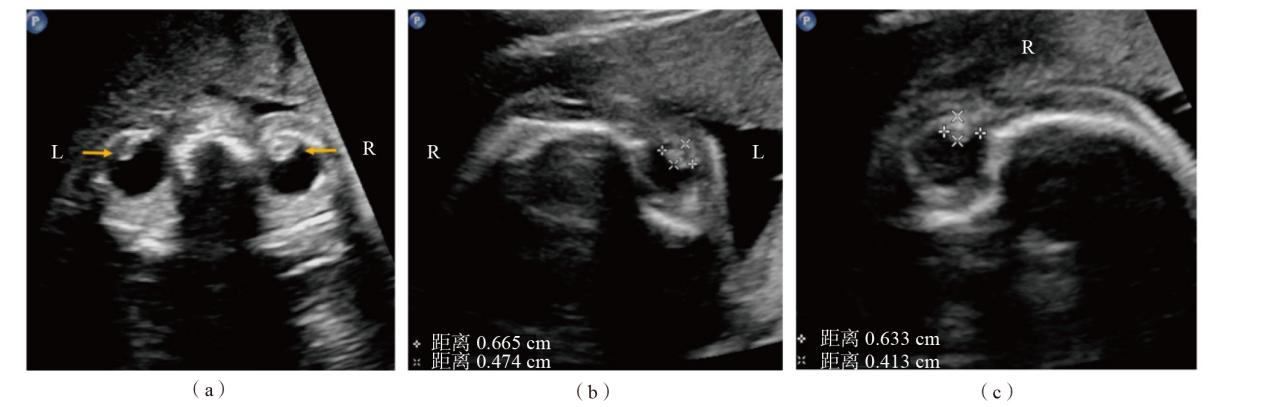
图1 孕24+3周胎儿四维医学彩色超声检查结果 注:(a)经双眼眶水平横切面,双眼晶状体内强回声光团(黄色箭头示);(b)测量左眼晶状体内强回声光团;(c)测量右眼晶状体内强回声光团;L为左侧;R为右侧。
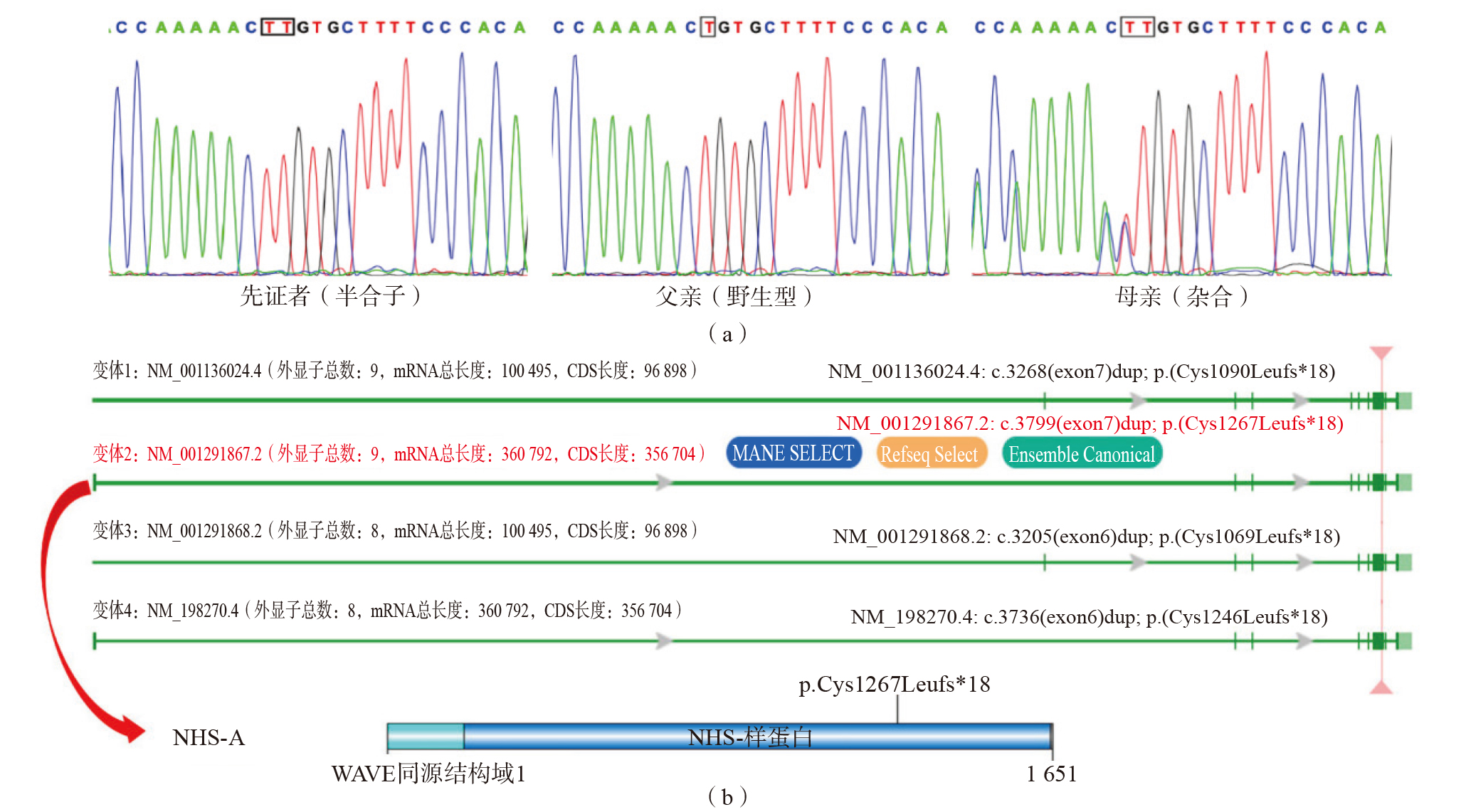
图2 胎儿及其父母Sanger测序图和基因、蛋白结构示意图 注:(a)胎儿NHS基因发生半合子变异c.3799dup(p.Cys1267Leufs*18),其母亲携带该变异,父亲为野生型;(b)NHS基因有4个转录本,以NM_001291867.2为主转录本,该胎儿半合子变异为c.3799dup(p.Cys1267Leufs*18),导致全长1 651个氨基酸的NHS-A蛋白变为1 283个氨基酸的异常截短蛋白。
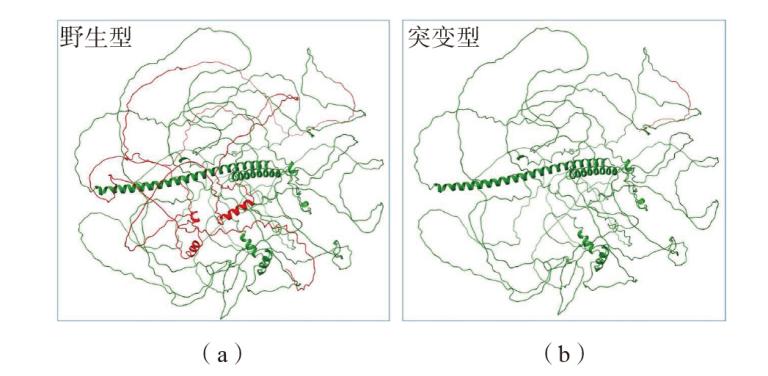
图3 NHS蛋白结构分析 注:(a)野生型;(b)突变型;绿色区域为正常区域,红色区域为变异区域。
| 参考文献 | 发表 时间 | 病例数 | 白内障 | 孕周 | 家族史 | 遗传原因 | 妊娠结局 |
|---|---|---|---|---|---|---|---|
| 本例胎儿 | 1 | 双侧 | 24 | 无 | NHS基因变异(c.3799dup) | 终止妊娠 | |
| GAARY等[ | 1993年 | 1 | 双侧 | 18 | 有 | 终止妊娠 | |
| MONTEAGUDO等[ | 1996年 | 3 | 2例双侧,1例单侧 | 15 | 有 | 终止妊娠 | |
| DRYSDALE等[ | 1997年 | 1 | 双侧 | 19 | 有 | 出生 | |
| BURGESS等[ | 1998年 | 1 | 双侧 | 18 | 无 | 出生 | |
| CENGIZ等[ | 2001年 | 1 | 双侧 | 26 | 无 | 出生 | |
| LEHMAN等[ | 2003年 | 1 | 单侧 | 28 | 无 | 出生 | |
| MASHIACH等[ | 2004年 | 4 | 3例双侧,1例单侧 | 15 | 均有 | 1例终止妊娠 | |
| RECHES等[ | 2007年 | 1 | 双侧 | 24 | 有 | NHS基因变异(c.3908_3918del) | 终止妊娠 |
| LÉONARD等[ | 2009年 | 1 | 双侧 | 27 | 无 | 出生 | |
| DASKALAKIS等[ | 2010年 | 1 | 双侧 | 22 | 无 | 出生 | |
| LEE等[ | 2013年 | 2 | 双侧 | 36 | 有 | 出生 | |
| CHEN等[ | 2015年 | 1 | 双侧 | 22 | 无 | 终止妊娠 | |
| TRKOVA等[ | 2016年 | 1 | 双侧 | 13 | 有 | RAB3GAP1基因复合杂合变异(p.Glu180*/p.Arg315*) | 出生 |
| 朱湘玉等[ | 2017年 | 1 | 双侧 | 无 | Xq25q26.1缺失引起的Lowe综合征 | 终止妊娠 | |
| AKSAY等[ | 2020年 | 1 | 双侧 | 21 | 无 | CRYBB1基因纯合变异(p.Lys252Arg) | 终止妊娠 |
| JUNG等[ | 2021年 | 8 | 7例双侧,1例单侧 | 26 | 3例有 | 出生 | |
| QIN等[ | 2022年 | 41 | 32例双侧,9例单侧 | 27 | 6例有 | 2 例非整倍体 | 31例终止 妊娠 |
| ZHENG等[ | 2022年 | 1 | 双侧 | 24 | 无 | OCRL基因变异(p.R334*) | 终止妊娠 |
| ROUXEL等[ | 2022年 | 1 | 双侧 | 21 | 有 | OCRL基因变异(p.Asp451Asn) | 终止妊娠 |
| TRAN等[ | 2022年 | 1 | 双侧 | 22 | 有 | NHS基因变异(c.107_109delCGCinsGG) | 终止妊娠 |
| ABDALLAH等[ | 2023年 | 1 | 双侧 | 23 | 无 | JAM3基因纯合变异(c.745dup) | 出生 |
| ITO等[ | 2024年 | 1 | 双侧 | 25 | 有 | 出生 | |
| MAILLET等[ | 2024年 | 5 | 均为双侧 | 1例终止妊娠 | |||
| BURRILL等[ | 2024年 | 1 | 单侧 | 有 | OCRL基因变异(c.2582-1G>C) | 终止妊娠 |
表1 通过产前超声检查诊断CC的胎儿的临床资料分析
| 参考文献 | 发表 时间 | 病例数 | 白内障 | 孕周 | 家族史 | 遗传原因 | 妊娠结局 |
|---|---|---|---|---|---|---|---|
| 本例胎儿 | 1 | 双侧 | 24 | 无 | NHS基因变异(c.3799dup) | 终止妊娠 | |
| GAARY等[ | 1993年 | 1 | 双侧 | 18 | 有 | 终止妊娠 | |
| MONTEAGUDO等[ | 1996年 | 3 | 2例双侧,1例单侧 | 15 | 有 | 终止妊娠 | |
| DRYSDALE等[ | 1997年 | 1 | 双侧 | 19 | 有 | 出生 | |
| BURGESS等[ | 1998年 | 1 | 双侧 | 18 | 无 | 出生 | |
| CENGIZ等[ | 2001年 | 1 | 双侧 | 26 | 无 | 出生 | |
| LEHMAN等[ | 2003年 | 1 | 单侧 | 28 | 无 | 出生 | |
| MASHIACH等[ | 2004年 | 4 | 3例双侧,1例单侧 | 15 | 均有 | 1例终止妊娠 | |
| RECHES等[ | 2007年 | 1 | 双侧 | 24 | 有 | NHS基因变异(c.3908_3918del) | 终止妊娠 |
| LÉONARD等[ | 2009年 | 1 | 双侧 | 27 | 无 | 出生 | |
| DASKALAKIS等[ | 2010年 | 1 | 双侧 | 22 | 无 | 出生 | |
| LEE等[ | 2013年 | 2 | 双侧 | 36 | 有 | 出生 | |
| CHEN等[ | 2015年 | 1 | 双侧 | 22 | 无 | 终止妊娠 | |
| TRKOVA等[ | 2016年 | 1 | 双侧 | 13 | 有 | RAB3GAP1基因复合杂合变异(p.Glu180*/p.Arg315*) | 出生 |
| 朱湘玉等[ | 2017年 | 1 | 双侧 | 无 | Xq25q26.1缺失引起的Lowe综合征 | 终止妊娠 | |
| AKSAY等[ | 2020年 | 1 | 双侧 | 21 | 无 | CRYBB1基因纯合变异(p.Lys252Arg) | 终止妊娠 |
| JUNG等[ | 2021年 | 8 | 7例双侧,1例单侧 | 26 | 3例有 | 出生 | |
| QIN等[ | 2022年 | 41 | 32例双侧,9例单侧 | 27 | 6例有 | 2 例非整倍体 | 31例终止 妊娠 |
| ZHENG等[ | 2022年 | 1 | 双侧 | 24 | 无 | OCRL基因变异(p.R334*) | 终止妊娠 |
| ROUXEL等[ | 2022年 | 1 | 双侧 | 21 | 有 | OCRL基因变异(p.Asp451Asn) | 终止妊娠 |
| TRAN等[ | 2022年 | 1 | 双侧 | 22 | 有 | NHS基因变异(c.107_109delCGCinsGG) | 终止妊娠 |
| ABDALLAH等[ | 2023年 | 1 | 双侧 | 23 | 无 | JAM3基因纯合变异(c.745dup) | 出生 |
| ITO等[ | 2024年 | 1 | 双侧 | 25 | 有 | 出生 | |
| MAILLET等[ | 2024年 | 5 | 均为双侧 | 1例终止妊娠 | |||
| BURRILL等[ | 2024年 | 1 | 单侧 | 有 | OCRL基因变异(c.2582-1G>C) | 终止妊娠 |
| [1] |
LECCA M, MAURI L, GANA S, et al. Novel molecular,structural and clinical findings in an Italian cohort of congenital cataract[J]. Clin Genet, 2024, 106(4):403-412.
DOI URL |
| [2] |
BERRY V, IONIDES A, PONTIKOS N, et al. The genetic landscape of crystallins in congenital cataract[J]. Orphanet J Rare Dis, 2020, 15(1):333.
DOI PMID |
| [3] |
LIU H L, ZHANG D W, HU F Y, et al. Mutational spectrum in a Chinese cohort with congenital cataracts[J]. Mol Genet Genomic Med, 2023, 11(9):e2196.
DOI URL |
| [4] |
LI H, YANG L, SUN Z, et al. A novel small deletion in the NHS gene associated with Nance-Horan syndrome[J]. Sci Rep, 2018, 8(1):2398.
DOI |
| [5] |
HUANG Y, MA L, ZHANG Z, et al. Nance-Horan syndrome pedigree due to a novel microdeletion and skewed X chromosome inactivation[J]. Mol Genet Genomic Med, 2023, 11(2):e2100.
DOI URL |
| [6] |
YU X, ZHAO Y, YANG Z, et al. Genetic research on Nance-Horan syndrome caused by a novel mutation in the NHS gene[J]. Gene, 2024, 906:148223.
DOI URL |
| [7] | RICHARDS S, AZIZ N, BALE S, et al. Standards and guidelines for the interpretation of sequence variants:a joint consensus recommendation of the American College of Medical Genetics and Genomics and the Association for Molecular Pathology[J]. Genet Med, 2015, 17(5):405-424. |
| [8] |
GAARY E A, RAWNSLEY E, MARIN-PADILLA J M, et al. In utero detection of fetal cataracts[J]. J Ultrasound Med, 1993, 12(4):234-236.
PMID |
| [9] |
MONTEAGUDO A, TIMOR-TRITSCH I E, FRIEDMAN A H, et al. Autosomal dominant cataracts of the fetus:early detection by transvaginal ultrasound[J]. Ultrasound Obstet Gynecol, 1996, 8(2):104-108.
DOI URL |
| [10] |
DRYSDALE K, KYLE P M, SEPULVEDA W. Prenatal detection of congenital inherited cataracts[J]. Ultrasound Obstet Gynecol, 1997, 9(1):62-63.
DOI URL |
| [11] |
BURGESS I A, MARTIN S L, HINES B A, et al. Prenatal detection of congenital idiopathic cataracts[J]. Med J Aust, 1998, 169(7):385-386.
DOI PMID |
| [12] |
CENGIZ B, BAXI L. Congenital cataract in triplet pregnancy after ivf with frozen embryos:prenatal diagnosis and management[J]. Fetal Diagn Ther, 2001, 16(4):234-236.
DOI URL |
| [13] |
LEHMAN S S. Antenatal ophthalmology[J]. J AAPOS, 2003, 7(6):428-429.
PMID |
| [14] |
MASHIACH R, VARDIMON D, KAPLAN B, et al. Early sonographic detection of recurrent fetal eye anomalies[J]. Ultrasound Obstet Gynecol, 2004, 24(6):640-643.
DOI URL |
| [15] |
RECHES A, YARON Y, BURDON K, et al. Prenatal detection of congenital bilateral cataract leading to the diagnosis of Nance-Horan syndrome in the extended family[J]. Prenat Diagn, 2007, 27(7):662-664.
DOI URL |
| [16] |
LÉONARD A, BERNARD P, HIEL A L, et al. Prenatal diagnosis of fetal cataract:case report and review of the literature[J]. Fetal Diagn Ther, 2009, 26(2):61-67.
DOI URL |
| [17] |
DASKALAKIS G, ANASTASAKIS E, LYBEROPOULOS E, et al. Prenatal detection of congenital cataract in a fetus with Lowe syndrome[J]. J Obstet Gynaecol, 2010, 30(4):409-410.
DOI PMID |
| [18] |
LEE K A, PARK M H, KIM Y J, et al. Isolated congenital hereditary cataract in a dizygotic twin:prenatal ultrasonographic diagnosis[J]. Twin Res Hum Genet, 2013, 16(5):994-997.
DOI URL |
| [19] |
CHEN P F, TSAI P Y, CHENG Y C, et al. Congenital cataracts diagnosed by prenatal ultrasound[J]. Taiwan J Obstet Gynecol, 2015, 54(4):461-462.
DOI URL |
| [20] |
TRKOVA M, HYNEK M, DUDAKOVA L, et al. Early detection of bilateral cataracts in utero may represent a manifestation of severe congenital disease[J]. Am J Med Genet A, 2016, 170(7):1843-1848.
DOI PMID |
| [21] | 朱湘玉, 李洁, 茹彤, 等. 一例由Xq25-26缺失引起的眼脑肾综合征的产前诊断及随访[J]. 中华医学遗传学杂志, 2017, 34(2):236-239. |
| [22] |
AKSAY S, BILDIRICI I, COAR C B, et al. Intrauterine cataract diagnosis and follow-up[J]. Turk J Ophthalmol, 2020, 50(4):245-247.
DOI PMID |
| [23] |
JUNG E H, LEE B J, YU Y S, et al. Postnatal ophthalmological characteristics in patients with congenital cataract diagnosed by fetal ultrasonography[J]. J Matern Fetal Neonatal Med, 2021, 34(20):3386-3392.
DOI URL |
| [24] |
QIN Y, ZHONG X, WEN H, et al. Prenatal diagnosis of congenital cataract:sonographic features and perinatal outcome in 41 cases[J]. Ultraschall Med, 2022, 43(6):e125-e134.
DOI URL |
| [25] | ZHENG Y, LI L, WANG L, et al. Prenatal ultrasound findings of X-linked congenital cataracts:case report and description of a novel variant[J]. Am J Transl Res, 2022, 14(12):9066-9071. |
| [26] |
ROUXEL F, FAURé J, FAURE J M, et al. Prenatal diagnosis of Lowe syndrome in a male fetus with isolated bilateral cataract[J]. Heliyon, 2022, 8(12):e12210.
DOI URL |
| [27] |
TRAN MAU-THEM F, DELANNE J, DENOMMÉ-PICHON A S, et al. Prenatal diagnosis by trio exome sequencing in fetuses with ultrasound anomalies:a powerful diagnostic tool[J]. Front Genet, 2023, 14:1099995.
DOI URL |
| [28] |
ABDALLAH MOADY T, ODEH M, FEDIDA A, et al. Case report:novel insights into hemorrhagic destruction of the brain,subependymal calcification,and cataracts disease[J]. Front Pediatr, 2023, 11:1178280.
DOI URL |
| [29] | ITO M, NEGISHI T, FUNAYAMA S, et al. Early detection and treatment of congenital cataracts using fetal ultrasound:a case of a newborn with a family history of congenital cataracts[J]. Cureus, 2024, 16(1):e53189. |
| [30] |
MAILLET C, GUILBAUD L, MONIER I, et al. Prevalence and prenatal diagnosis of congenital eye anomalies:a population-based study[J]. BJOG, 2024, 131(10):1385-1391.
DOI URL |
| [31] |
BURRILL N, KHALEK N, OLIVER E R, et al. Case report of fetus with Lowe syndrome:expanding the prenatal phenotype[J]. Prenat Diagn, 2024, 44(5):665-668.
DOI URL |
| [32] |
COCCIA M, BROOKS S P, WEBB T R, et al. X-linked cataract and Nance-Horan syndrome are allelic disorders[J]. Hum Mol Genet, 2009, 18(14):2643-2655.
DOI PMID |
| [33] |
HUANG K M, WU J, DUNCAN M K, et al. Xcat,a novel mouse model for Nance-Horan syndrome inhibits expression of the cytoplasmic-targeted Nhs1 isoform[J]. Hum Mol Genet, 2006, 15(2):319-327.
DOI URL |
| [34] |
WEN H, LI Q, MEI S, et al. A novel frameshift mutation in the NHS gene causes Nance-Horan syndrome in a Chinese family[J]. Gene, 2024, 907:148268.
DOI URL |
| [35] |
FOX J C, DUTTA R, NIHALANI B R, et al. Identification of pathogenic genetic variants in patients with acquired early-onset bilateral cataracts using next-generation sequencing[J]. J AAPOS, 2024, 28(1):103808.
DOI URL |
| [36] |
KAGAN K O, TOST F, HELING K S, et al. Fetal eye ultrasound:normal anatomy,abnormal findings,and clinical impact[J]. Ultraschall Med, 2024, 45(5):450-474.
DOI URL |
| [37] |
EMMS A, CASTLEMAN J, ALLEN S, et al. Next generation sequencing after invasive prenatal testing in fetuses with congenital malformations:prenatal or neonatal investigation[J]. Genes (Basel), 2022, 13(9):1517.
DOI URL |
| [38] |
MUSTAFA H J, BARBERA J P, SAMBATUR E V, et al. Diagnostic yield of exome sequencing in prenatal agenesis of corpus callosum:systematic review and meta-analysis[J]. Ultrasound Obstet Gynecol, 2024, 63(3):312-320.
DOI URL |
| [39] |
REILLY K, SONNER S, MCCAY N, et al. The incremental yield of prenatal exome sequencing over chromosome microarray for congenital heart abnormalities:a systematic review and meta-analysis[J]. Prenat Diagn, 2024, 44(6):821-831.
DOI URL |
| [40] |
CHANDLER N J, SCOTCHMAN E, MELLIS R, et al. Lessons learnt from prenatal exome sequencing[J]. Prenat Diagn, 2022, 42(7):831-844.
DOI URL |
| [41] |
GUVEN Y, SARACOGLU H P, AKSAKAL S D, et al. Nance-Horan syndrome:characterization of dental,clinical and molecular features in three new families[J]. BMC Oral Health, 2023, 23(1):314.
DOI |
| [42] |
SHARMA S, DATTA P, SABHARWAL J R, et al. Nance-Horan syndrome:a rare case report[J]. Contemp Clin Dent, 2017, 8(3):469-472.
DOI URL |
| [43] |
FU F, LI R, YU Q, et al. Application of exome sequencing for prenatal diagnosis of fetal structural anomalies:clinical experience and lessons learned from a cohort of 1 618 fetuses[J]. Genome Med, 2022, 14(1):123.
DOI |
| [44] |
SINGER-BERK M, GUDMUNDSSON S, BAXTER S, et al. Advanced variant classification framework reduces the false positive rate of predicted loss-of-function variants in population sequencing data[J]. Am J Hum Genet, 2023, 110(9):1496-1508.
DOI URL |
| [45] | SHRESTHA S K, LACHKE S A. Lens regeneration:the application of iSyTE and in Silico approaches to evaluate gene expression in lens organoids[J]. Methods Mol Biol, 2025, 2848:37-58. |
| [46] | 李莉, 郑广瑛, 宋佳茜, 等. NHS基因变异导致3个Nance-Horan综合征家系的临床和遗传学特征分析[J]. 中华眼科杂志, 2024, 60(9):757-765. |
| [1] | 夏远志, 尹向飞, 林斯恩, 梁小亮. 基于Meta分析评估BoBs技术在染色体非整倍体异常产前诊断中的价值[J]. 检验医学, 2025, 40(5): 477-483. |
| [2] | 郭玮. 基因检测技术在罕见病诊疗中的应用前景及挑战[J]. 检验医学, 2025, 40(2): 105-108. |
| [3] | 卢亚亚, 王亚琼, 彭慧芳, 娄丹. Ⅰ型神经纤维瘤病合并CDK13相关疾病1例报道并文献复习[J]. 检验医学, 2025, 40(2): 154-159. |
| [4] | 靳春雷, 胡辉, 刘姣, 杨慕枫, 单群达, 陈鹏龙. 单核苷酸多态性微阵列分析技术在不同产前诊断指征孕妇中的应用价值[J]. 检验医学, 2024, 39(9): 841-846. |
| [5] | 卢亚亚, 彭慧芳, 王剑, 娄丹. Sin3A基因变异致Witteveen-Kolk综合征遗传学分析[J]. 检验医学, 2024, 39(2): 126-131. |
| [6] | 杨微微, 姚立英, 任晨春, 王文靖, 张海霞, 李雯, 李博. 884例性染色体异常胎儿产前诊断结果分析[J]. 检验医学, 2024, 39(2): 149-154. |
| [7] | 韩雪, 闻柳, 宛杨. 唐氏筛查临界或高风险孕妇羊水染色体核型和基因组拷贝数变异结果分析[J]. 检验医学, 2023, 38(6): 548-552. |
| [8] | 张楚, 王建红, 李瑞, 肖艳华, 王恒, 张品肖, 徐凝馨, 夏半半. 5 696例孕妇拓展性无创产前基因检测结果[J]. 检验医学, 2023, 38(6): 553-558. |
| [9] | 郁婷婷, 王剑. 罕见病诊疗进展与挑战[J]. 检验医学, 2023, 38(2): 103-105. |
| [10] | 蔡潇艺, 娄丹, 杨兴鸽, 王剑. 15例疑似假肥大性肌营养不良患儿遗传学分析[J]. 检验医学, 2023, 38(2): 106-111. |
| [11] | 蔡春艳, 上官华坤, 吴文涌, 张莹, 袁欣, 陈瑞敏. HUWE1基因变异致X连锁智力障碍临床表型和遗传学分析[J]. 检验医学, 2023, 38(2): 117-123. |
| [12] | 闫安, 关煦慧子, 蔚田, 缪刚, 赵艳阳. 基于WES识别中国人群甲状腺乳头状癌新易感基因变异EPB41L4A rs1455421289[J]. 检验医学, 2023, 38(11): 1009-1014. |
| [13] | 易薇, 番云华, 刘厚昌, 禹崇飞, 杨必清, 葛世军, 林克勤, 褚嘉祐, 杨昭庆. 全外显子组测序在9p缺失综合征诊断中的应用[J]. 检验医学, 2022, 37(6): 539-542. |
| [14] | 孙雷, 龙驹, 樊祖茜, 吴素萍, 林桂先, 凌秀明. 双重相对定量SD-qPCR在快速诊断性染色体变异中的应用[J]. 检验医学, 2022, 37(6): 557-560. |
| [15] | 赵旭亮, 田瑞霞, 施友文, 俞敏, 焦鎏鎏, 朱复希. 全外显子家系测序在WDR35基因复合杂合变异导致SRPS-5胎儿产前诊断中的价值[J]. 检验医学, 2022, 37(10): 928-933. |
| 阅读次数 | ||||||
|
全文 |
|
|||||
|
摘要 |
|
|||||

