
Laboratory Medicine ›› 2026, Vol. 41 ›› Issue (4): 391-397.DOI: 10.3969/j.issn.1673-8640.2026.04.013
Previous Articles Next Articles
WANG Mian1, WANG Binbin2, SONG Zhiqiang2, YAO Yonghua1, TANG Gusheng2( )
)
Received:2024-10-29
Revised:2025-03-10
Online:2026-04-30
Published:2026-05-07
CLC Number:
WANG Mian, WANG Binbin, SONG Zhiqiang, YAO Yonghua, TANG Gusheng. An early prediction model for central nervous system leukemia/lymphoma infiltration of hematological malignancies based on significantly differential metabolomics[J]. Laboratory Medicine, 2026, 41(4): 391-397.
Add to citation manager EndNote|Ris|BibTeX
URL: https://www.shjyyx.com/EN/10.3969/j.issn.1673-8640.2026.04.013
| 组别 | 例数 | 白细胞计数/ (×106 L-1) | 葡萄糖/(mmol·L-1) | 蛋白质浓度/ (g·L-1) | 流式细胞术检测的异常 细胞百分比/% |
|---|---|---|---|---|---|
| CNSL组 | 25 | 11.00(2.00~45.00) | 3.00(2.73~3.85) | 0.44(0.31~0.67) | 50.138(15.212~79.108) |
| 对照组 | 29 | 1.00(0.00~2.00) | 3.50(3.20~3.80) | 0.29(0.25~0.33) | 0 |
| 统计值 | 4.095 | 1.764 | 3.583 | 6.840 | |
| P值 | <0.010 | 0.078 | <0.010 | <0.010 |
| 组别 | 例数 | 白细胞计数/ (×106 L-1) | 葡萄糖/(mmol·L-1) | 蛋白质浓度/ (g·L-1) | 流式细胞术检测的异常 细胞百分比/% |
|---|---|---|---|---|---|
| CNSL组 | 25 | 11.00(2.00~45.00) | 3.00(2.73~3.85) | 0.44(0.31~0.67) | 50.138(15.212~79.108) |
| 对照组 | 29 | 1.00(0.00~2.00) | 3.50(3.20~3.80) | 0.29(0.25~0.33) | 0 |
| 统计值 | 4.095 | 1.764 | 3.583 | 6.840 | |
| P值 | <0.010 | 0.078 | <0.010 | <0.010 |
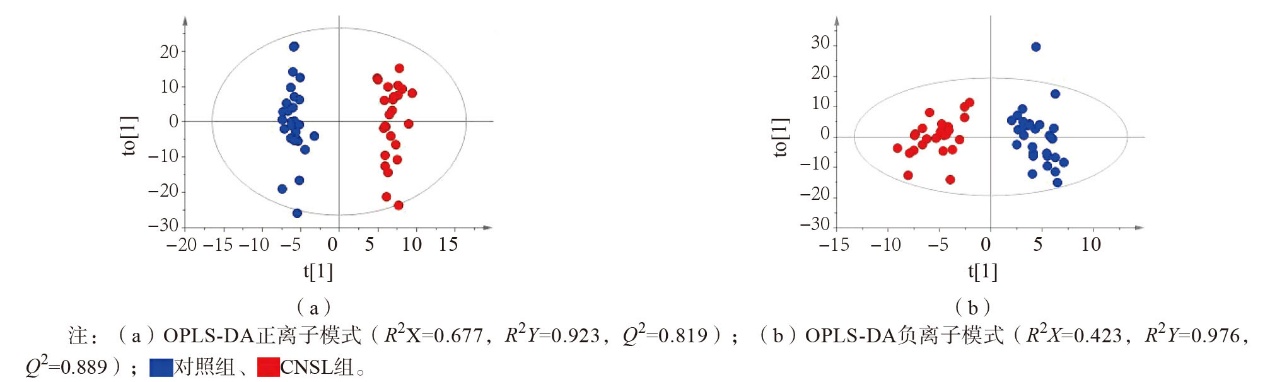
| 代谢物 | 变化趋势① | P值 | VIP②值 | 倍数变化③ |
|---|---|---|---|---|
| L-精氨酸 | ↑ | <0.010 0 | 1.17 | 1.31 |
| L-高胱氨酸 | ↓ | <0.050 0 | 1.17 | 0.72 |
| D-核糖 | ↓ | <0.050 0 | 1.18 | 0.81 |
| 溶血磷脂胆碱(6:0/0:0) | ↑ | <0.010 0 | 1.21 | 1.94 |
| 二氢胸腺嘧啶 | ↑ | <0.010 0 | 1.23 | 1.32 |
| N(6)-甲基赖氨酸 | ↑ | <0.010 0 | 1.22 | 2.07 |
| 多巴胺 | ↑ | <0.010 0 | 1.29 | 1.25 |
| 2-甲基柠檬酸 | ↓ | <0.010 0 | 1.36 | 0.60 |
| 生物素 | ↓ | <0.010 0 | 1.38 | 0.69 |
| 瓜氨酸 | ↑ | <0.010 0 | 1.39 | 1.93 |
| α-酮异戊酸 | ↑ | <0.010 0 | 1.40 | 1.43 |
| 羟基乙酸 | ↓ | <0.010 0 | 1.40 | 0.75 |
| 黄嘌呤 | ↑ | <0.010 0 | 1.44 | 1.80 |
| L-组氨酸 | ↑ | <0.010 0 | 1.51 | 2.62 |
| 甘油磷酰胆碱 | ↑ | <0.010 0 | 1.59 | 1.48 |
| L-谷氨酰胺 | ↑ | <0.001 0 | 1.64 | 1.51 |
| N-γ-谷氨酰胺 | ↑ | <0.001 0 | 1.79 | 1.87 |
| 维生素B1 | ↓ | <0.001 0 | 1.79 | 0.59 |
| 泛酸 | ↓ | <0.000 1 | 1.79 | 0.63 |
| N-乙酰神经氨酸 | ↓ | <0.000 1 | 1.87 | 0.49 |
| L-胱氨酸 | ↑ | <0.001 0 | 2.01 | 3.85 |
| 腺苷 | ↓ | <0.000 1 | 2.17 | 0.39 |
| L-缬氨酸 | ↓ | <0.010 0 | 1.38 | 0.57 |
| L-左旋谷氨酸 | ↓ | <0.001 0 | 1.62 | 0.61 |
| 4-吡哆酸 | ↓ | <0.000 1 | 1.70 | 0.50 |
| 肌酸 | ↓ | <0.050 0 | 1.05 | 0.28 |
| 甘露醇 | ↓ | <0.050 0 | 1.13 | 0.28 |
| 尿素 | ↓ | <0.050 0 | 1.15 | 0.21 |
| α-生育酚 | ↓ | <0.050 0 | 1.18 | 0.32 |
| L-天冬酰胺 | ↑ | <0.050 0 | 1.20 | 1.33 |
| 2-羟基丁酸 | ↑ | <0.050 0 | 1.22 | 1.32 |
| 焦谷氨酸 | ↓ | <0.010 0 | 1.22 | 0.22 |
| L-色氨酸 | ↑ | <0.050 0 | 1.32 | 2.01 |
| 次黄嘌呤 | ↓ | <0.000 1 | 1.73 | 0.64 |
| 副黄嘌呤 | ↓ | <0.000 1 | 1.81 | 0.48 |
| L-乳酸 | ↓ | <0.000 1 | 1.86 | 0.46 |
| 代谢物 | 变化趋势① | P值 | VIP②值 | 倍数变化③ |
|---|---|---|---|---|
| L-精氨酸 | ↑ | <0.010 0 | 1.17 | 1.31 |
| L-高胱氨酸 | ↓ | <0.050 0 | 1.17 | 0.72 |
| D-核糖 | ↓ | <0.050 0 | 1.18 | 0.81 |
| 溶血磷脂胆碱(6:0/0:0) | ↑ | <0.010 0 | 1.21 | 1.94 |
| 二氢胸腺嘧啶 | ↑ | <0.010 0 | 1.23 | 1.32 |
| N(6)-甲基赖氨酸 | ↑ | <0.010 0 | 1.22 | 2.07 |
| 多巴胺 | ↑ | <0.010 0 | 1.29 | 1.25 |
| 2-甲基柠檬酸 | ↓ | <0.010 0 | 1.36 | 0.60 |
| 生物素 | ↓ | <0.010 0 | 1.38 | 0.69 |
| 瓜氨酸 | ↑ | <0.010 0 | 1.39 | 1.93 |
| α-酮异戊酸 | ↑ | <0.010 0 | 1.40 | 1.43 |
| 羟基乙酸 | ↓ | <0.010 0 | 1.40 | 0.75 |
| 黄嘌呤 | ↑ | <0.010 0 | 1.44 | 1.80 |
| L-组氨酸 | ↑ | <0.010 0 | 1.51 | 2.62 |
| 甘油磷酰胆碱 | ↑ | <0.010 0 | 1.59 | 1.48 |
| L-谷氨酰胺 | ↑ | <0.001 0 | 1.64 | 1.51 |
| N-γ-谷氨酰胺 | ↑ | <0.001 0 | 1.79 | 1.87 |
| 维生素B1 | ↓ | <0.001 0 | 1.79 | 0.59 |
| 泛酸 | ↓ | <0.000 1 | 1.79 | 0.63 |
| N-乙酰神经氨酸 | ↓ | <0.000 1 | 1.87 | 0.49 |
| L-胱氨酸 | ↑ | <0.001 0 | 2.01 | 3.85 |
| 腺苷 | ↓ | <0.000 1 | 2.17 | 0.39 |
| L-缬氨酸 | ↓ | <0.010 0 | 1.38 | 0.57 |
| L-左旋谷氨酸 | ↓ | <0.001 0 | 1.62 | 0.61 |
| 4-吡哆酸 | ↓ | <0.000 1 | 1.70 | 0.50 |
| 肌酸 | ↓ | <0.050 0 | 1.05 | 0.28 |
| 甘露醇 | ↓ | <0.050 0 | 1.13 | 0.28 |
| 尿素 | ↓ | <0.050 0 | 1.15 | 0.21 |
| α-生育酚 | ↓ | <0.050 0 | 1.18 | 0.32 |
| L-天冬酰胺 | ↑ | <0.050 0 | 1.20 | 1.33 |
| 2-羟基丁酸 | ↑ | <0.050 0 | 1.22 | 1.32 |
| 焦谷氨酸 | ↓ | <0.010 0 | 1.22 | 0.22 |
| L-色氨酸 | ↑ | <0.050 0 | 1.32 | 2.01 |
| 次黄嘌呤 | ↓ | <0.000 1 | 1.73 | 0.64 |
| 副黄嘌呤 | ↓ | <0.000 1 | 1.81 | 0.48 |
| L-乳酸 | ↓ | <0.000 1 | 1.86 | 0.46 |
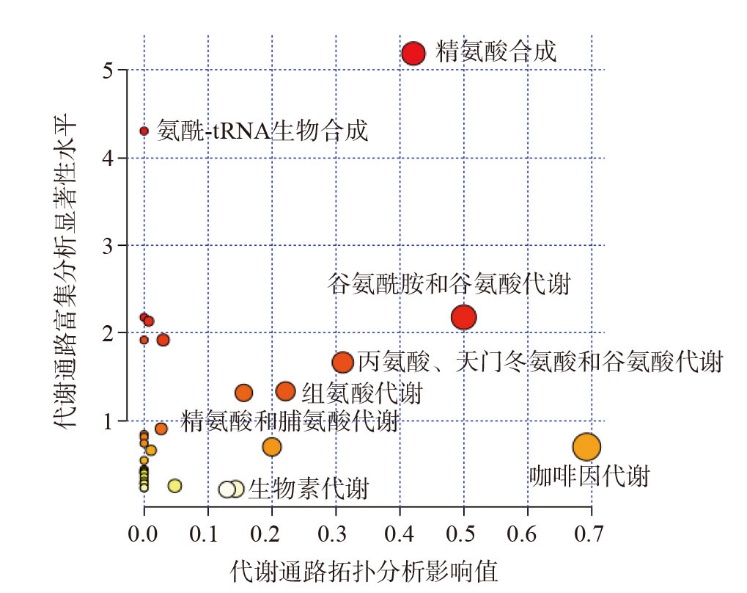
| 通路名称 | 代谢物总数/个 | 命中数/个 | P值 | 通路影响值 |
|---|---|---|---|---|
| 精氨酸合成 | 14 | 5 | <0.000 1 | 0.42 |
| D-谷氨酰胺和D-谷氨酸的代谢 | 6 | 2 | <0.010 0 | 0.50 |
| 丙氨酸、天门冬氨酸和谷氨酸代谢 | 28 | 3 | <0.050 0 | 0.31 |
| 组氨酸代谢 | 16 | 2 | <0.050 0 | 0.22 |
| 精氨酸和脯氨酸的代谢 | 38 | 3 | <0.010 0 | 0.16 |
| 通路名称 | 代谢物总数/个 | 命中数/个 | P值 | 通路影响值 |
|---|---|---|---|---|
| 精氨酸合成 | 14 | 5 | <0.000 1 | 0.42 |
| D-谷氨酰胺和D-谷氨酸的代谢 | 6 | 2 | <0.010 0 | 0.50 |
| 丙氨酸、天门冬氨酸和谷氨酸代谢 | 28 | 3 | <0.050 0 | 0.31 |
| 组氨酸代谢 | 16 | 2 | <0.050 0 | 0.22 |
| 精氨酸和脯氨酸的代谢 | 38 | 3 | <0.010 0 | 0.16 |
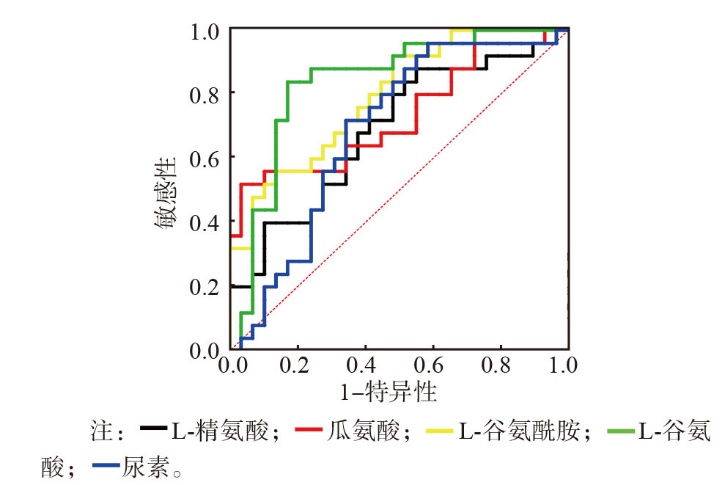
| 项目 | 单因素分析 | 多因素分析 | |||||||||
|---|---|---|---|---|---|---|---|---|---|---|---|
| β值 | 标准误 | Wald值 | OR值(95%CI) | P值 | β值 | 标准误 | Wald值 | OR值(95%CI) | P值 | ||
| 瓜氨酸 | 5.709 | 2.030 | 7.911 | 301.471 (5.645~16 100.546) | 0.005 | -16.281 | 7.561 | 4.636 | 8.493 2E-8 (3.111E-14~0.232) | 0.031 | |
| L-谷氨酰胺 | 0.052 | 0.016 | 9.963 | 1.053(1.020~1.087) | 0.002 | 0.160 | 0.059 | 7.260 | 1.174(1.045~1.318) | 0.007 | |
| L-谷氨酸 | -6.524 | 2.188 | 8.890 | 0.001(2.0E-5~0.107) | 0.003 | -4.125 | 4.063 | 1.031 | 0.016(6.0E-6~46.408) | 0.310 | |
| 脑脊液白细胞 | 0.223 | 0.099 | 5.034 | 1.250(1.029~1.519) | 0.025 | 0.489 | 0.347 | 1.986 | 1.630(0.826~3.215) | 0.159 | |
| 脑脊液蛋白质 | 8.883 | 3.289 | 7.295 | 7 210.692 (11.441~4 544 619.276) | 0.007 | 21.613 | 9.031 | 5.727 | 2 435 559 329(50.009~1.186E+17) | 0.017 | |
| 项目 | 单因素分析 | 多因素分析 | |||||||||
|---|---|---|---|---|---|---|---|---|---|---|---|
| β值 | 标准误 | Wald值 | OR值(95%CI) | P值 | β值 | 标准误 | Wald值 | OR值(95%CI) | P值 | ||
| 瓜氨酸 | 5.709 | 2.030 | 7.911 | 301.471 (5.645~16 100.546) | 0.005 | -16.281 | 7.561 | 4.636 | 8.493 2E-8 (3.111E-14~0.232) | 0.031 | |
| L-谷氨酰胺 | 0.052 | 0.016 | 9.963 | 1.053(1.020~1.087) | 0.002 | 0.160 | 0.059 | 7.260 | 1.174(1.045~1.318) | 0.007 | |
| L-谷氨酸 | -6.524 | 2.188 | 8.890 | 0.001(2.0E-5~0.107) | 0.003 | -4.125 | 4.063 | 1.031 | 0.016(6.0E-6~46.408) | 0.310 | |
| 脑脊液白细胞 | 0.223 | 0.099 | 5.034 | 1.250(1.029~1.519) | 0.025 | 0.489 | 0.347 | 1.986 | 1.630(0.826~3.215) | 0.159 | |
| 脑脊液蛋白质 | 8.883 | 3.289 | 7.295 | 7 210.692 (11.441~4 544 619.276) | 0.007 | 21.613 | 9.031 | 5.727 | 2 435 559 329(50.009~1.186E+17) | 0.017 | |
| [1] | BAILEY C, RICHARDSON L C, ALLEMANI C, et al. Adult leukemia survival trends in the United States by subtype:a population-based registry study of 370 994 patients diagnosed during 1995-2009[J]. Cancer, 2018, 124(19): 3856-3867. |
| [2] | MUNKER R, LABOPIN M, ESTEVE J, et al. Mixed phenotype acute leukemia:outcomes with allogeneic stem cell transplantation. A retrospective study from the Acute Leukemia Working Party of the EBMT[J]. Haematologica, 2017, 102(12):2134-2140. |
| [3] | ELLISON L F. Increasing survival from leukemia among adolescents and adults in Canada:a closer look[J]. Health Rep, 2016, 27(7):19-26. |
| [4] | JOHNSTON D L, ALONZO T A, GERBING R B, et al. Central nervous system disease in pediatric acute myeloid leukemia:a report from the Children's Oncology Group[J]. Pediatr Blood Cancer, 2017, 64(12):e26612. |
| [5] | CONSTANTINESCU C, BODOLEA C, PASCA S, et al. Clinical approach to the patient in critical state following immunotherapy and/or stem cell transplantation:guideline for the on-call physician[J]. J Clin Med, 2019, 8(6):884. |
| [6] | SANTAMBROGIO E, NICOLOSI M, VASSALLO F, et al. Aggressive non-Hodgkin lymphomas:risk factors and treatment of central nervous system recurrence[J]. Expert Rev Hematol, 2019, 12(9):787-796. |
| [7] | PUI C H, HOWARD S C. Current management and challenges of malignant disease in the CNS in paediatric leukaemia[J]. Lancet Oncol, 2008, 9(3):257-268. |
| [8] | KIM H K, SON S Y, OH J S, et al. Metabolic profiling during acute myeloid leukemia progression using paired clinical bone marrow serum samples[J]. Metabolites, 2021, 11(9):586. |
| [9] | FAME R M, LEHTINEN M K. Emergence and developmental roles of the cerebrospinal fluid system[J]. Dev Cell, 2020, 52(3):261-275. |
| [10] | BÁRCENAS-LÓPEZ D A, NÚÑEZ-ENRÍQUEZ J C, HIDALGO-MIRANDA A, et al. Transcriptome analysis identifies linc00152 as a biomarker of early relapse and mortality in acute lymphoblastic leukemia[J]. Genes(Basel), 2020, 11(3):302. |
| [11] | NIZIOŁ J, OSSOLIŃSKI K, TRIPET B P, et al. Nuclear magnetic resonance and surface-assisted laser desorption/ionization mass spectrometry-based serum metabolomics of kidney cancer[J]. Anal Bioanal Chem, 2020, 412(23):5827-5841. |
| [12] | NAVIAUX R K. Metabolic features of the cell danger response[J]. Mitochondrion, 2014, 16:7-17. |
| [13] | SEGAL M B. Extracellular and cerebrospinal fluids[J]. J Inherit Metab Dis, 1993, 16(4):617-638. |
| [14] | SUD M, FAHY E, COTTER D, et al. Metabolomics workbench:an international repository for metabolomics data and metadata,metabolite standards,protocols,tutorials and training,and analysis tools[J]. Nucleic Acids Res, 2016, 44(D1):D463-D470. |
| [15] | PAUL S, SHORT N J. Central nervous system involvement in adults with acute leukemia:diagnosis,prevention,and management[J]. Curr Oncol Rep, 2022, 24(4):427-436. |
| [16] | POPOV A, HENZE G, VERZHBITSKAYA T, et al. Absolute count of leukemic blasts in cerebrospinal fluid as detected by flow cytometry is a relevant prognostic factor in children with acute lymphoblastic leukemia[J]. J Cancer Res Clin Oncol, 2019, 145(5):1331-1339. |
| [17] | SHEN H, ZHAO Y, SHI Y, et al. The diagnostic and prognostic value of MRI in central nervous system involvement of acute myeloid leukemia:a retrospective cohort of 84 patients[J]. Hematology, 2020, 25(1):258-263. |
| [18] | 苏梓健, 韦佩祺, 袁莉, 等. 缺血性脑卒中代谢组学发病机制及药物干预的研究进展[J]. 中风与神经疾病杂志, 2023, 40(6):568-572. |
| [19] | MILL J, LI L. Recent advances in understanding of Alzheimer's disease progression through mass spectrometry-based metabolomics[J]. Phenomics, 2022, 2(1):1-17. |
| [20] | WANG D H, FUJITA Y, DONO A, et al. The genomic alterations in glioblastoma influence the levels of CSF metabolites[J]. Acta Neuropathol Commun, 2024, 12(1):13. |
| [21] | WANG F X, CHEN K, HUANG F Q, et al. Cerebrospinal fluid-based metabolomics to characterize different types of brain tumors[J]. J Neurol, 2020, 267(4):984-993. |
| [22] | RASHKOVAN M, FERRANDO A. Metabolic dependencies and vulnerabilities in leukemia[J]. Genes Dev, 2019, 33(21-22):1460-1474. |
| [23] | CANTOR J R, SABATINI D M. Cancer cell metabolism:one hallmark,many faces[J]. Cancer Discov, 2012, 2(10):881-898. |
| [24] | DUCKER G S, RABINOWITZ J D. One-carbon metabolism in health and disease[J]. Cell Metab, 2017, 25(1):27-42. |
| [1] | LIU Peng, CHANG Zhixin, PENG Lin, QI Dongdong. Preliminary study on the correlation between gut microbiota and metabolomics and schizophrenia [J]. Laboratory Medicine, 2026, 41(4): 374-379. |
| [2] | LIN Hui, CHEN Xiang, LI Sheng, TANG Manling. Non-targeted metabolomics analysis of atopic dermatitis in children [J]. Laboratory Medicine, 2026, 41(4): 380-385. |
| [3] | SHANG Yuanjiang, ZHU Guoqing, ZHANG Lei, SHEN Dandan, PAN Qiuhui. Application of metagenomic next-generation sequencing and traditional methods in central nervous system infection [J]. Laboratory Medicine, 2024, 39(11): 1101-1107. |
| [4] | XU Weixin, CHEN Qing, DU Wenyong, GAO Yan. Plasma metabolic markers in patients with insomnia disorder [J]. Laboratory Medicine, 2023, 38(5): 454-459. |
| [5] | CHEN Zhe, ZHANG Ling, LIU Jie, WANG Xia, ZHANG Bin, GAO Binghua. Relationship between serum miR-326 and chemotherapy sensitivity and prognosis in patients with treatment-related hematological malignancy [J]. Laboratory Medicine, 2023, 38(3): 251-256. |
| [6] | WANG Mian, YANG Jianmin, SONG Zhiqiang, TANG Gusheng. Research progress in the application of cerebrospinal fluid marker analysis in central nervous system leukemia [J]. Laboratory Medicine, 2022, 37(5): 483-488. |
| [7] | LE Jiangman, LI Tianyuan, TAN Meiyu, WANG Yajie, ZHOU Lida, SHU Jie, WU Jiaoxiang, SUN Hanxiao, XUAN Binbin, CAI Xushan, SHENG Huiming. Correlation of gestational diabetes mellitus with plasma TMAO [J]. Laboratory Medicine, 2021, 36(8): 795-799. |
| [8] | WANG Zipeng, OUYANG Changli, GENG Deqin, WANG Dunjing. Establishment of cerebrospinal fluid IL-6 reference interval in non-inflammatory central nervous system diseases [J]. Laboratory Medicine, 2021, 36(6): 627-630. |
| [9] | QIAO Yuli, HUANG Zongshuai, TIAN Yueru, GUAN Ming, JIANG Xiaofei. Primary exploration of rapid identification and drug sensitivity test of cerebrospinal fluid culture by blood culture enrichment method [J]. Laboratory Medicine, 2021, 36(3): 270-274. |
| [10] | HU Xiaobo. Current technical problem and specification of clinical body fluid analysis [J]. Laboratory Medicine, 2020, 35(11): 1087-1089. |
| [11] | LIU Jie, SHI Xinrong, ZHOU Shufen, XU Hongmin, ZHANG Lei, LIU Shuye. Serum metabolins predicting acute myocardial infarction patients' outcome [J]. Laboratory Medicine, 2019, 34(5): 383-389. |
| [12] | TIAN Guoli, ZHOU Zhuo, GUO Jing, WANG Yanmin, JI Wei. Role of gas chromatography-mass spectrometry in inherited metabolic diseases [J]. Laboratory Medicine, 2019, 34(10): 932-936. |
| [13] | FU Xiaoling, CHEN Kun, XU Jiaxue, GUAN Ming. Clinical characteristic of cerebrospinal fluid for non-small cell lung cancer patients with leptomeningeal metastasis [J]. Laboratory Medicine, 2018, 33(8): 692-696. |
| [14] | YUAN Fengxi, XUE Xiongyan, CHEN Caifeng, LAI Yuehong, LIANG Yongyi, LI Yan, XIE Wenchun, YANG Shaojie, WU Yanjie. Influence of hemolysis on the results of plasma catecholamines and their metabolites by liquid chromatography-tandem mass spectrometry [J]. Laboratory Medicine, 2018, 33(12): 1103-1107. |
| [15] | WANG Junfang, JIN Ying, NIU Weixia, LIU Jin. Fluorescence quantitation PCR for determining Mycobacterium tuberculosis DNA in cerebrospinal fluid [J]. Laboratory Medicine, 2017, 32(2): 135-137. |
| Viewed | ||||||
|
Full text |
|
|||||
|
Abstract |
|
|||||
