
Laboratory Medicine ›› 2025, Vol. 40 ›› Issue (12): 1165-1170.DOI: 10.3969/j.issn.1673-8640.2025.12.005
Previous Articles Next Articles
LI Minghong, MIN Cuili, GUO Qingbo, MA Lujuan
Received:2024-07-11
Revised:2025-05-12
Online:2025-12-30
Published:2025-12-26
CLC Number:
LI Minghong, MIN Cuili, GUO Qingbo, MA Lujuan. Predictive roles of serum 25(OH)D and SAA for the response to immunosuppressive therapy in autoimmune hepatitis[J]. Laboratory Medicine, 2025, 40(12): 1165-1170.
Add to citation manager EndNote|Ris|BibTeX
URL: https://www.shjyyx.com/EN/10.3969/j.issn.1673-8640.2025.12.005
| 组别 | 例数 | SAA/(mg·L-1) | 25(OH)D/(nmol·L-1) | AST/(U·L-1) | ALT/(U·L-1) | TB/(μmol·L-1) |
|---|---|---|---|---|---|---|
| AIH组 | 141 | 41.62±5.95 | 30.15±6.02 | 248.62±15.62 | 226.51±14.71 | 41.51±5.01 |
| 正常对照组 | 141 | 30.14±6.11 | 45.62±4.84 | 34.51±5.01 | 30.21±6.11 | 15.21±1.21 |
| t值 | 15.972 | 23.807 | 155.018 | 146.281 | 60.504 | |
| P值 | <0.001 | <0.001 | <0.001 | <0.001 | <0.001 |
| 组别 | 例数 | SAA/(mg·L-1) | 25(OH)D/(nmol·L-1) | AST/(U·L-1) | ALT/(U·L-1) | TB/(μmol·L-1) |
|---|---|---|---|---|---|---|
| AIH组 | 141 | 41.62±5.95 | 30.15±6.02 | 248.62±15.62 | 226.51±14.71 | 41.51±5.01 |
| 正常对照组 | 141 | 30.14±6.11 | 45.62±4.84 | 34.51±5.01 | 30.21±6.11 | 15.21±1.21 |
| t值 | 15.972 | 23.807 | 155.018 | 146.281 | 60.504 | |
| P值 | <0.001 | <0.001 | <0.001 | <0.001 | <0.001 |
| 项目 | SAA/(mg·L-1) | 25(OH)D/(nmol·L-1) | AST/ (U·L-1) | ALT/ (U·L-1) | TB/(μmol·L-1) | IgG/ (g·L-1) | γ-球蛋白/% | WBC计数/(×109L-1) |
|---|---|---|---|---|---|---|---|---|
| 治疗前 | 41.62±5.95 | 30.15±6.02 | 248.62±15.62 | 226.51±14.71 | 41.51±5.01 | 36.84±6.01 | 46.62±7.95 | 8.51±0.84 |
| 治疗后 | 30.78±6.84 | 48.21±7.64 | 221.83±19.22 | 203.21±17.63 | 33.81±3.05 | 24.56±3.94 | 30.60±5.21 | 8.66±0.62 |
| t值 | 14.326 | 22.267 | 12.951 | 10.994 | 16.324 | 20.737 | 19.163 | 1.814 |
| P值 | <0.001 | <0.001 | <0.001 | <0.001 | <0.001 | <0.001 | <0.001 | 0.072 |
| 项目 | SAA/(mg·L-1) | 25(OH)D/(nmol·L-1) | AST/ (U·L-1) | ALT/ (U·L-1) | TB/(μmol·L-1) | IgG/ (g·L-1) | γ-球蛋白/% | WBC计数/(×109L-1) |
|---|---|---|---|---|---|---|---|---|
| 治疗前 | 41.62±5.95 | 30.15±6.02 | 248.62±15.62 | 226.51±14.71 | 41.51±5.01 | 36.84±6.01 | 46.62±7.95 | 8.51±0.84 |
| 治疗后 | 30.78±6.84 | 48.21±7.64 | 221.83±19.22 | 203.21±17.63 | 33.81±3.05 | 24.56±3.94 | 30.60±5.21 | 8.66±0.62 |
| t值 | 14.326 | 22.267 | 12.951 | 10.994 | 16.324 | 20.737 | 19.163 | 1.814 |
| P值 | <0.001 | <0.001 | <0.001 | <0.001 | <0.001 | <0.001 | <0.001 | 0.072 |
| 组别 | 例数 | 性别 | 年龄/岁 | 体重指数/(kg·m-2) | 病程/月 | |||||
|---|---|---|---|---|---|---|---|---|---|---|
| 男/[例(%)] | 女/[例(%)] | |||||||||
| 应答不佳组 | 28 | 2(7.14) | 26(92.86) | 60.50±18.19 | 24.38±2.27 | 5.00±2.29 | ||||
| 应答良好组 | 113 | 13(11.50) | 100?(88.50) | 58.24±16.09 | 24.79±2.53 | 5.33±1.98 | ||||
| 统计值 | 0.107 | 0.648 | 0.788 | 0.757 | ||||||
| P值 | 0.743 | 0.518 | 0.432 | 0.450 | ||||||
| 组别 | SAA | 25(OH)D | 治疗后AST/ (U·L-1) | |||||||
| 治疗前/(mg·L-1) | 治疗后/(mg·L-1) | 治疗前/(nmol·L-1) | 治疗后/(nmol·L-1) | |||||||
| 应答不佳组 | 46.14±6.26 | 39.18±6.39 | 23.56±5.92 | 38.04±4.51 | 233.48±14.50 | |||||
| 应答良好组 | 40.51±5.34 | 28.70±5.17 | 31.78±4.82 | 50.72±5.99 | 218.95±19.20 | |||||
| 统计值 | 4.820 | 9.138 | 7.714 | 10.486 | 3.743 | |||||
| P值 | <0.001 | <0.001 | <0.001 | <0.001 | <0.001 | |||||
| 组别 | 治疗后ALT/ (U·L-1) | 治疗后TB/(μmol·L-1) | 治疗后IgG/ (g·L-1) | 治疗后γ-球蛋白/% | 治疗后WBC计数/(×109L-1) | |||||
| 应答不佳组 | 210.60±23.17 | 35.24±3.72 | 26.14±3.62 | 34.72±3.63 | 8.61±0.64 | |||||
| 应答良好组 | 201.38±15.56 | 33.45±2.76 | 24.17±3.93 | 29.57±5.05 | 8.67±0.61 | |||||
| 统计值 | 2.525 | 2.843 | 2.412 | 5.080 | 0.393 | |||||
| P值 | 0.013 | 0.005 | 0.017 | <0.001 | 0.695 | |||||
| 组别 | 例数 | 性别 | 年龄/岁 | 体重指数/(kg·m-2) | 病程/月 | |||||
|---|---|---|---|---|---|---|---|---|---|---|
| 男/[例(%)] | 女/[例(%)] | |||||||||
| 应答不佳组 | 28 | 2(7.14) | 26(92.86) | 60.50±18.19 | 24.38±2.27 | 5.00±2.29 | ||||
| 应答良好组 | 113 | 13(11.50) | 100?(88.50) | 58.24±16.09 | 24.79±2.53 | 5.33±1.98 | ||||
| 统计值 | 0.107 | 0.648 | 0.788 | 0.757 | ||||||
| P值 | 0.743 | 0.518 | 0.432 | 0.450 | ||||||
| 组别 | SAA | 25(OH)D | 治疗后AST/ (U·L-1) | |||||||
| 治疗前/(mg·L-1) | 治疗后/(mg·L-1) | 治疗前/(nmol·L-1) | 治疗后/(nmol·L-1) | |||||||
| 应答不佳组 | 46.14±6.26 | 39.18±6.39 | 23.56±5.92 | 38.04±4.51 | 233.48±14.50 | |||||
| 应答良好组 | 40.51±5.34 | 28.70±5.17 | 31.78±4.82 | 50.72±5.99 | 218.95±19.20 | |||||
| 统计值 | 4.820 | 9.138 | 7.714 | 10.486 | 3.743 | |||||
| P值 | <0.001 | <0.001 | <0.001 | <0.001 | <0.001 | |||||
| 组别 | 治疗后ALT/ (U·L-1) | 治疗后TB/(μmol·L-1) | 治疗后IgG/ (g·L-1) | 治疗后γ-球蛋白/% | 治疗后WBC计数/(×109L-1) | |||||
| 应答不佳组 | 210.60±23.17 | 35.24±3.72 | 26.14±3.62 | 34.72±3.63 | 8.61±0.64 | |||||
| 应答良好组 | 201.38±15.56 | 33.45±2.76 | 24.17±3.93 | 29.57±5.05 | 8.67±0.61 | |||||
| 统计值 | 2.525 | 2.843 | 2.412 | 5.080 | 0.393 | |||||
| P值 | 0.013 | 0.005 | 0.017 | <0.001 | 0.695 | |||||
| 因素 | β值 | 标准误 | Wald值 | P值 | OR①值(95%CI②) |
|---|---|---|---|---|---|
| 治疗前SAA | 0.400 | 0.170 | 5.561 | 0.018 | 1.492(1.070~2.081) |
| 治疗前25(OH)D | -0.397 | 0.176 | 5.050 | 0.025 | 0.673(0.476~0.951) |
| 治疗后SAA | 0.149 | 0.107 | 1.918 | 0.166 | 1.160(0.940~1.432) |
| 治疗后25(OH)D | -0.498 | 0.216 | 5.293 | 0.021 | 0.608(0.398~0.929) |
| 治疗后AST | 0.045 | 0.055 | 0.677 | 0.411 | 1.046(0.940~1.165) |
| 治疗后ALT | 0.016 | 0.040 | 0.165 | 0.685 | 1.017(0.939~1.101) |
| 治疗后TB | 0.178 | 0.283 | 0.395 | 0.529 | 1.195(0.686~2.083) |
| 治疗后IgG | 0.034 | 0.227 | 0.023 | 0.880 | 1.035(0.664~1.614) |
| 治疗后γ-球蛋白 | 0.308 | 0.185 | 2.751 | 0.097 | 1.360(0.946~1.957) |
| 因素 | β值 | 标准误 | Wald值 | P值 | OR①值(95%CI②) |
|---|---|---|---|---|---|
| 治疗前SAA | 0.400 | 0.170 | 5.561 | 0.018 | 1.492(1.070~2.081) |
| 治疗前25(OH)D | -0.397 | 0.176 | 5.050 | 0.025 | 0.673(0.476~0.951) |
| 治疗后SAA | 0.149 | 0.107 | 1.918 | 0.166 | 1.160(0.940~1.432) |
| 治疗后25(OH)D | -0.498 | 0.216 | 5.293 | 0.021 | 0.608(0.398~0.929) |
| 治疗后AST | 0.045 | 0.055 | 0.677 | 0.411 | 1.046(0.940~1.165) |
| 治疗后ALT | 0.016 | 0.040 | 0.165 | 0.685 | 1.017(0.939~1.101) |
| 治疗后TB | 0.178 | 0.283 | 0.395 | 0.529 | 1.195(0.686~2.083) |
| 治疗后IgG | 0.034 | 0.227 | 0.023 | 0.880 | 1.035(0.664~1.614) |
| 治疗后γ-球蛋白 | 0.308 | 0.185 | 2.751 | 0.097 | 1.360(0.946~1.957) |
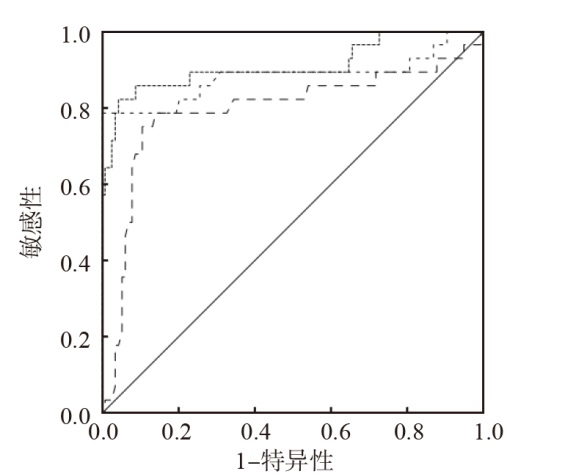
| 指标 | AUC(95%CI) | 最佳临界值 | 敏感性/% | 特异性/% | 约登指数 |
|---|---|---|---|---|---|
| SAA | 0.792(0.677~0.908) | 45.700 mg·L-1 | 0.786 | 0.858 | 0.644 |
| 25(OH)D | 0.881(0.781~0.981) | 24.600 nmol·L-1 | 0.786 | 0.991 | 0.777 |
| 联合检测 | 0.910(0.831~0.988) | 0.023 | 0.821 | 0.956 | 0.777 |
| 指标 | AUC(95%CI) | 最佳临界值 | 敏感性/% | 特异性/% | 约登指数 |
|---|---|---|---|---|---|
| SAA | 0.792(0.677~0.908) | 45.700 mg·L-1 | 0.786 | 0.858 | 0.644 |
| 25(OH)D | 0.881(0.781~0.981) | 24.600 nmol·L-1 | 0.786 | 0.991 | 0.777 |
| 联合检测 | 0.910(0.831~0.988) | 0.023 | 0.821 | 0.956 | 0.777 |
| [1] |
KOMORI A. Recent updates on the management of autoimmune hepatitis[J]. Clin Mol Hepatol, 2021, 27(1):58-69.
DOI URL |
| [2] | 胡明礼, 王绮夏, 马雄. 自身免疫性肝炎发病机制进展与临床干预新靶点[J]. 临床肝胆病杂志, 2022, 38(4):743-747. |
| [3] |
ZHU J, CHEN H, CUI J, et al. Oroxylin A inhibited autoimmune hepatitis-induced liver injury and shifted Treg/Th17 balance to Treg differentiation[J]. Exp Anim, 2023, 72(3):367-378.
DOI URL |
| [4] | SONG J, DAI J, CHEN X, et al. Bifidobacterium mitigates autoimmune hepatitis by regulating IL-33-induced Treg/Th17 imbalance via the TLR2/4 signaling pathway[J]. Histol Histopathol, 2024, 39(5):623-632. |
| [5] | 戴靖榕, 李婕, 何旭, 等. 营养不良和25羟维生素D及白介素1β与老年住院患者发生慢性阻塞性肺疾病的关系研究[J]. 中国全科医学, 2022, 25(2):189-196. |
| [6] | 齐坤, 刘云, 唐滔, 等. 1,25(OH)2D3通过调节Th17/Treg比值和RANKL/OPG轴缓解胶原诱导的关节炎[J]. 陆军军医大学学报, 2023, 45(15):1656-1665. |
| [7] | 刘振国, 白惠惠, 王顺达. 脓毒症患者SAA、PCT、ALB水平及SII、APACHEⅡ、SOFA评分与预后的相关性研究[J]. 海南医学, 2023, 34(17):2523-2526. |
| [8] | 谢万红, 王鼎, 张珂. 血清淀粉样蛋白A、C反应蛋白检测对系统性红斑狼疮患者的意义[J]. 检验医学与临床, 2021, 18(24):3509-3512. |
| [9] | 中华医学会肝病学分会, 中华医学会消化病学分会, 中华医学会感染病学分会. 自身免疫性肝炎诊断和治疗共识(2015)[J]. 中华肝脏病杂志, 2016, 24(1):23-35. |
| [10] | 文琼花, 唐敏云, 魏玉, 等. 血清腺苷脱氨酶和淀粉样蛋白A辅助诊断自身免疫性肝炎患者临床价值分析[J]. 实用肝脏病杂志, 2020, 23(4):508-511. |
| [11] | 李伟伟, 宋新文. 25-OH维生素D与自身免疫性肝炎的相关性[J]. 新乡医学院学报, 2017, 34(12):1080-1084. |
| [12] |
LI M, KIM Y M, KOH J H, et al. Serum amyloid A expression in liver promotes synovial macrophage activation and chronic arthritis via NFAT5[J]. J Clin Invest, 2024, 134(5):e167835.
DOI URL |
| [13] | 赵琳, 杨斌, 赵锁, 等. 慢性丙型病毒性肝炎患者血清IL-26、25(OH)D水平变化及其临床意义[J]. 胃肠病学和肝病学杂志, 2024, 33(8):1010-1014. |
| [14] | 延欢欢, 申文文. Th17/Treg比值、LECT2、CXCL10与自身免疫性肝炎患者肝功能和治疗后应答的关系研究[J]. 检验医学与临床, 2023, 20(9):1226-1230. |
| [15] |
PIOTTI K C, YANTISS R K, CHEN Z, et al. Serum amyloid A immunohistochemical staining patterns in hepatitis[J]. Histopathology, 2016, 69(6):937-942.
DOI PMID |
| [16] |
ABE K, FUJITA M, HAYASHI M, et al. Association of serum 25-hydroxyvitamin D levels with severe necroinflammatory activity and inflammatory cytokine production in type I autoimmune hepatitis[J]. PLoS One, 2020, 15(11):e0239481.
DOI URL |
| [17] | LOPEZ D V, AL-JABERI F A H, DAMAS N D, et al. Vitamin D inhibits IL-22 production through a repressive vitamin D response element in the il22 promoter[J]. Front Immunol, 2021,12:715059. |
| [18] | 易鸣, 黄燕萍. 儿童NS糖皮质激素治疗与25羟基维生素D3的关系[J]. 中国妇幼健康研究, 2020, 31(9):1151-1154. |
| [19] |
DAVIDSON Z E, WALKER K Z, TRUBY H. Clinical review:do glucocorticosteroids alter vitamin D status? A systematic review with meta-analyses of observational studies[J]. J Clin Endocrinol Metab, 2012, 97(3):738-744.
DOI URL |
| [1] | YAO Yanhong, ZHAI Chunli. Predictive role of serum amyloid A and homocysteine on pregnancy outcome in patients with gestational diabetes mellitus [J]. Laboratory Medicine, 2025, 40(8): 751-756. |
| [2] | GUO Jingjing, LI Haixia, MA Qian, HUANG Haiming, ZENG Ziyi, AN Chongwen, PANG Lu. A retrospective analysis of serum 25(OH)D levels and related factors in a physical examination population in a Grade 3 Class A hospital in Beijing [J]. Laboratory Medicine, 2025, 40(6): 545-550. |
| [3] | ZHENG Ying, LU Zhe, XUE Jing. Relationship between serum 25(OH)D3 level and lymphocyte subsets in children with systemic lupus erythematosus [J]. Laboratory Medicine, 2025, 40(3): 230-234. |
| [4] | ZHANG Jing. Synergistic role of vitamin D and blood glucose in pregnancy outcomes in patients with preeclampsia [J]. Laboratory Medicine, 2024, 39(8): 779-786. |
| [5] | SUN Kangde, YU Zhongmin, YAN Yuzhong. Roles on early diagnosis and prognosis of different infection indicators for bloodstream infection [J]. Laboratory Medicine, 2024, 39(3): 222-226. |
| [6] | REN Huirong, XU Tingjuan, WU Tao, HUANG Mei, YANG Liang. Role of serum progranulin in type Ⅰ autoimmune hepatitis prognosis evaluation [J]. Laboratory Medicine, 2023, 38(3): 245-250. |
| [7] | ZHOU Ying, REN Yihui, LI Guangming. Serum miR-148a expression in children with autoimmune hepatitis and its correlation with inflammatory factors [J]. Laboratory Medicine, 2023, 38(12): 1130-1134. |
| [8] | LIU Yang, GENG Kunjing, LI Hongjiang, SHI Haoxi, CHEN Sisi. Relationship of 25(OH)D3 and liver inflammatory stage with the efficacy of antiviral therapy [J]. Laboratory Medicine, 2022, 37(7): 628-631. |
| [9] | ZHANG Zhibin, YANG Wanyong, RUAN Fuwang, WEN Qinghui. Roles of total IgE,sIgE and 25(OH)D in the evaluation of infant atopic dermatitis [J]. Laboratory Medicine, 2022, 37(3): 217-220. |
| [10] | WU Wenping, XU Linjuan, WANG Jiaheng, ZHANG Nana. Correlation analysis of PBK/TOPK expression with treatment response and survival prognosis in elderly patients with acute myeloid leukemia [J]. Laboratory Medicine, 2022, 37(11): 1017-1022. |
| [11] | ZHAO Xiaomin, JIANG Xiaoyu, SHAN Kaili, SHAN Tieying, LIU Xiuzhen. Roles of Flt-3L,TF and 25(OH)D in iron deficiency anemia among infants and children [J]. Laboratory Medicine, 2022, 37(11): 1039-1043. |
| [12] | LI Dingfu, HUANG Jian, CAI Meiling, WANG Lizhen, JIAN Kaigan, YANG Feifei. Relationship between serum 25(OH)D and disease control in children with allergic rhinitis-asthma syndrome [J]. Laboratory Medicine, 2022, 37(1): 32-35. |
| [13] | XIONG Zhongbo, WANG Lei, YIN Beiqi, DAI Yue, WEI Xiaoqing, LU Pei. Clinical roles of SAA and CRP in pathological staging and metastasis of gastrointestinal cancer [J]. Laboratory Medicine, 2022, 37(1): 51-55. |
| [14] | LIU Jinyan, ZHAO Juntao, XIANG Mingjie. Mechanism and application of serum amyloid A in clinical diseases [J]. Laboratory Medicine, 2021, 36(7): 756-760. |
| [15] | ZHAO Xueling, ZHENG Xin, XU Huamei, SHI Hongyao. Correlation between serum 25(OH)D,specific IgE and VAS score in children with allergic rhinitis [J]. Laboratory Medicine, 2021, 36(6): 615-617. |
| Viewed | ||||||
|
Full text |
|
|||||
|
Abstract |
|
|||||
