
Laboratory Medicine ›› 2026, Vol. 41 ›› Issue (2): 106-111.DOI: 10.3969/j.issn.1673-8640.2026.02.002
Previous Articles Next Articles
MA Shanshan, ZHANG Rong, YIN Ting, ZHENG Anshun, WANG Zhiwei, WANG Yongan, WANG Leilei( )
)
Received:2025-02-14
Revised:2025-07-01
Online:2026-02-28
Published:2026-03-06
CLC Number:
MA Shanshan, ZHANG Rong, YIN Ting, ZHENG Anshun, WANG Zhiwei, WANG Yongan, WANG Leilei. Genetic analysis and pregnancy outcomes of 19 fetuses with abnormal copy number in 22q11.2 region of chromosome[J]. Laboratory Medicine, 2026, 41(2): 106-111.
Add to citation manager EndNote|Ris|BibTeX
URL: https://www.shjyyx.com/EN/10.3969/j.issn.1673-8640.2026.02.002
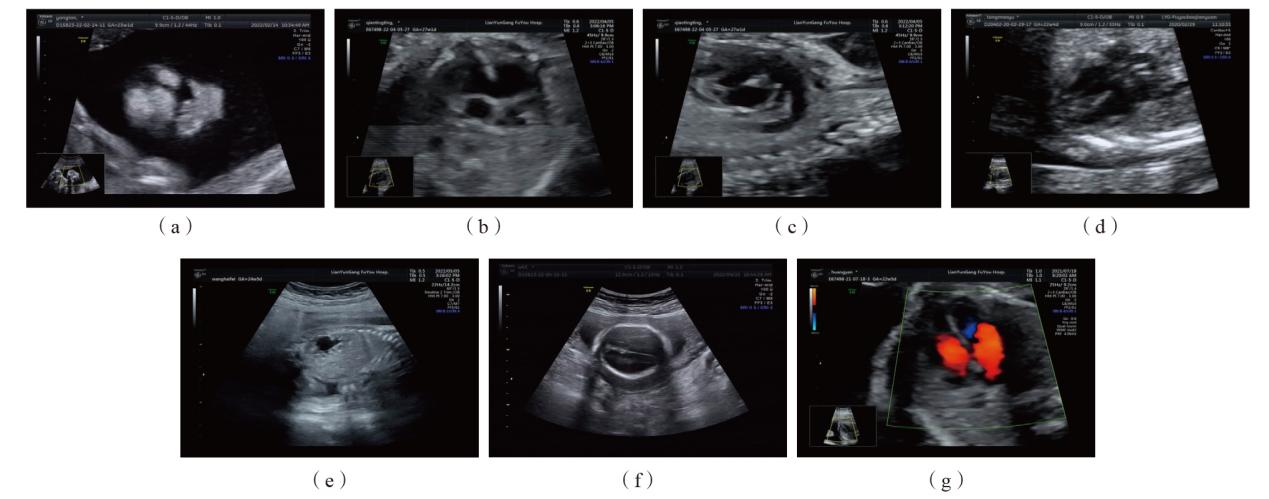
| 编号 | 穿刺孕周/周 | 22q11.2缺失区域 | 大小/Mb | 关键致病基因 | 变异判读结果 | 遗传方式 | 胎儿超声异常 | 其他产前 诊断指征 | 胎儿心脏畸形 |
|---|---|---|---|---|---|---|---|---|---|
| P1 | 19+2 | 22q11.2(18,916,842-21,800,471)x1 | 2.88 | TBX1、CRKL | P | 心轴增大;心脏发育异常 | 不良孕产史 | 是 | |
| P2 | 19+3 | 22q11.2(18,648,855-21,800,471)x1 | 3.15 | TBX1、CRKL | P | 胎儿多发CPC;唇裂(考虑合并腭裂) | 否 | ||
| P3 | 27+2 | 22q11.2(18,648,855-21,800,471)x1 | 3.15 | TBX1、CRKL | P | VSD;升主动脉内径狭窄;主动脉弓未明确显示 | 是 | ||
| P4 | 20+6 | 22q11.2(18,648,855-20,312,661)x1 | 1.66 | TBX1、CRKL | P | NIPT①提示22q11.2微缺失; | 否 | ||
| P5 | 18+6 | 22q11.2(18,919,477-20,312,661)x1 | 1.39 | TBX1、CRKL | P | DS②高风险 | 否 | ||
| P6 | 25+4 | 22q11.2(18,648,855-21,800,471)x1 | 3.15 | TBX1、CRKL | P | 母源 | 右位主动脉弓,左锁骨下动脉迷走;先天性血管环;三尖瓣微量反流;小脑髓池增宽;母体腹内段脐静脉稍增宽(内径为10.2 mm) | 不良孕产史 | 是 |
| P7 | 23 | 22q11.2(21,059,669-21,464,764)x1 | 0.41 | CRKL | LP | VSD;肺动脉主干内径不成比例 | 是 | ||
| P8 | 20+4 | 22q11.2(21,059,669_21,800,471)x1 | 0.74 | CRKL | LP | 主肺动脉和升主动脉内径比例稍失调;三尖瓣微量反流;双侧CPC;右肾积水;透明隔腔隐见且内径偏窄 | 高龄 | 是 |
| 编号 | 穿刺孕周/周 | 22q11.2缺失区域 | 大小/Mb | 关键致病基因 | 变异判读结果 | 遗传方式 | 胎儿超声异常 | 其他产前 诊断指征 | 胎儿心脏畸形 |
|---|---|---|---|---|---|---|---|---|---|
| P1 | 19+2 | 22q11.2(18,916,842-21,800,471)x1 | 2.88 | TBX1、CRKL | P | 心轴增大;心脏发育异常 | 不良孕产史 | 是 | |
| P2 | 19+3 | 22q11.2(18,648,855-21,800,471)x1 | 3.15 | TBX1、CRKL | P | 胎儿多发CPC;唇裂(考虑合并腭裂) | 否 | ||
| P3 | 27+2 | 22q11.2(18,648,855-21,800,471)x1 | 3.15 | TBX1、CRKL | P | VSD;升主动脉内径狭窄;主动脉弓未明确显示 | 是 | ||
| P4 | 20+6 | 22q11.2(18,648,855-20,312,661)x1 | 1.66 | TBX1、CRKL | P | NIPT①提示22q11.2微缺失; | 否 | ||
| P5 | 18+6 | 22q11.2(18,919,477-20,312,661)x1 | 1.39 | TBX1、CRKL | P | DS②高风险 | 否 | ||
| P6 | 25+4 | 22q11.2(18,648,855-21,800,471)x1 | 3.15 | TBX1、CRKL | P | 母源 | 右位主动脉弓,左锁骨下动脉迷走;先天性血管环;三尖瓣微量反流;小脑髓池增宽;母体腹内段脐静脉稍增宽(内径为10.2 mm) | 不良孕产史 | 是 |
| P7 | 23 | 22q11.2(21,059,669-21,464,764)x1 | 0.41 | CRKL | LP | VSD;肺动脉主干内径不成比例 | 是 | ||
| P8 | 20+4 | 22q11.2(21,059,669_21,800,471)x1 | 0.74 | CRKL | LP | 主肺动脉和升主动脉内径比例稍失调;三尖瓣微量反流;双侧CPC;右肾积水;透明隔腔隐见且内径偏窄 | 高龄 | 是 |
| 编号 | 穿刺孕周/周 | 22q11.2重复区域 | 大小/Mb | 关键致病基因 | 变异 判读 | 遗传方式 | 胎儿超声异常 | 其他产前 诊断指征 | 胎儿心脏畸形 |
|---|---|---|---|---|---|---|---|---|---|
| P9 | 20+2 | 22q11.2(20,716,876-21,800,471)x3 | 1.08 | CRKL | LP | 母源 | 不良妊娠史 | 否 | |
| P10 | 17+3 | 22q11.2(20,754,239-21,461,017)x3 | 1.50 | CRKL | LP | 母源 | DS高风险;孕妇眼睑下垂 | 否 | |
| P11 | 19+3 | 22q11.2(18,970,561-21,800,471)x3 | 2.83 | TBX1、CRKL | P | 母源 | NIPT提示22号染色体部分重复 | 否 | |
| P12 | 21+2 | 22q11.2(18,648,855-21,464,764)x3 | 2.82 | TBX1、CRKL | P | DS临界风险;NIPT提示22号染色体存在异常 | 否 | ||
| P13 | 22+1 | 22q11.2(18,648,855-21,804,597)x3 | 3.15 | TBX1、CRKL | P | DS临界风险;染色体异常家族史 | 否 | ||
| P14 | 19+3 | 22q11.2(18,916,960-21,800,471)x3 | 2.88 | TBX1、CRKL | P | DS临界风险;孕妇智力低下 | 否 | ||
| P15 | 18+1 | 22q11.2(18,648,855-21,800,471)x3 | 3.15 | TBX1、CRKL | P | 父源 | 三尖瓣微量反流;NF增厚(5.0 mm) | 否 | |
| P16 | 18+5 | 22q11.2(20,312,660-21,915,207)x3 | 1.6 | CRKL | LP | DS高风险; 高龄 | 否 | ||
| P17 | 18+1 | 22q11.2(18,916,842-21,464,764)x3 | 2.55 | TBX1、CRKL | P | VSD,NT增厚 (3.0 mm) | 高龄 | 是 | |
| P18 | 18+1 | 22q11.2(18,984,187-21,459,713)x3 | 2.48 | TBX1、CRKL | P | 父源 | DS高风险 | 否 | |
| P19 | 13+1 | 22q11.2(18,648,855-21,461,017)x3 | 2.81 | TBX1、CRKL | P | NT增厚(2.8 mm) | 否 |
| 编号 | 穿刺孕周/周 | 22q11.2重复区域 | 大小/Mb | 关键致病基因 | 变异 判读 | 遗传方式 | 胎儿超声异常 | 其他产前 诊断指征 | 胎儿心脏畸形 |
|---|---|---|---|---|---|---|---|---|---|
| P9 | 20+2 | 22q11.2(20,716,876-21,800,471)x3 | 1.08 | CRKL | LP | 母源 | 不良妊娠史 | 否 | |
| P10 | 17+3 | 22q11.2(20,754,239-21,461,017)x3 | 1.50 | CRKL | LP | 母源 | DS高风险;孕妇眼睑下垂 | 否 | |
| P11 | 19+3 | 22q11.2(18,970,561-21,800,471)x3 | 2.83 | TBX1、CRKL | P | 母源 | NIPT提示22号染色体部分重复 | 否 | |
| P12 | 21+2 | 22q11.2(18,648,855-21,464,764)x3 | 2.82 | TBX1、CRKL | P | DS临界风险;NIPT提示22号染色体存在异常 | 否 | ||
| P13 | 22+1 | 22q11.2(18,648,855-21,804,597)x3 | 3.15 | TBX1、CRKL | P | DS临界风险;染色体异常家族史 | 否 | ||
| P14 | 19+3 | 22q11.2(18,916,960-21,800,471)x3 | 2.88 | TBX1、CRKL | P | DS临界风险;孕妇智力低下 | 否 | ||
| P15 | 18+1 | 22q11.2(18,648,855-21,800,471)x3 | 3.15 | TBX1、CRKL | P | 父源 | 三尖瓣微量反流;NF增厚(5.0 mm) | 否 | |
| P16 | 18+5 | 22q11.2(20,312,660-21,915,207)x3 | 1.6 | CRKL | LP | DS高风险; 高龄 | 否 | ||
| P17 | 18+1 | 22q11.2(18,916,842-21,464,764)x3 | 2.55 | TBX1、CRKL | P | VSD,NT增厚 (3.0 mm) | 高龄 | 是 | |
| P18 | 18+1 | 22q11.2(18,984,187-21,459,713)x3 | 2.48 | TBX1、CRKL | P | 父源 | DS高风险 | 否 | |
| P19 | 13+1 | 22q11.2(18,648,855-21,461,017)x3 | 2.81 | TBX1、CRKL | P | NT增厚(2.8 mm) | 否 |
| 母体 编号 | 出生时身高/cm | 出生时体重/g | 性别 | 年龄 | 随访结果 |
|---|---|---|---|---|---|
| P4 | 50 | 3 200 | 男 | 6个月 | 未见明显异常 |
| P9 | 49 | 3 300 | 男 | 6岁 | 未见明显异常 |
| P10 | 50 | 3 550 | 男 | 4岁 | 囟门闭合较晚 |
| P11 | 48 | 3 500 | 女 | 6岁 | 未见明显异常 |
| P13 | 50 | 3 100 | 男 | 5岁 | 未见明显异常 |
| P14 | 50 | 3 000 | 男 | 5岁 | 未见明显异常 |
| P15 | 51 | 3 600 | 男 | 28个月 | 未见明显异常 |
| P18 | 50 | 3 900 | 男 | 7个月 | 未见明显异常 |
| 母体 编号 | 出生时身高/cm | 出生时体重/g | 性别 | 年龄 | 随访结果 |
|---|---|---|---|---|---|
| P4 | 50 | 3 200 | 男 | 6个月 | 未见明显异常 |
| P9 | 49 | 3 300 | 男 | 6岁 | 未见明显异常 |
| P10 | 50 | 3 550 | 男 | 4岁 | 囟门闭合较晚 |
| P11 | 48 | 3 500 | 女 | 6岁 | 未见明显异常 |
| P13 | 50 | 3 100 | 男 | 5岁 | 未见明显异常 |
| P14 | 50 | 3 000 | 男 | 5岁 | 未见明显异常 |
| P15 | 51 | 3 600 | 男 | 28个月 | 未见明显异常 |
| P18 | 50 | 3 900 | 男 | 7个月 | 未见明显异常 |
| [1] |
BITTEL D C, YU S, NEWKIRK H, et al. Refining the 22q11.2 deletion breakpoints in DiGeorge syndrome by aCGH[J]. Cytogenet Genome Res, 2009, 124(2):113-120.
DOI URL |
| [2] |
PORTNOÏ M F. Microduplication 22q11.2:a new chromosomal syndrome[J]. Eur J Med Genet, 2009, 52(2):88-93.
DOI URL |
| [3] |
BOTTO L D, MAY K, FERNHOFF P M, et al. A population-based study of the 22q11.2 deletion:phenotype,incidence,and contribution to major birth defects in the population[J]. Pediatrics, 2003, 112(1):101-107.
DOI URL |
| [4] |
OSKARSDÓTTIR S, VUJIC M, FASTH A. Incidence and prevalence of the 22q11 deletion syndrome:a population-based study in Western Sweden[J]. Arch Dis Child, 2004, 89(2):148-151.
DOI URL |
| [5] |
SHAIKH T H, KURAHASHI H, SAITTA S C, et al. Chromosome 22-specific low copy repeats and the 22q11.2 deletion syndrome:genomic organization and deletion endpoint analysis[J]. Hum Mol Genet, 2000, 9(4):489-501.
DOI URL |
| [6] |
BALDINI A. DiGeorge syndrome:the use of model organisms to dissect complex genetics[J]. Hum Mol Genet, 2002, 11(20):2363-2369.
DOI URL |
| [7] |
RACEDO S E, MCDONALD-MCGINN D M, CHUNG J H, et al. Mouse and human CRKL is dosage sensitive for cardiac outflow tract formation[J]. Am J Hum Genet, 2015, 96(2):235.
DOI PMID |
| [8] |
CIRILLO A, LIONCINO M, MARATEA A, et al. Clinical manifestations of 22q11.2 deletion syndrome[J]. Heart Fail Clin, 2022, 18(1):155-164.
DOI PMID |
| [9] | CORTÉS-MARTÍN J, PEÑUELA N L, SÁNCHEZ-GARCÍA J C, et al. Deletion syndrome 22q11.2:a systematic review[J]. Children(Basel), 2022, 9(8):1168. |
| [10] |
GOLDMUNTZ E. 22q11.2 deletion syndrome and congenital heart disease[J]. Am J Med Genet C Semin Med Genet, 2020, 184(1):64-72.
DOI URL |
| [11] | 崔玉, 肖建平, 赵丽, 等. 19例22q11.2微重复的产前诊断及遗传咨询[J]. 中华医学遗传学杂志, 2021, 38(12):1180-1184. |
| [12] |
RAMELLI G P, SILACCI C, FERRARINI A, et al. Microduplication 22q11.2 in a child with autism spectrum disorder:clinical and genetic study[J]. Dev Med Child Neurol, 2008, 50(12):953-955.
DOI URL |
| [13] | RIGGS E R, ANDERSEN E F, CHERRY A M, et al. Technical standards for the interpretation and reporting of constitutional copy-number variants:a joint consensus recommendation of the American College of Medical Genetics and Genomics (ACMG)and the Clinical Genome Resource (ClinGen)[J]. Genet Med, 2020, 22(2):245-257. |
| [14] |
AGERGAARD P, OLESEN C, ØSTERGAARD J R, et al. The prevalence of chromosome 22q11.2 deletions in 2 478 children with cardiovascular malformations. A population-based study[J]. Am J Med Genet A, 2012, 158A(3):498-508.
DOI URL |
| [15] | GOLDMUNTZ E, CLARK B J, MITCHELL L E, et al. Frequency of 22q11 deletions in patients with conotruncal defects[J]. J Am Coll Cardiol, 199, 32(2):492-498. |
| [16] |
PEYVANDI S, LUPO P J, GARBARINI J, et al. 22q11.2 deletions in patients with conotruncal defects:data from 1 610 consecutive cases[J]. Pediatr Cardiol, 2013, 34(7):1687-1694.
DOI URL |
| [17] | MCDONALD-MCGINN D M, KIRSCHNER R, GOLDMUNTZ E, et al. The Philadelphia story:the 22q11.2 deletion:report on 250 patients[J]. Genet Couns, 1999, 10(1):11-24. |
| [18] |
WINCENT J, BRUNO D L, VAN BON B W, et al. Sixteen new cases contributing to the characterization of patients with distal 22q11.2 microduplications[J]. Mol Syndromol, 2010, 1(5):246-254.
DOI PMID |
| [19] |
TAN T Y, COLLINS A, JAMES P A, et al. Phenotypic variability of distal 22q11.2 copy number abnormalities[J]. Am J Med Genet A, 2011, 155A(7):1623-1633.
DOI PMID |
| [20] |
OU Z, BERG J S, YONATH H, et al. Microduplications of 22q11.2 are frequently inherited and are associated with variable phenotypes[J]. Genet Med, 2008, 10(4):267-277.
DOI PMID |
| [21] |
COPPINGER J, MCDONALD-MCGINN D, ZACKAI E, et al. Identification of familial and de novo microduplications of 22q11.2-q11.23 distal to the 22q11.2 microdeletion syndrome region[J]. Hum Mol Genet, 2009, 18(8):1377-1383.
DOI URL |
| [22] | PINCHEFSKY E, LANEUVILLE L, SROUR M. Distal 22q11.2 microduplication:case report and review of the literature[J]. Child Neurol Open, 2017,4:2329048X17737651. |
| [23] |
LI S, HAN X, YE M, et al. Prenatal diagnosis of microdeletions or microduplications in the proximal,central,and distal regions of chromosome 22q11.2:ultrasound findings and pregnancy outcome[J]. Front Genet, 2019, 10:813.
DOI URL |
| [24] |
ROSENFELD J A, COE B P, EICHLER E E, et al. Estimates of penetrance for recurrent pathogenic copy-number variations[J]. Genet Med, 2013, 15(6):478-481.
DOI PMID |
| [25] |
CIOFFI S, MARTUCCIELLO S, FULCOLI F G, et al. Tbx1 regulates brain vascularization[J]. Hum Mol Genet, 2014, 23(1):78-89.
DOI PMID |
| [26] |
PAYLOR R, GLASER B, MUPO A, et al. Tbx 1 haploinsufficiency is linked to behavioral disorders in mice and humans:implications for 22q11 deletion syndrome[J]. Proc Natl Acad Sci U S A, 2006, 103(20):7729-7734.
DOI URL |
| [27] |
MCDONALD-MCGINN D M, SULLIVAN K E, MARINO B, et al. 22q11.2 deletion syndrome[J]. Nat Rev Dis Primers, 2015, 1:15071.
DOI |
| [28] |
GURIS D L, FANTES J, TARA D, et al. Mice lacking the homologue of the human 22q11.2 gene CRKL phenocopy neurocristopathies of DiGeorge syndrome[J]. Nat Genet, 2001, 27(3):293-298.
DOI |
| [29] |
ZHENG P, NOROSKI L M, HANSON I C, et al. Molecular mechanisms of functional natural killer deficiency in patients with partial DiGeorge syndrome[J]. J Allergy Clin Immunol, 2015, 135(5):1293-1302.
DOI PMID |
| Viewed | ||||||
|
Full text |
|
|||||
|
Abstract |
|
|||||
