
Laboratory Medicine ›› 2026, Vol. 41 ›› Issue (9): 913-918.DOI: 10.3969/j.issn.1673-8640.2026.09.015
Previous Articles Next Articles
YANG Xue, WANG Qing( ), JIANG Lingli, ZHOU Jing, HU Xiaobo
Received:2025-07-06
Revised:2026-03-24
Online:2026-09-30
Published:2026-09-29
CLC Number:
YANG Xue, WANG Qing, JIANG Lingli, ZHOU Jing, HU Xiaobo. Analysis of clinical laboratory quality indicators for Shanghai's tertiary public hospitals from 2020 to 2024[J]. Laboratory Medicine, 2026, 41(9): 913-918.
Add to citation manager EndNote|Ris|BibTeX
URL: https://www.shjyyx.com/EN/10.3969/j.issn.1673-8640.2026.09.015
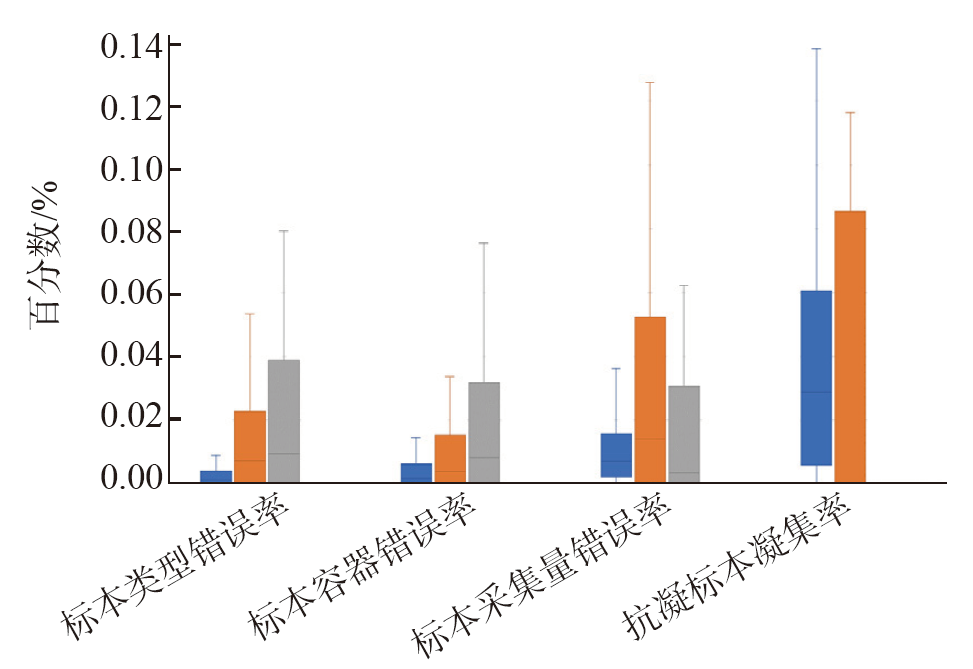
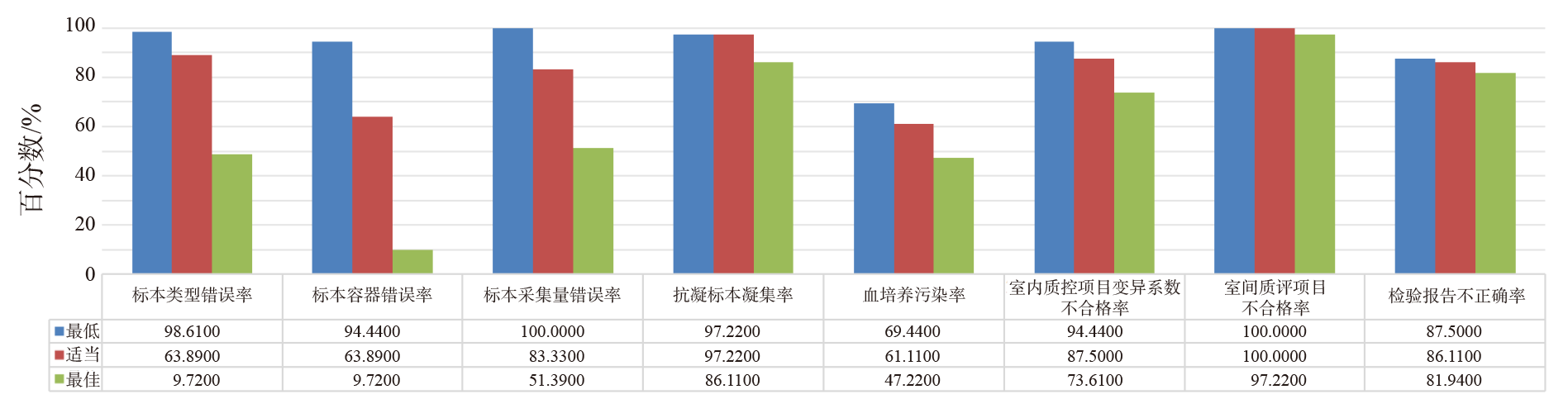
| 质量指标 | 最低质量规范 | 适当的质量规范 | 最佳的质量规范 |
|---|---|---|---|
| 标本类型错误率 | 0.039 | 0.016 | 0.003 |
| 标本容器错误率 | 0.019 | 0.006 | 0.000 |
| 标本采集量错误率 | 0.070 | 0.033 | 0.012 |
| 抗凝标本凝集率 | 0.527 | 0.240 | 0.126 |
| 血培养污染率 | 1.256 | 0.933 | 0.730 |
| 室内质控项目变异系数不合格率 | 5.519 | 2.429 | 0.704 |
| 室间质评项目不合格率 | 2.863 | 1.881 | 1.192 |
| 检验报告不正确率 | 0.043 | 0.020 | 0.011 |
| 质量指标 | 最低质量规范 | 适当的质量规范 | 最佳的质量规范 |
|---|---|---|---|
| 标本类型错误率 | 0.039 | 0.016 | 0.003 |
| 标本容器错误率 | 0.019 | 0.006 | 0.000 |
| 标本采集量错误率 | 0.070 | 0.033 | 0.012 |
| 抗凝标本凝集率 | 0.527 | 0.240 | 0.126 |
| 血培养污染率 | 1.256 | 0.933 | 0.730 |
| 室内质控项目变异系数不合格率 | 5.519 | 2.429 | 0.704 |
| 室间质评项目不合格率 | 2.863 | 1.881 | 1.192 |
| 检验报告不正确率 | 0.043 | 0.020 | 0.011 |
| 质量指标 | 年份 | 实验室数/家 | 实验室结果 | ||||||
|---|---|---|---|---|---|---|---|---|---|
| 百分数/% | σ水平 | ||||||||
| P25 | P50 | P75 | P25 | P50 | P75 | ||||
| 检验前阶段 | |||||||||
| 标本类型错误率 | 2020 | 65 | 0 | 0.004 8 | 0.010 8 | 5.2 | 5.4 | 6.0 | |
| 2021 | 65 | 0.000 8 | 0.004 1 | 0.008 3 | 5.3 | 5.4 | 5.8 | ||
| 2022 | 64 | 0.000 7 | 0.003 6 | 0.013 0 | 5.2 | 5.5 | 5.8 | ||
| 2023 | 70 | 0.000 7 | 0.004 1 | 0.009 7 | 5.2 | 5.4 | 5.8 | ||
| 2024 | 72 | 0.000 7 | 0.003 7 | 0.010 1 | 5.2 | 5.5 | 5.8 | ||
| 标本容器错误率 | 2020 | 64 | 0.000 2 | 0.003 2 | 0.012 3 | 5.2 | 5.5 | 6.1 | |
| 2021 | 64 | 0.000 9 | 0.003 1 | 0.008 9 | 5.2 | 5.5 | 5.8 | ||
| 2022 | 63 | 0.001 0 | 0.004 3 | 0.009 0 | 5.2 | 5.4 | 5.8 | ||
| 2023 | 70 | 0.000 3 | 0.004 0 | 0.011 3 | 5.2 | 5.4 | 6.0 | ||
| 2024 | 72 | 0.000 8 | 0.004 1 | 0.009 9 | 5.2 | 5.4 | 5.8 | ||
| 标本采集量错误率 | 2020 | 64 | 0.001 1 | 0.010 9 | 0.021 9 | 5.0 | 5.2 | 5.7 | |
| 2021 | 64 | 0.004 1 | 0.012 6 | 0.024 6 | 5.0 | 5.2 | 5.4 | ||
| 2022 | 63 | 0.004 0 | 0.012 8 | 0.027 0 | 5.0 | 5.2 | 5.4 | ||
| 2023 | 70 | 0.002 4 | 0.013 7 | 0.027 3 | 5.0 | 5.1 | 5.6 | ||
| 2024 | 72 | 0.002 6 | 0.011 0 | 0.021 4 | 5.0 | 5.2 | 5.5 | ||
| 抗凝标本凝集率 | 2020 | 63 | 0.020 3 | 0.038 9 | 0.084 2 | 4.6 | 4.9 | 5.0 | |
| 2021 | 64 | 0.015 0 | 0.046 2 | 0.103 9 | 4.6 | 4.8 | 5.1 | ||
| 2022 | 63 | 0.013 5 | 0.045 5 | 0.091 7 | 4.6 | 4.8 | 5.1 | ||
| 2023 | 70 | 0.004 4 | 0.026 0 | 0.079 1 | 4.7 | 5.0 | 5.4 | ||
| 2024 | 70 | 0.005 8 | 0.030 3 | 0.060 5 | 4.7 | 4.9 | 5.4 | ||
| 血培养污染率 | 2020 | 54 | 0 | 0.683 1 | 1.371 8 | 3.7 | 4.0 | 6.0 | |
| 2021 | 60 | 0.218 1 | 0.645 8 | 0.935 6 | 3.9 | 4.0 | 4.4 | ||
| 2022 | 60 | 0.455 7 | 1.016 3 | 1.638 2 | 3.6 | 3.8 | 4.1 | ||
| 2023 | 64 | 0.250 2 | 0.789 3 | 1.389 5 | 3.7 | 3.9 | 4.3 | ||
| 2024 | 65 | 0.211 9 | 0.683 0 | 1.207 3 | 3.8 | 4.0 | 4.4 | ||
| 检验阶段 | |||||||||
| 室内质控项目开展率 | 2020 | 62 | 89.750 0 | 96.850 0 | 100.000 0 | 2.8 | 3.4 | 6.0 | |
| 2021 | 64 | 91.650 0 | 98.950 0 | 100.000 0 | 2.9 | 3.8 | 6.0 | ||
| 2022 | 63 | 90.410 0 | 98.890 0 | 100.000 0 | 2.8 | 3.8 | 6.0 | ||
| 2023 | 70 | 86.720 0 | 95.690 0 | 100.000 0 | 2.6 | 3.2 | 6.0 | ||
| 2024 | 72 | 91.770 0 | 98.990 0 | 100.000 0 | 2.9 | 3.8 | 6.0 | ||
| 室内质控项目变异系数不合格率 | 2020 | 60 | 0 | 0 | 3.860 0 | 3.3 | 6.0 | 6.0 | |
| 2021 | 63 | 0 | 0 | 2.860 0 | 3.4 | 6.0 | 6.0 | ||
| 2022 | 62 | 0 | 0 | 1.660 0 | 3.6 | 6.0 | 6.0 | ||
| 2023 | 69 | 0 | 0 | 0.330 0 | 4.2 | 6.0 | 6.0 | ||
| 2024 | 70 | 0 | 0 | 0.630 0 | 4.0 | 6.0 | 6.0 | ||
| 室间质评项目参加率 | 2020 | 55 | 97.980 0 | 100.000 0 | 100.000 0 | 3.5 | 6.0 | 6.0 | |
| 2021 | 65 | 100.000 0 | 100.000 0 | 100.000 0 | 6.0 | 6.0 | 6.0 | ||
| 2022 | 57 | 100.000 0 | 100.000 0 | 100.000 0 | 6.0 | 6.0 | 6.0 | ||
| 2023 | 70 | 100.000 0 | 100.000 0 | 100.000 0 | 6.0 | 6.0 | 6.0 | ||
| 2024 | 72 | 100.000 0 | 100.000 0 | 100.000 0 | 6.0 | 6.0 | 6.0 | ||
| 室间质评项目不合格率 | 2020 | 60 | 0 | 0 | 0 | 6.0 | 6.0 | 6.0 | |
| 2021 | 65 | 0 | 0 | 0.160 0 | 4.4 | 6.0 | 6.0 | ||
| 2022 | 64 | 0 | 0 | 0 | 6.0 | 6.0 | 6.0 | ||
| 2023 | 70 | 0 | 0 | 0.310 0 | 4.2 | 6.0 | 6.0 | ||
| 2024 | 72 | 0 | 0 | 0 | 6.0 | 6.0 | 6.0 | ||
| 实验室间比对率 | 2020 | 53 | 24.730 0 | 45.050 0 | 83.750 0 | 2.2 | 1.6 | 0.5 | |
| 2021 | 60 | 31.710 0 | 74.850 0 | 100.000 0 | 1.0 | 2.2 | 6.0 | ||
| 2022 | 60 | 41.830 0 | 88.740 0 | 100.000 0 | 1.3 | 2.7 | 6.0 | ||
| 2023 | 66 | 50.880 0 | 91.210 0 | 100.000 0 | 1.5 | 2.9 | 6.0 | ||
| 2024 | 69 | 61.610 0 | 91.530 0 | 100.000 0 | 1.8 | 2.9 | 6.0 | ||
| 检验报告不正确率 | 2020 | 63 | 0 | 0 | 0 | 6.0 | 6.0 | 6.0 | |
| 2021 | 64 | 0 | 0 | 0.000 8 | 5.8 | 6.0 | 6.0 | ||
| 2022 | 64 | 0 | 0 | 0.002 1 | 5.6 | 6.0 | 6.0 | ||
| 2023 | 69 | 0 | 0 | 0.003 6 | 5.5 | 6.0 | 6.0 | ||
| 2024 | 72 | 0 | 0 | 0.002 0 | 5.6 | 6.0 | 6.0 | ||
| 检验后阶段 | |||||||||
| 危急值通报率 | 2020 | 61 | 100.000 0 | 100.000 0 | 100.000 0 | 6.0 | 6.0 | 6.0 | |
| 2021 | 63 | 100.000 0 | 100.000 0 | 100.000 0 | 6.0 | 6.0 | 6.0 | ||
| 2022 | 61 | 100.000 0 | 100.000 0 | 100.000 0 | 6.0 | 6.0 | 6.0 | ||
| 2023 | 70 | 100.000 0 | 100.000 0 | 100.000 0 | 6.0 | 6.0 | 6.0 | ||
| 2024 | 72 | 100.000 0 | 100.000 0 | 100.000 0 | 6.0 | 6.0 | 6.0 | ||
| 危急值通报及时率 | 2020 | 61 | 100.000 0 | 100.000 0 | 100.000 0 | 6.0 | 6.0 | 6.0 | |
| 2021 | 63 | 99.930 0 | 100.000 0 | 100.000 0 | 4.7 | 6.0 | 6.0 | ||
| 2022 | 61 | 99.750 0 | 100.000 0 | 100.000 0 | 4.3 | 6.0 | 6.0 | ||
| 2023 | 70 | 97.840 0 | 100.000 0 | 100.000 0 | 3.5 | 6.0 | 6.0 | ||
| 2024 | 72 | 99.650 0 | 100.000 0 | 100.000 0 | 4.2 | 6.0 | 6.0 | ||
| 质量指标 | 年份 | 实验室数/家 | 实验室结果 | ||||||
|---|---|---|---|---|---|---|---|---|---|
| 百分数/% | σ水平 | ||||||||
| P25 | P50 | P75 | P25 | P50 | P75 | ||||
| 检验前阶段 | |||||||||
| 标本类型错误率 | 2020 | 65 | 0 | 0.004 8 | 0.010 8 | 5.2 | 5.4 | 6.0 | |
| 2021 | 65 | 0.000 8 | 0.004 1 | 0.008 3 | 5.3 | 5.4 | 5.8 | ||
| 2022 | 64 | 0.000 7 | 0.003 6 | 0.013 0 | 5.2 | 5.5 | 5.8 | ||
| 2023 | 70 | 0.000 7 | 0.004 1 | 0.009 7 | 5.2 | 5.4 | 5.8 | ||
| 2024 | 72 | 0.000 7 | 0.003 7 | 0.010 1 | 5.2 | 5.5 | 5.8 | ||
| 标本容器错误率 | 2020 | 64 | 0.000 2 | 0.003 2 | 0.012 3 | 5.2 | 5.5 | 6.1 | |
| 2021 | 64 | 0.000 9 | 0.003 1 | 0.008 9 | 5.2 | 5.5 | 5.8 | ||
| 2022 | 63 | 0.001 0 | 0.004 3 | 0.009 0 | 5.2 | 5.4 | 5.8 | ||
| 2023 | 70 | 0.000 3 | 0.004 0 | 0.011 3 | 5.2 | 5.4 | 6.0 | ||
| 2024 | 72 | 0.000 8 | 0.004 1 | 0.009 9 | 5.2 | 5.4 | 5.8 | ||
| 标本采集量错误率 | 2020 | 64 | 0.001 1 | 0.010 9 | 0.021 9 | 5.0 | 5.2 | 5.7 | |
| 2021 | 64 | 0.004 1 | 0.012 6 | 0.024 6 | 5.0 | 5.2 | 5.4 | ||
| 2022 | 63 | 0.004 0 | 0.012 8 | 0.027 0 | 5.0 | 5.2 | 5.4 | ||
| 2023 | 70 | 0.002 4 | 0.013 7 | 0.027 3 | 5.0 | 5.1 | 5.6 | ||
| 2024 | 72 | 0.002 6 | 0.011 0 | 0.021 4 | 5.0 | 5.2 | 5.5 | ||
| 抗凝标本凝集率 | 2020 | 63 | 0.020 3 | 0.038 9 | 0.084 2 | 4.6 | 4.9 | 5.0 | |
| 2021 | 64 | 0.015 0 | 0.046 2 | 0.103 9 | 4.6 | 4.8 | 5.1 | ||
| 2022 | 63 | 0.013 5 | 0.045 5 | 0.091 7 | 4.6 | 4.8 | 5.1 | ||
| 2023 | 70 | 0.004 4 | 0.026 0 | 0.079 1 | 4.7 | 5.0 | 5.4 | ||
| 2024 | 70 | 0.005 8 | 0.030 3 | 0.060 5 | 4.7 | 4.9 | 5.4 | ||
| 血培养污染率 | 2020 | 54 | 0 | 0.683 1 | 1.371 8 | 3.7 | 4.0 | 6.0 | |
| 2021 | 60 | 0.218 1 | 0.645 8 | 0.935 6 | 3.9 | 4.0 | 4.4 | ||
| 2022 | 60 | 0.455 7 | 1.016 3 | 1.638 2 | 3.6 | 3.8 | 4.1 | ||
| 2023 | 64 | 0.250 2 | 0.789 3 | 1.389 5 | 3.7 | 3.9 | 4.3 | ||
| 2024 | 65 | 0.211 9 | 0.683 0 | 1.207 3 | 3.8 | 4.0 | 4.4 | ||
| 检验阶段 | |||||||||
| 室内质控项目开展率 | 2020 | 62 | 89.750 0 | 96.850 0 | 100.000 0 | 2.8 | 3.4 | 6.0 | |
| 2021 | 64 | 91.650 0 | 98.950 0 | 100.000 0 | 2.9 | 3.8 | 6.0 | ||
| 2022 | 63 | 90.410 0 | 98.890 0 | 100.000 0 | 2.8 | 3.8 | 6.0 | ||
| 2023 | 70 | 86.720 0 | 95.690 0 | 100.000 0 | 2.6 | 3.2 | 6.0 | ||
| 2024 | 72 | 91.770 0 | 98.990 0 | 100.000 0 | 2.9 | 3.8 | 6.0 | ||
| 室内质控项目变异系数不合格率 | 2020 | 60 | 0 | 0 | 3.860 0 | 3.3 | 6.0 | 6.0 | |
| 2021 | 63 | 0 | 0 | 2.860 0 | 3.4 | 6.0 | 6.0 | ||
| 2022 | 62 | 0 | 0 | 1.660 0 | 3.6 | 6.0 | 6.0 | ||
| 2023 | 69 | 0 | 0 | 0.330 0 | 4.2 | 6.0 | 6.0 | ||
| 2024 | 70 | 0 | 0 | 0.630 0 | 4.0 | 6.0 | 6.0 | ||
| 室间质评项目参加率 | 2020 | 55 | 97.980 0 | 100.000 0 | 100.000 0 | 3.5 | 6.0 | 6.0 | |
| 2021 | 65 | 100.000 0 | 100.000 0 | 100.000 0 | 6.0 | 6.0 | 6.0 | ||
| 2022 | 57 | 100.000 0 | 100.000 0 | 100.000 0 | 6.0 | 6.0 | 6.0 | ||
| 2023 | 70 | 100.000 0 | 100.000 0 | 100.000 0 | 6.0 | 6.0 | 6.0 | ||
| 2024 | 72 | 100.000 0 | 100.000 0 | 100.000 0 | 6.0 | 6.0 | 6.0 | ||
| 室间质评项目不合格率 | 2020 | 60 | 0 | 0 | 0 | 6.0 | 6.0 | 6.0 | |
| 2021 | 65 | 0 | 0 | 0.160 0 | 4.4 | 6.0 | 6.0 | ||
| 2022 | 64 | 0 | 0 | 0 | 6.0 | 6.0 | 6.0 | ||
| 2023 | 70 | 0 | 0 | 0.310 0 | 4.2 | 6.0 | 6.0 | ||
| 2024 | 72 | 0 | 0 | 0 | 6.0 | 6.0 | 6.0 | ||
| 实验室间比对率 | 2020 | 53 | 24.730 0 | 45.050 0 | 83.750 0 | 2.2 | 1.6 | 0.5 | |
| 2021 | 60 | 31.710 0 | 74.850 0 | 100.000 0 | 1.0 | 2.2 | 6.0 | ||
| 2022 | 60 | 41.830 0 | 88.740 0 | 100.000 0 | 1.3 | 2.7 | 6.0 | ||
| 2023 | 66 | 50.880 0 | 91.210 0 | 100.000 0 | 1.5 | 2.9 | 6.0 | ||
| 2024 | 69 | 61.610 0 | 91.530 0 | 100.000 0 | 1.8 | 2.9 | 6.0 | ||
| 检验报告不正确率 | 2020 | 63 | 0 | 0 | 0 | 6.0 | 6.0 | 6.0 | |
| 2021 | 64 | 0 | 0 | 0.000 8 | 5.8 | 6.0 | 6.0 | ||
| 2022 | 64 | 0 | 0 | 0.002 1 | 5.6 | 6.0 | 6.0 | ||
| 2023 | 69 | 0 | 0 | 0.003 6 | 5.5 | 6.0 | 6.0 | ||
| 2024 | 72 | 0 | 0 | 0.002 0 | 5.6 | 6.0 | 6.0 | ||
| 检验后阶段 | |||||||||
| 危急值通报率 | 2020 | 61 | 100.000 0 | 100.000 0 | 100.000 0 | 6.0 | 6.0 | 6.0 | |
| 2021 | 63 | 100.000 0 | 100.000 0 | 100.000 0 | 6.0 | 6.0 | 6.0 | ||
| 2022 | 61 | 100.000 0 | 100.000 0 | 100.000 0 | 6.0 | 6.0 | 6.0 | ||
| 2023 | 70 | 100.000 0 | 100.000 0 | 100.000 0 | 6.0 | 6.0 | 6.0 | ||
| 2024 | 72 | 100.000 0 | 100.000 0 | 100.000 0 | 6.0 | 6.0 | 6.0 | ||
| 危急值通报及时率 | 2020 | 61 | 100.000 0 | 100.000 0 | 100.000 0 | 6.0 | 6.0 | 6.0 | |
| 2021 | 63 | 99.930 0 | 100.000 0 | 100.000 0 | 4.7 | 6.0 | 6.0 | ||
| 2022 | 61 | 99.750 0 | 100.000 0 | 100.000 0 | 4.3 | 6.0 | 6.0 | ||
| 2023 | 70 | 97.840 0 | 100.000 0 | 100.000 0 | 3.5 | 6.0 | 6.0 | ||
| 2024 | 72 | 99.650 0 | 100.000 0 | 100.000 0 | 4.2 | 6.0 | 6.0 | ||
| 项目 | 实验室数/家 | 实验室结果/min | 项目 | 实验室数/家 | 实验室结果/min | ||||
|---|---|---|---|---|---|---|---|---|---|
| P25 | P50 | P75 | P25 | P50 | P75 | ||||
| 检验前周转时间中位数 | 实验室内周转时间中位数 | ||||||||
| 住院 | 住院 | ||||||||
| 2020 | 62 | 56 | 80 | 112 | 2020 | 64 | 92 | 123 | 172 |
| 2021 | 62 | 54 | 69 | 99 | 2021 | 63 | 97 | 125 | 163 |
| 2022 | 62 | 58 | 76 | 99 | 2022 | 62 | 84 | 123 | 154 |
| 2023 | 66 | 54 | 72 | 108 | 2023 | 66 | 85 | 117 | 146 |
| 2024 | 71 | 52 | 68 | 95 | 2024 | 72 | 78 | 115 | 140 |
| 急诊 | 急诊 | ||||||||
| 2020 | 60 | 14 | 23 | 38 | 2020 | 62 | 32 | 52 | 84 |
| 2021 | 60 | 16 | 24 | 37 | 2021 | 61 | 32 | 50 | 69 |
| 2022 | 59 | 16 | 25 | 36 | 2022 | 60 | 32 | 50 | 68 |
| 2023 | 65 | 15 | 24 | 34 | 2023 | 65 | 30 | 41 | 64 |
| 2024 | 70 | 11 | 20 | 30 | 2024 | 71 | 30 | 46 | 71 |
| 门诊 | 门诊 | ||||||||
| 2020 | 63 | 16 | 30 | 45 | 2020 | 65 | 66 | 100 | 134 |
| 2021 | 62 | 15 | 28 | 42 | 2021 | 63 | 72 | 102 | 138 |
| 2022 | 63 | 15 | 27 | 40 | 2022 | 64 | 64 | 91 | 124 |
| 2023 | 66 | 16 | 28 | 47 | 2023 | 66 | 66 | 100 | 124 |
| 2024 | 71 | 12 | 25 | 36 | 2024 | 72 | 62 | 90 | 115 |
| 项目 | 实验室数/家 | 实验室结果/min | 项目 | 实验室数/家 | 实验室结果/min | ||||
|---|---|---|---|---|---|---|---|---|---|
| P25 | P50 | P75 | P25 | P50 | P75 | ||||
| 检验前周转时间中位数 | 实验室内周转时间中位数 | ||||||||
| 住院 | 住院 | ||||||||
| 2020 | 62 | 56 | 80 | 112 | 2020 | 64 | 92 | 123 | 172 |
| 2021 | 62 | 54 | 69 | 99 | 2021 | 63 | 97 | 125 | 163 |
| 2022 | 62 | 58 | 76 | 99 | 2022 | 62 | 84 | 123 | 154 |
| 2023 | 66 | 54 | 72 | 108 | 2023 | 66 | 85 | 117 | 146 |
| 2024 | 71 | 52 | 68 | 95 | 2024 | 72 | 78 | 115 | 140 |
| 急诊 | 急诊 | ||||||||
| 2020 | 60 | 14 | 23 | 38 | 2020 | 62 | 32 | 52 | 84 |
| 2021 | 60 | 16 | 24 | 37 | 2021 | 61 | 32 | 50 | 69 |
| 2022 | 59 | 16 | 25 | 36 | 2022 | 60 | 32 | 50 | 68 |
| 2023 | 65 | 15 | 24 | 34 | 2023 | 65 | 30 | 41 | 64 |
| 2024 | 70 | 11 | 20 | 30 | 2024 | 71 | 30 | 46 | 71 |
| 门诊 | 门诊 | ||||||||
| 2020 | 63 | 16 | 30 | 45 | 2020 | 65 | 66 | 100 | 134 |
| 2021 | 62 | 15 | 28 | 42 | 2021 | 63 | 72 | 102 | 138 |
| 2022 | 63 | 15 | 27 | 40 | 2022 | 64 | 64 | 91 | 124 |
| 2023 | 66 | 16 | 28 | 47 | 2023 | 66 | 66 | 100 | 124 |
| 2024 | 71 | 12 | 25 | 36 | 2024 | 72 | 62 | 90 | 115 |
| [1] |
Sciacovelli L, Padoan A, Aita A, et al. Quality indicators in laboratory medicine:state-of-the-art,quality specifications and future strategies[J]. Clin Chem Lab Med, 2023, 61(4):688-695.
DOI PMID |
| [2] | 国家卫生计生委办公厅. 国家卫生计生委办公厅关于印发麻醉等6个专业质控指标(2015年版)的通知[EB/OL]. (2015-04-10)[2025-06-01]. https://www.nhc.gov.cn/wjw/pyzl/201504/21d3d68865d147b1a76e881b7bc1b9e8.shtml. |
| [3] | International Organization for Standardization. Medical laboratories reguirements for quality and competence:ISO 15189:2022[S]. Geneva: Switzerland, 2022. |
| [4] | 国家卫生和计划生育委员会. WS/T 496-2017 临床实验室质量指标[S]. 北京: 中国标准出版社, 2017. |
| [5] |
Zhang L, Jiang K, Chen J, et al. Quality indicators in laboratory medicine:a 2020-2023 experience in a Chinese province[J]. Clin Chem Lab Med, 2025, 63(8):1573-1581.
DOI URL |
| [6] | 中华人民共和国国家卫生健康委员. WS/T 641-2018 临床检验定量测定室内质量控制[S]. 2018. |
| [7] |
Plebani M. Errors in clinical laboratories or errors in laboratory medicine?[J]. Clin Chem Lab Med, 2006, 44(6):750-759.
DOI PMID |
| [8] | 段敏, 王薇, 赵海建, 等. 2018年全国临床检验质量指标室间质量评价结果分析及初步质量规范的制定[J]. 临床检验杂志, 2018, 36(12):931-936. |
| [9] | 张志新, 王薇, 杜雨轩, 等. 2019-2021年全国15项临床检验质量指标室间质量评价结果分析[J]. 临床检验杂志, 2022, 40(8):624-628. |
| [10] | 张丽超, 陈佳灵, 林增文, 等. 2023年广东省16项临床检验质量指标调查[J]. 临床检验杂志, 2025, 43(8):614-618. |
| [11] |
Li Y, Chen F, Chen X. The surveys on quality indicators for the total testing process in clinical laboratories of Fujian Province in China from 2018 to 2023[J]. Clin Chem Lab Med, 2024, 63(1):118-128.
DOI PMID |
| [12] | 陈兴华. 血培养标本采集发生污染的原因分析及对策[J]. 临床检验杂志(电子版), 2017, 6(2):195-196. |
| [13] | 邓桂林, 文迦箱, 饶娟, 等. 实验室信息管理系统在检验质量关键指标管理中的价值探讨[J]. 中国卫生产业, 2021, 18(18):59-63. |
| [1] | CHEN Tian, CAI Qinzhen, TAO Yuxuan, WANG Jun, SHANG Yu, WU Mo, TUO Wenbin, YUAN Chunhui, XIANG Yun. Research progress on laboratory diagnostic methods for Mycoplasma pneumonia [J]. Laboratory Medicine, 2026, 41(3): 299-306. |
| [2] | LI Hanhua, WU Yazhou, WENG Wenhao. Status of laboratory testing for autoimmune encephalitis-related antibodies [J]. Laboratory Medicine, 2025, 40(3): 209-217. |
| [3] | MA Zhan, WENG Wenhao. Autoimmune liver disease in children and progress of laboratory diagnosis [J]. Laboratory Medicine, 2025, 40(3): 218-222. |
| [4] | FAN Xiaoyu, LI Qing, TU Jiaxin, JIN Zhonggan, YU Keying, SUN Hewei, LUO Xialin, JU Yi. Application of inductively coupled plasma mass spectrometry in clinical laboratory medicine [J]. Laboratory Medicine, 2025, 40(11): 1126-1131. |
| [5] | FANG Huiling, JU Yi, OU Yuanzhu, ZHU Yuqing, LI Qing, JIN Zhonggan, ZHAO Xiaojun, FAN Xiaoyu, YU Keying. Current status of liquid chromatography-tandem mass spectrometry in clinical laboratories in Shanghai [J]. Laboratory Medicine, 2024, 39(9): 853-858. |
| [6] | MENG Xi, WEI Zhen, BAI Jianhua, HAO Xiaoke, ZENG Xianfei. Application of EWMA,HIQC and autoverification in primary medical institutions [J]. Laboratory Medicine, 2023, 38(9): 884-889. |
| [7] | TAN Chunyan, ZHOU Ying, MO Zhijiang. Errors in Appendix B examples of WS/T 505—2017 and correction [J]. Laboratory Medicine, 2023, 38(6): 569-573. |
| [8] | OU Tong, ZHANG Bing, ZHANG Xiuming. Re-understanding about the rational application of clinical laboratory determination technologies for COVID-19 diagnosis [J]. Laboratory Medicine, 2022, 37(4): 303-308. |
| [9] | KAN Lijuan, ZHANG Lijun, ZHANG Xiuming. Interpretation and application of 15 quality control indicators in clinical laboratories [J]. Laboratory Medicine, 2022, 37(10): 907-914. |
| [10] | JING Jie, WANG Beilei, LIU Shanrong. Explainable artificial intelligence in disease diagnosis and treatment [J]. Laboratory Medicine, 2021, 36(9): 976-980. |
| [11] | CHEN Ping, CHEN Tingting. Establishment of clinical laboratory risk control system based on the ISO 15189 quality system [J]. Laboratory Medicine, 2021, 36(8): 869-874. |
| [12] | CAI Qi, WANG Jianbiao. Clinical laboratory examinations for parasitic diseases [J]. Laboratory Medicine, 2021, 36(10): 1001-1007. |
| [13] | DU Jinghui, LI Sha, LIU Xu. Application of clinical laboratory testing techniques in the diagnosis of COVID-19 [J]. Laboratory Medicine, 2020, 35(8): 843-848. |
| [14] | FU Yawen, DU Yuzhen, GAO Feng. Standards of CLSI clinical laboratory automation systems [J]. Laboratory Medicine, 2020, 35(4): 370-373. |
| [15] | Lai Yuanyuan, Wang Yuting, Chen Jiani, Qi Jun, He Zhenye. Etiology, laboratory testing and laboratory biological safety protection of SARS-CoV-2 [J]. Laboratory Medicine, 2020, 35(3): 278-281. |
| Viewed | ||||||
|
Full text |
|
|||||
|
Abstract |
|
|||||
