
Laboratory Medicine ›› 2025, Vol. 40 ›› Issue (3): 253-258.DOI: 10.3969/j.issn.1673-8640.2025.03.009
Previous Articles Next Articles
YU Jiajie1, ZHANG Zhizhi1, LUO Qingqiong1, KE Xing2( )
)
Received:2024-04-02
Revised:2024-12-26
Online:2025-03-30
Published:2025-04-10
CLC Number:
YU Jiajie, ZHANG Zhizhi, LUO Qingqiong, KE Xing. Predicting early colorectal tumor risk using a deep learning model based on multiple serum tumor markers[J]. Laboratory Medicine, 2025, 40(3): 253-258.
Add to citation manager EndNote|Ris|BibTeX
URL: https://www.shjyyx.com/EN/10.3969/j.issn.1673-8640.2025.03.009
| 组别 | 例数 | 年龄/岁 | 性别 | |
|---|---|---|---|---|
| 男/例 | 女/例 | |||
| 训练集 | 50 | 59 ± 11 | 25 | 25 |
| 验证集 | 22 | 59 ± 11 | 11 | 11 |
| 组别 | 例数 | 年龄/岁 | 性别 | |
|---|---|---|---|---|
| 男/例 | 女/例 | |||
| 训练集 | 50 | 59 ± 11 | 25 | 25 |
| 验证集 | 22 | 59 ± 11 | 11 | 11 |
| 组别 | 例数 | 年龄/岁 | 性别 | 临床分期 | ||
|---|---|---|---|---|---|---|
| 男/例 | 女/例 | 早期/例 | 中晚期/例 | |||
| 训练集 | 123 | 65 ± 10 | 70 | 53 | 25 | 99 |
| 验证集 | 53 | 65 ± 10 | 30 | 23 | 10 | 42 |
| 组别 | 例数 | 年龄/岁 | 性别 | 临床分期 | ||
|---|---|---|---|---|---|---|
| 男/例 | 女/例 | 早期/例 | 中晚期/例 | |||
| 训练集 | 123 | 65 ± 10 | 70 | 53 | 25 | 99 |
| 验证集 | 53 | 65 ± 10 | 30 | 23 | 10 | 42 |
| 组别 | 例数 | 年龄/岁 | 性别 | 病理分类 | |||
|---|---|---|---|---|---|---|---|
| 男/例 | 女/例 | 管状腺瘤/例 | 增生性息肉/例 | 炎性息肉/例 | |||
| 训练集 | 77 | 63 ± 10 | 45 | 32 | 43 | 21 | 13 |
| 验证集 | 33 | 63 ± 10 | 19 | 14 | 19 | 9 | 5 |
| 组别 | 例数 | 年龄/岁 | 性别 | 病理分类 | |||
|---|---|---|---|---|---|---|---|
| 男/例 | 女/例 | 管状腺瘤/例 | 增生性息肉/例 | 炎性息肉/例 | |||
| 训练集 | 77 | 63 ± 10 | 45 | 32 | 43 | 21 | 13 |
| 验证集 | 33 | 63 ± 10 | 19 | 14 | 19 | 9 | 5 |
| 组别 | 例数 | CA50/(U·mL-1) | AFP/(ng·mL-1) | CEA/(ng·mL-1) | CA19-9/(U·mL-1) |
|---|---|---|---|---|---|
| 结直肠肿瘤疾病组 | 286 | 6.71(3.66~10.58) | 2.94(1.67~3.36) | 2.56(1.31~5.65) | 10.60(5.88~18.80) |
| 正常对照组 | 72 | 1.15(0.50~4.00) | 2.79(1.98~3.71) | 1.41(1.06~2.16) | 7.66(4.91~11.60) |
| Z值 | -8.240 | -2.094 | -5.078 | -3.489 | |
| P值 | <0.001 | 0.036 | <0.001 | <0.001 | |
| 组别 | CA125/(U·mL-1) | CA15-3/(U·mL-1) | CA72-4/(U·mL-1) | CYFRA21-1/(ng·mL-1) | CA242/(U·mL-1) |
| 结直肠肿瘤疾病组 | 13.25(7.70~15.63) | 9.25(6.48~13.20) | 2.00(1.50~5.39) | 2.18(1.46~2.96) | 6.96(2.45~10.33) |
| 正常对照组 | 12.05(10.00~15.90) | 8.00(5.72~12.00) | 1.63(0.90~3.66) | 1.73(1.47~2.14) | 4.10(2.71~7.60) |
| Z值 | -3.358 | -1.677 | -2.438 | -4.053 | -0.875 |
| P值 | 0.001 | 0.093 | 0.015 | <0.001 | 0.382 |
| 组别 | 例数 | CA50/(U·mL-1) | AFP/(ng·mL-1) | CEA/(ng·mL-1) | CA19-9/(U·mL-1) |
|---|---|---|---|---|---|
| 结直肠肿瘤疾病组 | 286 | 6.71(3.66~10.58) | 2.94(1.67~3.36) | 2.56(1.31~5.65) | 10.60(5.88~18.80) |
| 正常对照组 | 72 | 1.15(0.50~4.00) | 2.79(1.98~3.71) | 1.41(1.06~2.16) | 7.66(4.91~11.60) |
| Z值 | -8.240 | -2.094 | -5.078 | -3.489 | |
| P值 | <0.001 | 0.036 | <0.001 | <0.001 | |
| 组别 | CA125/(U·mL-1) | CA15-3/(U·mL-1) | CA72-4/(U·mL-1) | CYFRA21-1/(ng·mL-1) | CA242/(U·mL-1) |
| 结直肠肿瘤疾病组 | 13.25(7.70~15.63) | 9.25(6.48~13.20) | 2.00(1.50~5.39) | 2.18(1.46~2.96) | 6.96(2.45~10.33) |
| 正常对照组 | 12.05(10.00~15.90) | 8.00(5.72~12.00) | 1.63(0.90~3.66) | 1.73(1.47~2.14) | 4.10(2.71~7.60) |
| Z值 | -3.358 | -1.677 | -2.438 | -4.053 | -0.875 |
| P值 | 0.001 | 0.093 | 0.015 | <0.001 | 0.382 |
| 序号 | 特征 | 特征系数 | 相对权重 |
|---|---|---|---|
| 1 | CEA | 0.279 8 | 1.000 0 |
| 2 | CA50 | 0.253 2 | 0.905 2 |
| 3 | CA15-3 | 0.145 4 | 0.519 9 |
| 4 | CA242 | 0.137 8 | 0.492 5 |
| 5 | CYFRA21-1 | 0.089 3 | 0.319 4 |
| 6 | CA72-4 | 0.075 5 | 0.269 7 |
| 7 | 性别 | 0.019 0 | 0.067 8 |
| 序号 | 特征 | 特征系数 | 相对权重 |
|---|---|---|---|
| 1 | CEA | 0.279 8 | 1.000 0 |
| 2 | CA50 | 0.253 2 | 0.905 2 |
| 3 | CA15-3 | 0.145 4 | 0.519 9 |
| 4 | CA242 | 0.137 8 | 0.492 5 |
| 5 | CYFRA21-1 | 0.089 3 | 0.319 4 |
| 6 | CA72-4 | 0.075 5 | 0.269 7 |
| 7 | 性别 | 0.019 0 | 0.067 8 |
| 组别 | AUC(95%CI①) | 最佳临界值 | 准确度/% | F1分数 | 敏感性/% | 特异性/% | 阳性预测值 | 阴性预测值 | Youden指数 |
|---|---|---|---|---|---|---|---|---|---|
| 训练集 | 0.997(0.994~1.000) | 0.535 | 96.8 | 0.980 | 96.5 | 98.0 | 0.995 | 0.875 | 0.945 |
| 验证集 | 0.931(0.878~0.983) | 0.433 | 85.2 | 0.904 | 94.2 | 77.3 | 0.938 | 0.607 | 0.715 |
| 组别 | AUC(95%CI①) | 最佳临界值 | 准确度/% | F1分数 | 敏感性/% | 特异性/% | 阳性预测值 | 阴性预测值 | Youden指数 |
|---|---|---|---|---|---|---|---|---|---|
| 训练集 | 0.997(0.994~1.000) | 0.535 | 96.8 | 0.980 | 96.5 | 98.0 | 0.995 | 0.875 | 0.945 |
| 验证集 | 0.931(0.878~0.983) | 0.433 | 85.2 | 0.904 | 94.2 | 77.3 | 0.938 | 0.607 | 0.715 |
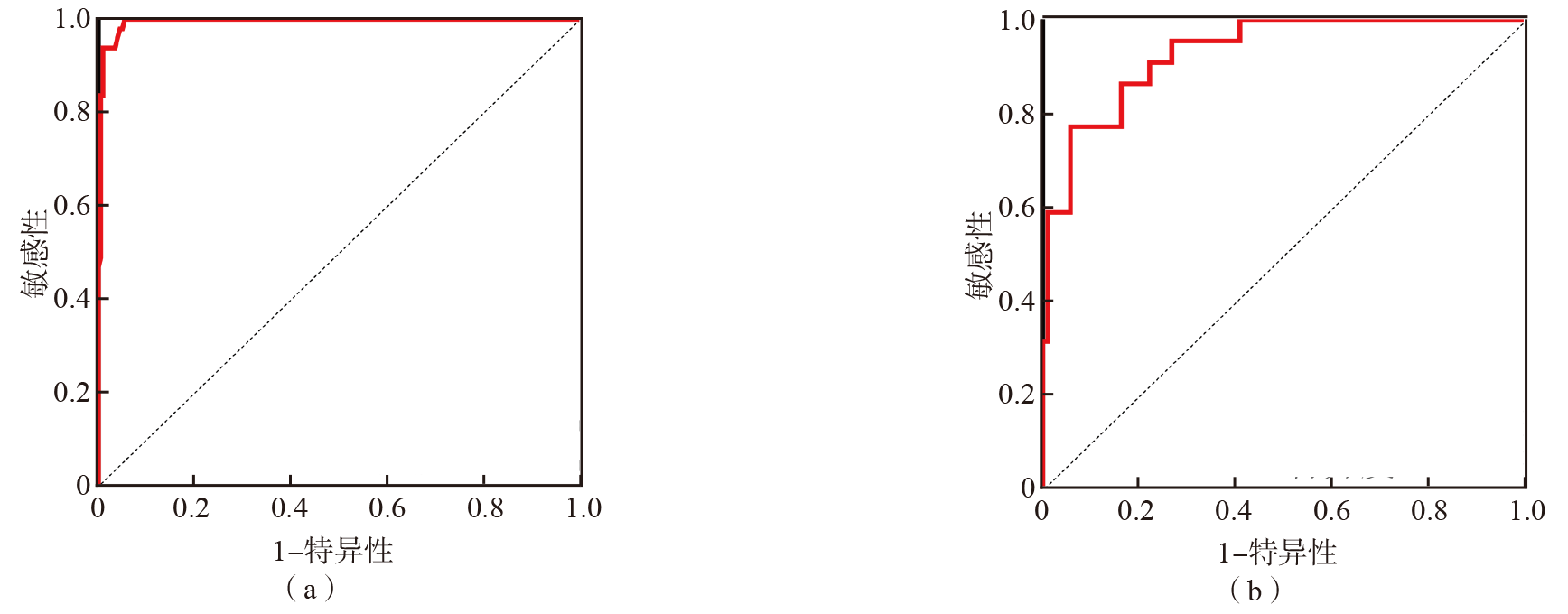
| 项目 | AUC(95%CI) | 最佳临界值 | 敏感性/% | 特异性/% | Youden指数 |
|---|---|---|---|---|---|
| CA15-3 | 0.567(0.490~0.644) | 8.845 U·mL-1 | 53.8 | 62.5 | 0.163 |
| CA72-4 | 0.592(0.521~0.663) | 5.225 U·mL-1 | 24.4 | 93.1 | 0.175 |
| CYFRA21-1 | 0.660(0.595~0.720) | 2.000 ng·mL-1 | 62.1 | 72.2 | 0.343 |
| CA242 | 0.535(0.464~0.605) | 3.070 U·mL-1 | 32.2 | 83.3 | 0.155 |
| CA50 | 0.820(0.767~0.873) | 2.230 U·mL-1 | 89.5 | 59.7 | 0.492 |
| CEA | 0.697(0.639~0.755) | 2.840 ng·mL-1 | 44.3 | 91.7 | 0.360 |
| 项目 | AUC(95%CI) | 最佳临界值 | 敏感性/% | 特异性/% | Youden指数 |
|---|---|---|---|---|---|
| CA15-3 | 0.567(0.490~0.644) | 8.845 U·mL-1 | 53.8 | 62.5 | 0.163 |
| CA72-4 | 0.592(0.521~0.663) | 5.225 U·mL-1 | 24.4 | 93.1 | 0.175 |
| CYFRA21-1 | 0.660(0.595~0.720) | 2.000 ng·mL-1 | 62.1 | 72.2 | 0.343 |
| CA242 | 0.535(0.464~0.605) | 3.070 U·mL-1 | 32.2 | 83.3 | 0.155 |
| CA50 | 0.820(0.767~0.873) | 2.230 U·mL-1 | 89.5 | 59.7 | 0.492 |
| CEA | 0.697(0.639~0.755) | 2.840 ng·mL-1 | 44.3 | 91.7 | 0.360 |
| 组别 | 正常对照组 | 结直肠肿瘤疾病组 |
|---|---|---|
| 训练集 | ||
| 正常对照者 | 49 | 1 |
| 结直肠肿瘤疾病患者 | 7 | 193 |
| χ²值 | 367.83 | |
| P值 | <0.001 | |
| 验证集 | ||
| 正常对照者 | 17 | 5 |
| 结直肠肿瘤疾病患者 | 11 | 75 |
| χ²值 | 355.42 | |
| P值 | <0.001 | |
| 组别 | 正常对照组 | 结直肠肿瘤疾病组 |
|---|---|---|
| 训练集 | ||
| 正常对照者 | 49 | 1 |
| 结直肠肿瘤疾病患者 | 7 | 193 |
| χ²值 | 367.83 | |
| P值 | <0.001 | |
| 验证集 | ||
| 正常对照者 | 17 | 5 |
| 结直肠肿瘤疾病患者 | 11 | 75 |
| χ²值 | 355.42 | |
| P值 | <0.001 | |
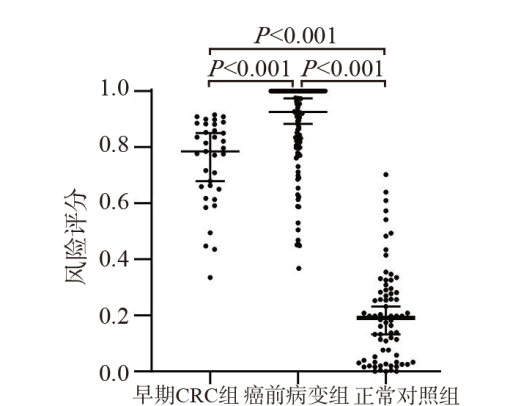
| 组别 | AUC(95%CI) | 最佳临界值 | 敏感性/% | 特异性/% | Youden指数 |
|---|---|---|---|---|---|
| 早期CRC组 | 0.983(0.965~1.000) | 0.435 | 97.1 | 90.3 | 0.874 |
| 癌前病变组 | 0.991(0.983~0.999) | 0.580 | 92.7 | 95.8 | 0.885 |
| 组别 | AUC(95%CI) | 最佳临界值 | 敏感性/% | 特异性/% | Youden指数 |
|---|---|---|---|---|---|
| 早期CRC组 | 0.983(0.965~1.000) | 0.435 | 97.1 | 90.3 | 0.874 |
| 癌前病变组 | 0.991(0.983~0.999) | 0.580 | 92.7 | 95.8 | 0.885 |
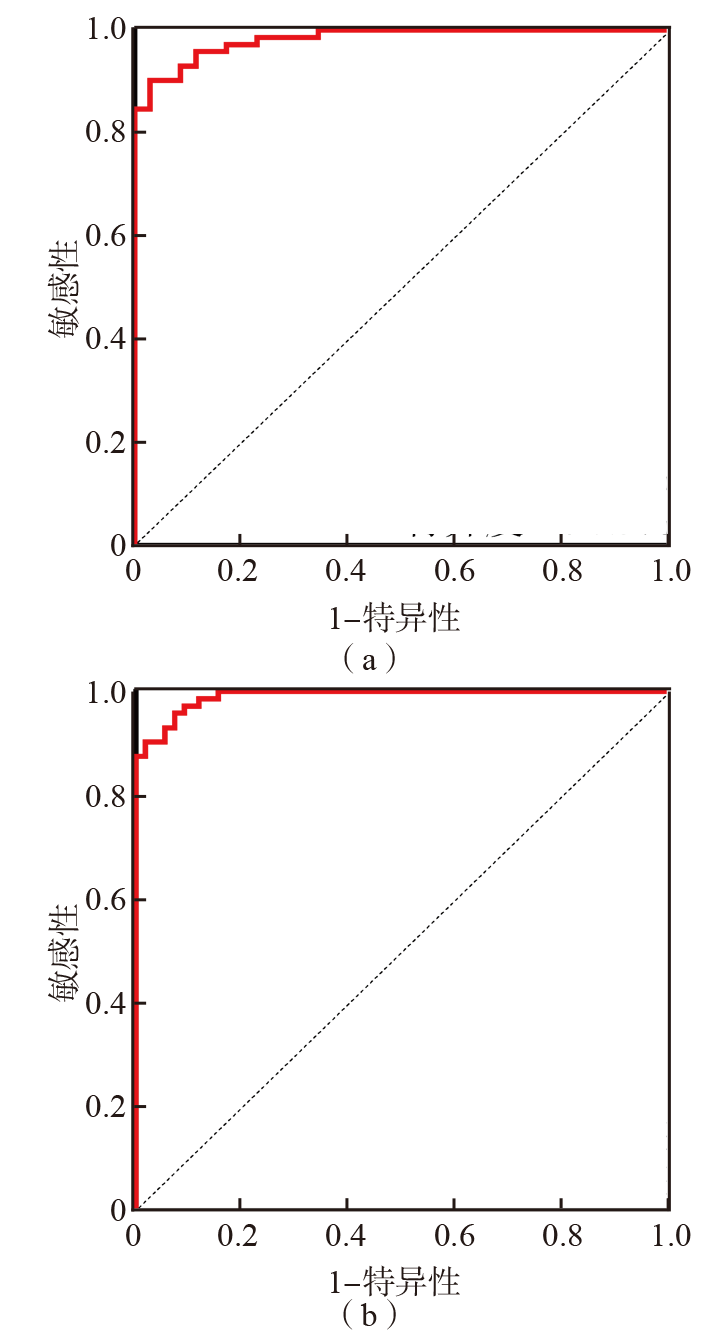
| [1] | CHUANG J P, TSAI H L, CHEN P J, et al. Comprehensive review of biomarkers for the treatment of locally advanced colon cancer[J]. Cells, 2022, 11(23):3744. |
| [2] | MAES-CARBALLO M, GARCÍA-GARCÍA M, MARTÍN-DÍAZ M, et al. A comprehensive systematic review of colorectal cancer screening clinical practices guidelines and consensus statements[J]. Br J Cancer, 2023, 128(6):946-957. |
| [3] | DING Q, KONG X, ZHONG W, et al. Fecal biomarkers:Non-invasive diagnosis of colorectal cancer[J]. Front Oncol, 2022, 12:971930. |
| [4] | YUAN R Q, ZHAO H, WANG Y, et al. SEPTIN9-SDC2-VIM methylation signature as a biomarker for the early diagnosis of colorectal cancer[J]. Am J Cancer Res, 2022, 12(7):3128-3140. |
| [5] |
CAO H, ZHU L, LI L, et al. Serum CA724 has no diagnostic value for gastrointestinal tumors[J]. Clin Exp Med, 2023, 23(6):2433-2442.
DOI PMID |
| [6] | PAKU M, UEMURA M, KITAKAZE M, et al. Clinical significance of preoperative and postoperative serum CEA and carbohydrate antigen 19-9 levels in patients undergoing curative resection of locally recurrent rectal cancer[J]. Dis Colon Rectum, 2023, 66(3):392-400. |
| [7] | LUO H, SHEN K, LI B, et al. Clinical significance and diagnostic value of serum NSE,CEA,CA19-9,CA125 and CA242 levels in colorectal cancer[J]. Oncol Lett, 2020, 20(1):742-750. |
| [8] | KOPPAD S, BASAVA A, NASH K, et al. Machine learning based identification of colon cancer candidate diagnostics genes[J]. Biology, 2022, 11(3):365. |
| [9] | SKREDE O J, DE RAEDT S, KLEPPE A, et al. Deep learning for prediction of colorectal cancer outcome:a discovery and validation study[J]. Lancet, 2020, 395(10221):350-360. |
| [10] | KAVITHA M S, GANGADARAN P, JACKSON A, et al. Deep neural network models for colon cancer screening[J]. Cancers, 2022, 14(15):3707. |
| [11] | WANF F, CHEN G, ZHANG Z, et al. The Chinese Society of Clinical Oncology(CSCO):clinical guidelines for the diagnosis and treatment of colorectal cancer,2024 update[J]. Cancer Commun(Lond), 2024:1-28. |
| [12] | LADABAUM U, MANNALITHARA A, WENG Y, et al. Comparative effectiveness and cost-effectiveness of colorectal cancer screening with blood-based biomarkers(liquid biopsy)vs fecal tests or colonoscopy[J]. Gastroenterology, 2024, 167(2):378-391. |
| [13] | HANNA M, DEY N, GRADY W M. Emerging tests for noninvasive colorectal cancer screening[J]. Clin Gastroenterol Hepatol, 2023, 21(3):604-616. |
| [14] | LI Y J, WANG X, WU Y J, et al. Access to colorectal cancer screening in populations in China,2020:a coverage-focused synthesis analysis[J]. Int J Cancer, 2024, 155(3):558-568. |
| [15] | KE X, LIU W, SHEN L, et al. Early screening of colorectal precancerous lesions based on combined measurement of multiple serum tumor markers using artificial neural network analysis[J]. Biosensors(Basel), 2023, 13(7):685. |
| [16] | KE X, CAI X, BIAN B, et al. Predicting early gastric cancer risk using machine learning:a population-based retrospective study[J]. Digit health, 2024, 10:20552076241240905. |
| [17] | 中华医学会检验医学分会分子诊断学组. 早期结直肠癌和癌前病变实验诊断技术中国专家共识[J]. 中华检验医学杂志, 2021, 44(5):372-380. |
| [18] | LIU S, XU M, QIAO X, et al. Prediction of serosal invasion in gastric cancer:development and validation of multivariate models integrating preoperative clinicopathological features and radiographic findings based on late arterial phase CT images[J]. BMC Cancer, 2021, 21(1):1038. |
| [19] | GAWEL S H, LUCHT M, GOMER H, et al. Evaluation of algorithm development approaches:development of biomarker panels for early detection of colorectal lesions[J]. Clin Chim Acta, 2019, 498:108-115. |
| [20] | QIN Y, HUO M, LIU X, et al. Biomarkers and computational models for predicting efficacy to tumor ICI immunotherapy[J]. Front Immunol, 2024, 15:1368749. |
| [21] | NOVIELLI P, ROMANO D, MAGARELLI M, et al. Explainable artificial intelligence for microbiome data analysis in colorectal cancer biomarker identification[J]. Front Microbiol, 2024, 15:1348974. |
| [22] |
LUO T, CHEN X, PAN W, et al. The sorafenib resistance-related gene signature predicts prognosis and indicates immune activity in hepatocellular carcinoma[J]. Cell Cycle, 2024, 23(2):150-168.
DOI PMID |
| [23] | LIN G, CHEN W, FAN Y, et al. Machine learning radiomics-based prediction of non-sentinel lymph node metastasis in chinese breast cancer patients with 1-2 positive sentinel lymph nodes:a multicenter study[J]. Acad Radiol, 2024, 31(8):3081-3095. |
| [1] | HUANG Ren, SHI Weizhong, LU Renquan, GUO Lin, WANG Yanchun. Combined determination of Septin9 gene methylation and SDC2 gene methylation in auxiliary diagnosis of colorectal cancer [J]. Laboratory Medicine, 2025, 40(6): 519-524. |
| [2] | WU Yazhou, LI Hanhua, MENG Leijun, CHEN Xuefei, SUN Yuhan, WENG Wenhao, ZHENG Bing. Fusobacterium nucleatum promoting chemoresistance of colorectal cancer cells via lncRNA XIST [J]. Laboratory Medicine, 2025, 40(5): 428-436. |
| [3] | YU Xue, QI Aihong, LI Jinhui, QUAN Zhihui, LI Kui, QIU Yurong. Application role of an AI-patient based real time quality control intelligent monitoring platform for risk quality management of serum tumor markers [J]. Laboratory Medicine, 2025, 40(3): 264-270. |
| [4] | CHEN Zhijin, WANG Yuting, ZHENG Haiyin, LIU Qingzhong. Preliminary establishment of the reference range for cytokeratin 19 fragment and analysis of related factors [J]. Laboratory Medicine, 2025, 40(11): 1070-1074. |
| [5] | QI Xinglun, YAO Yifan, SHEN Shushi, YANG Zheng, ZHU Junjie, FAN Lina, YANG Dagan. Performance evaluation of different large language models in interpreting tumor marker determination reports [J]. Laboratory Medicine, 2025, 40(11): 1075-1081. |
| [6] | LUO Yuanmei, LIU Chang, CHEN Lilong, LI Zhenzhang, YUE Yubiao, LI Yang, XU Lingqing. Acute promyelocytic leukemia diagnosis assisted by YOLOV8 deep learning model [J]. Laboratory Medicine, 2025, 40(10): 998-1003. |
| [7] | ZHENG Hui, CHEN Yingxiu, YE Lüyin, LU Renquan, GUO Lin. Relationship between peripheral blood T lymphocyte subsets and tumor progression in patients with colorectal cancer [J]. Laboratory Medicine, 2024, 39(4): 330-335. |
| [8] | XU Yunchuan, HUANGFU Yuchan, MA Yanhui. Effect of highly expressed IL-35 on Th1 and Th17 plasticity in colorectal cancer [J]. Laboratory Medicine, 2024, 39(4): 343-350. |
| [9] | ZOU Chen, XU Runhao, DING Yi, ZHANG Jie, WENG Wenhao, WANG Zhenhua, CAO Yun. Colorectal cancer screening model based on ProteomeXchange database [J]. Laboratory Medicine, 2024, 39(12): 1181-1189. |
| [10] | LEI Ming, ZHAI Li, WEI Ying, LIN Yichen, GUO Mengyue. Application of nomogram model based on clinical characteristics and serum tumor markers in differential diagnosis of benign and malignant lung lesions [J]. Laboratory Medicine, 2024, 39(10): 956-962. |
| [11] | LAN Jun, LU Shuting, YANG Jianrui. Roles of serum IL-26 and IL-27 levels in patients with colorectal cancer [J]. Laboratory Medicine, 2024, 39(1): 7-12. |
| [12] | LI Liangshan, ZHAO Hu, WANG Shiwen. Screening potential prognostic biomarkers of colorectal cancer based on weighted gene co-expression network analysis [J]. Laboratory Medicine, 2023, 38(9): 825-832. |
| [13] | ZHU Rixiang, YIN Jie. Relationship between soluble growth stimulating gene 2 protein and clinicopathological features and prognosis in patients with colorectal cancer [J]. Laboratory Medicine, 2023, 38(7): 629-633. |
| [14] | JIANG Mengying, LIU Yiwen, HE Yiqing, XU Jing, YANG Cuixia, GAO Feng, DU Yan. Clinical role of serum S1P in the early diagnosis of colorectal cancer [J]. Laboratory Medicine, 2023, 38(4): 307-312. |
| [15] | ZHANG Guoliang, LIU Yiwen, HE Yiqing, XU Jing, YANG Cuixia, GAO Feng, LIU Hua. Roles of serum HYAL1 and HA in the auxiliary diagnosis and therapeutic monitoring of colorectal cancer [J]. Laboratory Medicine, 2023, 38(4): 313-319. |
| Viewed | ||||||
|
Full text |
|
|||||
|
Abstract |
|
|||||
